Showing posts with label County Cricket. Show all posts

Wednesday, March 14, 2012

My Favourite Cricketer: Michael Vaughan, by Max Benson of Test Match Sofa

Max Benson, of Test Match Sofa, explains why Michael Vaughan is his favourite cricketer.  Max tweetst at @sofa_maxb.

Northern batsmen aren’t stylish. Northern batsmen are Geoffrey Boycott, Michael Atherton and Paul Collingwood. They are grafters and men of toil, hell-bent on building an innings by any grim means necessary.

All stereotypes are rooted in truth, but my favourite cricketer goes against that particular grain. He possessed a heavenly mix of balance, exquisite timing and sheer class at the crease - creating at will a thing of true beauty each time he unfurled a cover drive or square pull. Indeed, this smitten writer may well go to the grave believing there to be nothing finer in this life than a Michael Vaughan cover drive.

Born the wrong side of the Pennines it was fortunate that Yorkshire accepted him in 1993, just after relaxing their part-admirable, part-ludicrous rule that allowed only players born within the county to be considered for selection. It was Doug Padgett, a veteran of over 500 First Class games for the county who persisted in bringing Vaughan to the club. The thought of him enjoying the career he did with a red instead of a white rose on his chest sends a chill down many a Tyke’s spine. Never mind those that did get away before common sense prevailed.

I first saw Vaughan play for Yorkshire in a one day game at North Marine Road, Scarborough, in 1999. He top-scored with an understated 41, taking the Tykes to a seven-wicket win against Leicestershire, but it was the following summer where he began to shine on a bigger stage.

The first Test match I saw live was at Headingley in 2000. The famous two-day Test against the West Indies, in fact, as luck would have it.  ‘’Don’t expect them all to be like that,’’ my dad felt obliged to caution the ten-year-old me, beaming after Caddick and Gough had dismantled the tourists for 61 in their second innings and a deliriously boozed-up army of nuns and Elvises stormed the field from the old Western Terrace.

Amidst the chaos and tumbling wickets that day, one man personified calm. Vaughan’s expertly crafted 76 took England to what proved to be a match-winning score of 272. Graeme Hick had stayed with him for a neat half century of his own, but it was Vaughan who steadied the ship so ably from 93/4 in front of his expectant home crowd against the aging yet undiminished brilliance of Curtly Ambrose and Courtney Walsh.

His coolness under pressure was paramount in the decision to award him the England captaincy in 2003, the year in which he all-too-briefly topped the world batting rankings after racking up 633 runs and three centuries in yet another Ashes defeat Down Under. Allied to his superb man management skills and, somewhat paradoxically, his one-of-the-lads mentality; the decision to hand him the reigns was undoubtedly the right one.

The England side had improved steadily under Duncan Fletcher and Nasser Hussain, four years on from when the latter was booed onto the Oval balcony after defeat to New Zealand left England bottom of the Test rankings in 1999. Central contracts helped transform a ragged and insecure bunch of county players into a cohesive unit, and Vaughan was the perfect man to take them to the next level.  He dealt instinctively well on a personal level with the self-destructive Andrew Flintoff and the fragile Steve Harmison, while his on-field demeanour and tactical nous made him by far the best all-round leader in world cricket at the time.

The defining moment for Vaughan’s captaincy came as he led his country in probably the greatest Test series of all time against the Aussies in 2005. Prising the urn from the enemy for the first time since 1987, a rollercoaster series captured the imagination of a football-orientated English press and public like never before.

But Vaughan was fallible, too. His batting suffered, perhaps inevitably, with the strains of captaincy and his final dozen innings or so for Yorkshire in 2009 were painful to watch as the magic – or at least the eyes and joints - appeared to have gone for good. We’re all human. We all get old.

He had always suffered more than most with injuries. The summer of 2006 was a complete write-off, as was the following winter’s whitewash in Australia, all due to a chronic knee problem. A serious hamstring injury followed, and Vaughan was cruelly destined never to regain the magic that had graced county and country for nigh on a decade.

That only adds to the reasons for him being a ‘favourite’. He played on for as long as possible because of a love and deep respect for the game, yet knew to bow out without losing too much dignity on the field. And besides, who would be so heartless as to deny such a player a bit of extra grace to play out a few more innings on the county circuit as the curtain came down on a sterling career? Well, Yorkshire, probably.

In a media-saturated world now awash with anodyne quotes straight off a script from most of our sportsmen and women, Vaughan’s departure from the England captaincy couldn’t have been further from the catatonic norm.

His tearful farewell in full glare of the world’s media was fantastic proof of his boyish love of the game. To see an Ashes-winning gladiator reduced to tears spoke volumes for his sincerity as a player and pride in his country. It was a single moment encapsulating what sport really is: blood, sweat, tears and hyperbole.

Vaughan embodied much of what I believe is great about the game we love. He could ooze style and class when at his work and read the game beautifully with a sound tactical mind. Most striking is that he remained ‘one of the boys’ – a hideous phrase - and someone whose raw passion and enthusiasm we simple fans could relate to. I, and I suspect many others, wanted to share a pint with him – the ultimate compliment for a Yorkshireman. No one in their right mind wanted to drink with Boycott.

Back to My Favourite Cricketer homepage.

Thursday, November 3, 2011

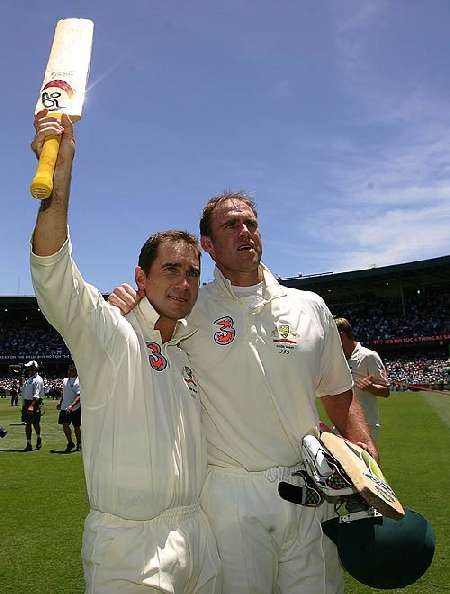
My Favourite Cricketer: Justin Langer, by Sarah C Robinson

In continuing our series "My Favourite Cricketer", Sarah C Robinson of the excellent Slowly Learning the Offside Rule writes about Australia's most contradictory opener, Justin Langer.

As an England cricket fan, there is one rule: Thou shall not support an Aussie.

And so, this is my confession. I have sinned. My favourite cricketer is an Australian batsman. It is the often underappreciated Justin Langer.

For me, nothing summarises Langer’s career better than Telemachus Brown’s song ‘(Wrong About) Justin Langer’ in which a couple argue about his career. The singer says “All I argued was Langer wasn’t my favourite player... The way you looked at me like we were gonna end. It’s all my fault, it was my very own clanger. I’ll admit I was wrong about Justin Langer.”

It was the 2nd April 2006, and Justin Langer was playing in his 100th Test match. For a man who has always spoken about how much wearing the Baggy Green cap means to him, it was one of the greatest honours to have played for Australia that many times. His parents had flown from Perth to Johannesburg to watch.

A Ntini bouncer hit him on his right earpiece, and he immediately collapsed to the ground. He was led offthe pitch bleeding and taken to hospital. The injury was described as a ‘significant concussion’ and he was warned he should not take the field again, in case a ball hit his head a second time. Another blow could be life-threatening.

Langer was all too aware of the danger, and he himself knew he was in no condition to bat. He was vomiting, his head was throbbing and he had spent most of the game in his room.  Nevertheless, on the last day he dragged himself from his bed and headed to the Wanderers.

As Australian wickets tumbled in the second innings, captain Ricky Ponting suddenly became aware of the fact that he’d lost Langer. "I started looking for him, and found him with his whites on, and his pads, his arm guard, his helmet," Ponting said. "He was running laps in the change room, trying to convince himself that he was suddenly OK.” Ponting told Langer that he could not bat under any circumstances even if that meant Australia losing. Langer said the chance of him being hit on the head again was slim and that he would bat if needed.

In the end, Australia won by two wickets and Ponting never had to make the decision to end the match before Langer could take himself out to the field. Langer is convinced that he would have batted if needed. Ponting argues he would not have let him do it.

Courtesy: www.india-server.com
This story, more than any other, reminds me of the passion and determination Justin Langer has. He didn’t just want to play for his country. He was obsessed with playing for his country – and winning.

Justin Langer is often underappreciated. He played alongside some of the greatest players the world has seen, including Waugh and Warne, and he perhaps will never be remembered as a true great of the game. But his role in the side was vital. He was a stable figure at the top of the innings, not always the most aesthetically pleasing, but stubborn and determined nonetheless. He played in 105 Test matches for Australia at an average of 45.27 with twenty-three 100s and thirty 50s.

After making his Test debut, he only played eight Tests in six years. For some, this would be enough reason to give up on the dream of playing international cricket, but Langer battled through, batting consistently for Western Australia. He eventually formed the second best opening partnership in Test match history with Matthew Hayden, scoring 5,655 runs between them in 113 innings (second only to Gordon Greenidge and Desmond Haynes). 

From 2006-2009, he also played county cricket in England for Somerset, and gained the respect of his teammates and spectators alike. He captained the side for two years, and helped them to secure a place in the Twenty20 Champions League in 2009.

During this period, I had the honour of meeting him three times. On every occasion, he was generous with his time, likable and friendly. On the first occasion, after he had signed my scorecard, I asked him for a photograph. He obliged, but while signing some more autographs, he turned to me again and asked if I would like a second photograph, this time without him wearing his sunglasses. Somehow, I managed to say yes and so have two photos with him from that day. They always say you should never meet your heroes, but it was an absolute pleasure to meet him. If possible, I admired him even more.

Courtesy: The Age
Langer is a man of contradictions. He likes the quiet of meditation and yoga, and enjoys gardening. And yet he also has a passion for boxing and used to train with an ex-SAS soldier. His book Seeing the Sunrise, published in 2008, is one of the most inspiring books I have ever read. It is full of motivational stories from his playing career and a very fascinating read.

When he finally retired in 2007, after helping to win the Ashes 5-0, he was emotional. "The reason it's so hard is that I don't want to let it go,” he said. “I don't want to stop playing for Australia. It's emotional, I feel sad about it but I know in my heart it's the right thing to do. To me, it's not just a game. It's been the vehicle that I've learned how to handle success, how to handle criticism, how to handle failure, how to fight back from adversity. I've learned about mateship, I've learned about leadership - it's never been just a game for me.”

It is likely many people in Australia never thought Langer would make it as a consistent Test match player, and definitely not that he would play in over 100 Tests. As it turned out, his playing career is full of fantastic knocks and he proved to be a vital member of the Australian cricket team. He is one of the most determined cricketers to have played cricket. Representing his country was the ultimate accolade, and he worked as hard as he possibly could to achieve it.

Langer, to me, is more than just a cricketer. He is a reminder that you can achieve anything you want if you work really hard. Not only that, he is one of the nicest men involved in cricket.

I’m certain a lot of people admit that they were wrong about Justin Langer.

Sarah C Robinson writes at Slowly Learning the Offside Rule and tweets at @SarahCRobinson

Thursday, September 8, 2011

My Favourite Cricketer: Tim Bresnan by Len, the Yorkshire County Kit Man

In our continuing series inviting the world's best cricket writers and bloggers to contribute thoughts on "My Favourite Cricketer", Len the Yorkshire County Kit Man of Last of the Summer Whine explains why his favourite is Tim Bresnan.

(c) Reuters
These are giddy, exhilarating times to be an England supporter. In the space of nine months we’ve seen the Ashes retained and the cream of Australian cricket rendered impotent by a series of emasculating batting collapses, uncoordinated Mitchell Johnson bowling spells and a succession of faceless, wicketless spin options who stood as much chance of stemming the relentless tide of Cook & Trott’s run-scoring as King Canute.

Three crushing innings victories were the result. A tsunami of sporting destruction that left even the most jingoistic Australian fan curled up in the corner of their living room, shielding their eyes from Channel Nine’s coverage and admitting through gritted teeth that county cricket wasn’t quite as crap as they’d always made out.

Five months later, India arrived on England’s shores. A team of big name reputations, confident in their number one status, expected to provide the toughest of competition. Yet within weeks, bodies that had strength for the sprint of 20/20 were revealed to lack stamina for the marathon of test cricket. India’s bowling attack crumbled quicker than a Kolkata pitch and it’s batting line-up, trumpeted as the strongest in world cricket, was reduced to showing all the resistance of Imelda Marcos in a branch of Clarks.

(c) Getty Images
Two more innings victories were added to the three from the previous winter. A whitewash was achieved. And after the final match at the Oval, England was crowned the new top ranked test nation. A triumph signified by the sight of Andrew Strauss holding aloft the ICC’s effortlessly camp test championship mace. A trophy so tacky it made England’s captain look more like Lithuania’s entry for Eurovision than joint architect of one of the most successful teams in world sport.

Joining in the celebrations that day was my favourite cricketer, Tim Bresnan. A player who wasn’t perhaps the catalyst for England’s success, but one who’d become an increasingly integral part of it.

Bresnan’s path to the England side has been a long one. Certainly the slim shouldered sixteen year old who made his first team debut for Yorkshire back in 2001, bowling RP Singh-like mid-seventies seamers, has made quite a transformation to become the England bowler most likely to smash the ball into an opposition batsmen’s fingers.


(c) BBC
Back then, looking on from the stands, I wasn’t entirely convinced he’d even make it as a first-class cricketer. He looked so young; frail almost. A boy in a man’s world. I’d seen Paul Jarvis (who also played for Yorkshire at sixteen) develop into a test cricketer, but at a similar age Jarvis appeared to have more pace and more promise. The chubby-cheeked eighteen year old Darren Gough didn’t give the impression of a future test cricketer either but, even in his first season for Yorkshire, he’d looked equipped to survive the county circuit. But Bresnan? I wasn’t so sure.

The next few years saw a change in body shape, a filling out towards the second row forward physique that seems appropriate for someone raised in the Rugby league hotbed around Pontefract and Castleford. Performances improved year on year. Bresnan proved my doubts ill founded and in the process undertook an apprenticeship in county cricket that was to prepare him for his subsequent international career.
(c) ECB
Clearly England saw his value, with a call up to the one day side coming against Sri Lanka in 2006. I thought at the time it might be a premature move, and the combination of flat pitches, a losing side and experienced international batsmen in prime form saw Bresnan’s bowling being flailed to all corners. Others – Saj Mahmood, Liam Plunkett, Kabir Ali – fared just as badly, if not worse, but the selectors decided that Bresnan wasn’t ready, with some in the press happy to write him off completely.

A return to the county scene saw more improvement. These were the years when his were often the only young pair of legs in an aging, if experienced, Yorkshire attack. These the years of putting in the hard yards; of never getting to open the attack; of only coming on after twenty, sometimes thirty overs had gone. Years of learning to bowl with the old ball; learning to bowl reverse swing; learning when to bowl the yorker, when to bowl the surprise bouncer. Years of learning from Gillespie, Gough and Hoggard.

There was improvement too with the bat. I was there at the Oval in 2007 as the ball rebounded off the sightscreen at the Pavilion End and Bresnan raised his bat to acknowledge a maiden first-class century. I was there at Chelmsford later the same year as he powered his way to a second, this time for England Lions against the touring Indians.

It was partly those performances for England Lions, both home and away, that led him back into the selector’s thoughts. And this time he was better prepared for the step up to international cricket.

(c) Dave Morton
Having one of your players in the England set-up can be a bitter-sweet experience for the county fan. On the one hand you’re delighted for the player, and proud your club has produced him. On the other there’s the knowledge that they’ll either become a success at international level, and therefore unlikely to play much more domestic cricket, or if they fail to make the grade there’s the chance confidence will be adversely affected followed by a slump in form.

Bresnan took another route, becoming a squad player for England who’s often found himself twelfth man and having to make a mad rush on the motorway to join up with a county game already underway. For a player used to bowling regular, long spells, it’s at times affected his rhythm.

Despite that there’s definitely been an improvement in his bowling since the England tour of Bangladesh eighteen months ago. It’s not due to a great technical change – beyond perhaps a slight tightening of his delivery point to closer into the stumps – nor a sudden increase in pace. It’s more that he’s bowling with added confidence. Bowling like a man who’d been told his worth by the England set-up. Bowling like a man who feels he fits into international cricket.

And fit in he does. At the time of writing his test record reads ten wins out of ten, with a batting average of 45.42, a bowling average of 23.60. There are plenty of critics who’ll point to an overall first-class record seemingly at odds with that success. But these are people who watch stats more closely than they do matches. Regular Yorkshire supporters, opposition players and teammates understand the truth. That Bresnan has improved markedly from the teenager first trust onto the county circuit. More importantly, he’s a player motivated by the match situation; one who plays for his team, rather than his average. The success he’s having now is built on the selflessness and hard work of the past.

(c) Tom Shaw/Getty Images
That some people fail to understand that is perhaps part of his appeal. Because Bresnan remains a much misunderstood cricketer. His bowling is generally quicker than he’s given credit for; his batting more considered than the image of the lower order biffer some create in their minds as he walks to the middle. He’s pigeon-holed as ‘stocky’, when he’s actually strong, reliably injury free and full of stamina.

Even England supporters make the mistake of identifying with him for the wrong reasons. Seeing in him a club player wrote large. Feeling that he could be them, as if that was some kind of compliment. The reality is no one watching from the stands could angle the ball into Rahul Dravid then make it hold its line to hit the top of off. Just as they could ever cream Brett Lee through the covers for four in a Champions Trophy semi-final.
Instead we should celebrate what Bresnan actually is. Strong, honest, hard working, selfless, self depreciating and above all skilful. A player appearing to lack pretence. One with no front, no PR, no arrogance.  Just a ready smile backed by the confidence of a man who knows he belongs at the top of his craft.

That’s why he’s my favourite cricketer.

You can find Len's work at Last of the Summer Whine, or follow him on Twitter at @CountyKitMan.

Back to My Favourite Cricketer series homepage.

Wednesday, May 11, 2011

Book review: The Willow Wand, by Derek Birley

This is a re-post from our affiliate book review blog, Books with Balls. There, you'll find the literature from a number of guy-friendly genres thoughtfully reviewed. Recent posts include this one, a review of the memoirs of late night TV's Craig Ferguson and a series of pieces on renowned historical fiction author Bernard Cornwell.

by Ben Roberts

The Willow Wand's
aim is to explore some of the many myths of cricket. However, for the most part it is somewhat difficult to identify truly what myth is at any one point that being investigated. One must have an in-depth knowledge of cricket and indeed English cricket to truly take in what most of Birley has to say. Despite the significant amount of historical research put into this work, it does not provide a systematic presentation of cricketing history.

But this is not meant to be a negative opinion, just a reduction in the expectations with which I approached this work. What you do get from The Willow Wand is a mosaic of characters and time from throughout the long and rich history of the sport.

The book drives constantly that cricket is a medium in which persons sought to prove distinguishable features. Gentlemen from Players (Amateurs from Professionals), Wealth from Poverty, light skin from dark – none ever proved to be successful and in hindsight all actions of the sort proving petty and hypocritical. Such is the ridiculous extent of sociology that cricket has been pushed and pulled. Birley took time to sum up his beliefs in the final chapter titled 'Fun and Games' whereupon as you might expect from the title he concludes that one cannot see cricket through any other lens.

Refreshingly honest about the figures of the past, Birley does not airbrush over the faults of the game and its traditions. He questions long held views of the cricketing figures of the past such as Lord's Harris & Hawke as well as P.F. (Plum) Warner; opinion on the latter he makes reference to in his updated edition as drawing criticism from some parts upon the books initial print run in 1979.

Of particular enjoyment personally were his descriptions of West Indian crickets background, a topic not often broached, as well as his discussion on whether cricket and art can be stated as being one and the same. For the modern cricket enthusiast stung by the increased commercialism and descent into the abyss of gambling-driven corruption it may hurt to read that the prominent driver of many of the earliest recorded matches was commercialism and gambling. Matches were often fixed not for monetary gain but as an act of patronage to the amateur dignitary!

Being a cricketing nerd, I enjoyed the book as I became immersed in the nostalgia and dreamed of being involved during golden times in cricket history. But it is only a book for those like myself who bring a certain level of background knowledge to it and can enjoy it to the full. Others will become confused and frustrated as it constantly switches back and forth between stories, eras and personalities. The high English used by Birley remains difficult for the modern reader (criticism at this point can be leveled in both directions) - Birley is clearly a man of an age where cricketers of the right ilk never had names, only initials. Somewhere between tennis balls and footballs.

Cover Image thanks to bookdepository.co.uk

Wednesday, April 13, 2011

The English Game: Essex & Sussex

by columnist Ben Roberts

Essex

The current day Essex hero, Alastair Cook, returned home from his stellar 700 plus run Ashes tour to a heroes welcome. The Essex County Cricket Club has a long history of producing England representatives of the highest order. As well, Essex have also been a side described as providing entertaining and attractive cricket, but unfortunately lacking the depth of player resources in a smaller county.

With player resources, weather patterns and perhaps the moon and stars aligned, Essex have been able to produce historically noted performances. In 1948 they were the only county to dismiss the touring 'Invincible' Australians in under a day. Of course this was after they had totalled 721 runs!

The 1950s typified the Essex story. After finishing last in the 1950 season, Trevor Bailey and Barry Knight formed a bowling partnership that was as good as any in the country. Essex competed with all comers thanks to Bailey and Knight, but come the time of injury or national call up of these two the team was caught short of class players and could not sustain momentum.

Bailey was a fine all-rounder for Essex scoring over 20,000 runs and taking over 1,500 wickets. The 'Barnacle' was also a regular thorn in the side of England's opponents. Bailey was and still is an astute observer and student of the game, his play being thoughtful and his post playing career as a journalist and radio commentator likewise. Knight was a fast-bowler and attacking batsman who later emigrated to Sydney and set up one of the earlier indoor cricket coaching schools. The school, combined with Knight's wisdom, were to have a profound effect on future Australian captain Allan Border.

Border went on to be a high profile recruit during Essex's glory period in the mid 1980s. In the midst of a tumultuous and unsuccessful time in Australian cricket, Border, still relatively new to the position of Australian captain, took the opportunity to play with Essex during the southern hemisphere winter. Border was later to comment in his autobiography of the positive effect that this stint had on his career and captaincy.

The glorious 14 seasons from 1979 until 1992 yielded Essex the only County Championships in their history. They were led by Graham Gooch and Keith Fletcher, both now occupying 1st and 2nd positions in the list of all time run scorers for the county. In all, from 14 seasons Essex claimed six championships and also were able to provide the English team with a number of representatives, in some instances up to four at one time.


Sussex

Sussex are the oldest county cricket club of them all. Despite the significance of their heritage, history is not favourable in terms of success for them. Pre-1890 Sussex was only declared “Champion County” once, and this was a shared title; and it took 113 years after the formation of the County Championship for Sussex to finally collected their first.

The county did not waste much time in collecting their 2nd and 3rd championships. They came at a speed in comparison to their first, in the 2006 and 2007 seasons. The winning of these three championships plus some limited over trophies dictated Sussex as the leading team of the decade. The decades conclusion was not without drama as post 2007's success, Sussex were relegated to and then won Division 2, to be promoted again, all in the space of three seasons.

Former Zimbabwe test cricketer and long time Western Australia representative Murray Goodwin played throughout the decade for Sussex. He made the highest ever score (335 not out) in Sussex history during the 2003 season in helping the county to the inaugural championship. His score remained a record until he beat it in 2009 with 344 not out.

County Championship regulars Michael Bevan and Michael Di Venuto both spent time at Sussex. Victorian and Australian player Tony Dodemaide played three seasons with the county from 1989 until 1991. In the 1990 limited overs cup competition Dodemaide helped Sussex dismiss the Irish national team for 72, his figures were 6 for 9 from 11 overs. Having captained Australian teams on tours to England in 1880 and 1882, Billy Murdoch was considered to be enough of a gentleman to be invited to captain Sussex. Murdoch took up this offer and later went on to represent England.

In the early history of the county championship Fred Tate followed by his son Maurice Tate were the counties leading bowlers. Fred collected 1,306 wickets for Sussex during his career and Maurice remains the leading wicket taker for the county by almost 400 wickets finished with a tally of 2,211. Where Fred was an exponent of off-spin, Maurice became a fast bowler. Maurice also had a highly regarded test match career, his 39 test matches yielding 155 wickets, and his lower order batting valuable for county and country as well.

Sussex also produced another great in Ted Dexter. Though later maligned for his stint as chairman of selectors, he was a great all-rounder for the county. The 1970-71 Ashes series brought to fame, at least in Australian eyes, the volatile and dangerous Jon Snow. The sometime poet in addition to his cricketing career was a player for Sussex for 18 seasons during the 1960s and 1970s.

Tuesday, March 8, 2011

World Cup Cricket: The time for Ireland to step up has come

In their recent appearances at the World Cup, Ireland's results have belied their status as one of cricket's "minnows". In 2007 in the Caribbean they infamously defeated Pakistan, tied with Zimbabwe and triumphed over Bangladesh; this tournament they've already upset heavyweights England behind a whirlwind middle-order display and their group stage efforts are only just half completed. There's plenty good argument that they should maintain full ODI status once this Cup concludes. Credit where credit is due - they've earned their stripes and deserve to reap the benefits.


When they defeated arch rivals England last week, Ireland proved themselves once and for all the strongest of the ICC's affiliate nations. Time and again they've defended their status as the strongest paupers around and the ICC should recognise now that their setup, fraught and import-dependent as it is, is strong enough to challenge superior programmes. They may not necessarily win, but that's merely an inconsequential detail: in any fixture between a top-five cricket nation and a bottom-five side the result is a near certainty anyway. Ireland have the same odds of upsetting Australia in Australia as Bangladesh; in neutral fixtures they may have a better chance of a masterminding a boilover.


They are themselves capable of playing some very good cricket and outmatch their affiliate counterparts by some considerable distance. Some would suggest that an Irish side would further water down international competition, but in truth if these nations are allowed to compete at the World Cup then the competition is weakened enough already. By admitting unready nations to these tournaments, the ICC has made a rod for its own back: only Ireland of the affiliates (and Kenya four years before) have announced their presence with any kind of definitive display.


Bangladesh, the last country admitted permanently to the ICC brethren, provides the best precedent for the proescution. Before their happy 2007 World Cup campaign, their cricketing highlight came on a damp day in the south of England when Mushrafe Mortaza (can someone tell me why he wasn't selected for this event?) led them to a win over the 2005 Australian Ashes tourists in a triangular ODI series. With their Kevin O'Brien-inspired big win last week, Ireland have surpassed this achievement already. The Tigers are the archetypal case of "failure to thrive" and mimic the Zimbabwe teams of the mid-90s, inconsistent sides with a few good players.


The largest obstacle Ireland's path is the lack of a top-flight domestic competition. In football, FIFA requires any World Cup hosts to have a top level home league; the ICC similarly looks not just at results but at grass-roots development. Unfortunately for Ireland, their best players - Eoin Morgan and Ed Joyce, most prominently - are attracted to the county circuit and thus the country risks that these stars will be lost to the lure of Test cricket. This talent drain, combined with a former reliance on expats like Trent Johnston and Jeremy Bray, suggests Ireland are temporarily punching above their weight and so are likely to be drawn back into the Affiliate pack. A grand total of only thirteen fully professional Irish cricketers also doesn't bode well for promotion.


Should Ireland be serious about entering the ODI circuit as a full member, junior development must be their first priority. Ireland has positives in achieving this: a European home base and administration small enough to be unhampered by bureaucracy. Perhaps the country's greatest cricket advantage derives from its great weakness: proximity to England. Where Bangladesh has enough cricketers to stock a first-class system, Ireland does not, meaning elite Irish players need to find competition on distant shores. The best way of ensuring an evolving junior programme comes through the excitement bred by major competitions. Placing an Ireland side in the County Championship could nurture a breeding ground for young Irish cricketers and provide a pathway for their best talents. It could also serve as a developmental yardstick, allowing them (and the ICC) to see how much the sport had grown.


In the most brutally honest terms, Ireland aren't going to win the World Cup any time soon, but so what? When the ICC allows a country full status, it isn't an admission that the country is ready to actually compete. Bangladesh haven't thrilled anyone with their performances on the world stage; neither has Zimbabwe, despite short periods of improved play; Sri Lanka were effectively patsies until their improbable 1996 World Cup triumph - the major nations' whipping boy for nearly twenty years. This is a neat, but flawed comparison as in those countries cricket isn't the underground sport it is in Ireland. However, the fact remains that the ineffective administration shown by Bangladesh over the past ten years means there's severe doubt as to Bangladesh ability to ever field a threatening side. As painful as it is, Bangladesh and Zimbabwe just make up numbers.


Admittedly this is a harsh assessment of both Zimbabwe and Bangladesh and doesn't take into account the sociological, political and geographical unrest suffered by both nations over the past decades. Those factors - and Ireland's insolvency - contribute to a changing cricket world, one where a two-tier system is almost irrevocably in place. Cricket, whether we like it or not, is now a divided across "have" and "have not" lines": and if Ireland wants to join the lower tier, then why stop them?

Thursday, February 24, 2011

The English Game: Lancashire & Northamptonshire

by Ben Roberts


Lancashire

The Australian test team have been defeated in three of the four past Ashes series due in no small part to two modern day Lancashire heroes. Andrew Flintoff proved his strength in England’s 2005 and 2009 victories. His charismatic presence with bat and ball, and indeed in the field in 2009, lifted the English regularly in both northern summers. James Anderson, somewhat dismissed by opponents in his earlier career, provided Australian cricketers, and cricket watchers alike with a lesson in swing bowling during the recent series in Australia.

Lancashire has had two periods of sustained success in the championship, at the turn of 20th century and the golden era of the 1920′s and 1930′s. The most recent success came with sharing the 1950 championship with Surrey although they did win division 2 in 2005 to regain promotion. Lancashire have been the most successful limited overs team of all counties, despite not being able to win the T20 championship as yet.

Lancashire have always been another strong provider of personnel to English cricket. Batsmen of the quality of Cyril Washbrook and Eddie Paynter were champions for both club and country during the Lancashire glory years of the 1920s and 1930s, Paynter finishing his career with a test batting average of over 59. In an earlier part of this era, the Tyldesley brothers, Ernest and Johnny, forged cricket careers that led them both to represent their country and remain to this day the highest and second highest run scorers for Lancashire.

Brian Statham holds the record for the most wickets in the county’s history, 1,816, and too represented England, forming a lethal bowling combination with Yorkshireman Fred Trueman during the 1950s. There is a great deal of irony in this bowling partnership as Lancashire versus Yorkshire, the ‘Red Rose’ versus the ‘White Rose’, potentially has been the greatest rivalry in cricket history. That you should elect to refer to a match in terms of a 15th century war speaks of the desperation to perform.

During the golden era, Australian test cricketer EA “Ted” McDonald was part of the Lancashire team. McDonald’s 198 wickets in a single season is still the record haul for a Lancashire bowler. Forgotten Australian cricketer Stuart Law played for the county from 2002 until 2008, and captained the county also. Andrew Symonds is another modern Australian cricketer to have worn the ‘Red Rose’, but Australians, and indeed numerous other international players, have a greater affinity with Lancashire cricket outside of the county.

The Lancashire League is famed for its competitiveness and highly remunerated professional positions. A combination of both qualities, along with quotas on international players in county teams, led to a consistently strong flow of high quality cricketers making their way to Lancashire from early times. The league was very often the first port of call for emigrating internationals before being recruited by a county. Australian and West Indian cricketers have always been a favourite recruiting target of the Lancashire clubs.


Northamptonshire

In the late 1990s and early 2000s Northamptonshire was a home to a group of Australian cricketers playing under the banner of being good enough for any test team in the world, except of course Australia. We may lament, ‘Oh for Australia to have that ‘problem’ now’. Matthew Hayden, who captained Northants prior to becoming a regular test team member, Phillip Jacques and Martin Love all played for a period at the club. The most successful Australian at this time however was clearly Michael Hussey.

Hussey during his time at Northants remained an enigma of first-class cricket, with huge run scoring feats for both the county and Western Australia not being enough for many years for him to gain national selection. Hussey holds the record for the highest individual score for the county (and indeed the second highest score); as well he holds the record for the most runs for Northants in a championship season.

Northants have also seen great Australian bowlers turn out for them. In the 1950s George Tribe followed the well worn path of Lancashire League cricket to become a champion for Northants, holding a number of records to this day. In the late 1980s and prior to Australia’s revival as a cricket team, Dennis Lillee was sounded out to make a comeback. After playing for Tasmania during the 1987-88 Australian summer, Lillee signed on for Northants for the 1988 English summer. Injury truncated Lillee’s stint at Northants to 8 matches, and his comeback attempt went no further.

But what of Northamptonshire as a county club. They have never won the County Championship, having come second four times. They share this ignominy with Gloucestershire and Somerset. Up until the Second World War they were one of the county championships perennial strugglers. From May 1935 until May 1939 the county recorded no victory in the County Championship. In a somewhat mirrored history to Somerset, Northants embarked on a post war recruiting drive.

Frank Tyson probably the most noted from those recruited. The express paceman served both Northants and England well, and for both it was a great loss when he emigrated to Australia in the prime of his career. The county has been criticised for the high number of international imports (primarily South African) that they have recruited over the years. Many South African cricketers took advantage during the apartheid ban of the Northant welcome. Alan Lamb, also later of the England test team, was the most successful with over 20,000 runs for the county.

Monday, February 7, 2011

The English Game: Somerset & Middlesex

by Balanced Sports columnist Ben Roberts.

Somerset

The early history of Somerset County Cricket Club was less than successful and this perhaps helped set the tone for the county until today. Post the Second World War Somerset began to recruit heavily as the strategy for success on the field. Fearful of failure, Somerset have continued to be a heavy recruiter of both English and International talent up until the present day. Some limited over trophies have been won by Somerset, but the County Championship remains conspicuously absent from the county's honours.

In the 1950s Somerset followed the trend of most county's in dispensing of its policy of only appointing amateur players to captain. Maurice Tremlett (grandfather of current English fast bowler Chris) was the first professional to captain the county. At the same time they recruited former Australian test player Colin McCool from Lancashire league cricket. McCool had emigrated to England after being unable to get back into the Australian team. Ironically when McCool was selected in 1948 to tour England it forced the unselected Bruce Dooland to make the same decision, Dooland ending up a Nottinghamshire champion.


From the 1950s onwards the list of players to have represented Somerset reads like a 'Who's Who' of cricket history. Probably the greatest group of players collected together was in the early 1980s when Ian Botham was joined by the West Indian pair Joel Garner and Vivian Richards. So great were Richards performances for the West Indies and the county that he later went on to become Sir Vivian, and the gates at Somerset's home in Taunton bear his name. All three departed the county in acrimony, yet one of the replacements was another fluent stroke maker in Martin Crowe.


McCool is one of the noted Australians to have played for the county but he is not alone with many of his fellow countrymen having become residents of the West Country for a period. The earliest was Sammy Woods who having played test cricket for both Australia and England went onto lead the county as captain for 13 seasons at the turn of the 20th century. In recent times current Australian selector and former Tasmanian batsmen, Jamie Cox, led the county for 3 years, and Justin Langer upon his retirement from international cricket also took on the captaincy of Somerset for the same length of time. Current Australian T20 captain Cameron White has set county records as well in the shorter forms of the game during the past few seasons.


Despite the cavalcade of great players to have taken the field for Somerset, they are yet to break through and win thecounty's first championship. Potentially the regular desire to recruit high profile players has led the county to continue to field teams of champions, and not the cliché of a champion team.


Middlesex


That Middlesex finished the 2010 County Championship in 8th position in division 2 and Somerset 2nd in division 1 is an opposing reflection to the relative success of each county. Where Somerset are yet to win their first championship, Middlesex have won 12. Maybe it is because the county's home is at Lords, the home of cricket, but Middlesex have always produced leaders of the English game.


Present captain Andrew Strauss is a former captain of the county, and still calls it home when not playing for England. In the earlier years of last century, Pelham 'Plum' Warner was captain of Middlesex and England before later becoming president of the Marylebone Cricket Club. In between these two figures many have captained both county and country. In the most successful period for the club during the 1970s and 1980s Mike Brearley followed by Mike Gatting (both English captains as well) led the county to 7 championships.


Again to make comparison to Somerset, unlike them Middlesex do not have a history bursting with individual champions of the game. That is not to say they have not had great players, most of whom have been home grown talent rather than recruited. That the historic county of Middlesex includes regions of and nearby to the densely populated London maybe is a primary reason for not having the need to recruit from elsewhere. England representative Fred Titmus was a long time stalwart of the county. 30 years after his retirement he still leads the county in wickets taken. Titmus finished his career with over 2,300 wickets for Middlesex.


Justin Langer, again mentioned above for his time at Somerset, also spent three seasons at Middlesex. This included captaining the county also, in 2000. Langer at this time was still yet to become a regular in the Australian test team having been in and out of the national side since 1993. Langer and Gatting combined for an opening partnership record of 372 in 1998, Langer's first season with the county.


More recently the county has not experienced great on-field success. Since their last county championship in 1993 and the split of the championship at the conclusion of the 1999 season, Middlesex have been transient between divisions, spending more time in division 2 than what would be expected of a county with such a successful history.

Tuesday, February 1, 2011

The English Game: Derbyshire

by Balanced Sports columnist, Ben Roberts


The history of Derbyshire County Cricket Club is reflected in their 2010 result, last place in Division 2. Unlike the aforementioned Nottinghamshire, Derbyshire has perennially been one of the weaker teams in the County Championship.


Derbyshire has won the championship only once in its history, 1936. The period around this victory was the only time in the county's history when they competed strongly for championship honours. Early in the 20th century and for the most part post-1936 Derbyshire has not been identified as a threat for championship honours. The recruitment of international players at the club has also been limited, South African Eddie Barlow being the most high profile.


Despite a lack of success, the club has produced England representatives. The players gaining English selection have generally been serviceable cricketers, maybe great on their day. Fast bowlers Devon Malcolm and Dominic Cork are probably the most recognisable names from recent history.


Australia's Dean Jones captained the county in the 1997 season, including a great tussle with the touring Australian team. With both teams playing for a result it came down to Derbyshire requiring 370 in the final innings of the match for victory. The county team achieved this mammoth target with just one wicket remaining, Jones contributing a quick half-century. Despite the great result the match can also be noted for other reasons.


The Australian captain Mark Taylor was in the middle of a career threatening form slump. He had recently been dropped from the limited overs team, never to return, and his place in the test team was not at all certain. After failing in the first innings, early in the second innings Taylor edged to second slip where he was dropped. His second innings half century probably saved his place in the test team. Derbyshire's second slip fielder that day was Jones.

The English Game: Nottinghamshire

by Balanced Sports columnist Ben Roberts.


The 2010 division one champions have for the most part of their history been a strong performer in first-class cricket. Nottinghamshire have collected six county championships, the most recent being last season and 2005. Nottinghamshire have always had the benefit, and in the present day this means even more, of having a home ground where test cricket is played. The revenue generated and facility improvements made to the ground from test cricket benefit greatly the county club.


Throughout the 20th century Nottinghamshire was serviced with players from coal mining families. The no nonsense approach to cricket that these hardened men brought also flowed onto English teams throughout the years. In the 1932-33 Ashes series the Australian batsmen faced Nottinghamshire's finest opening bowling pair in Harold Larwood and Bill Voce. Both Voce and Larwood throughout the 1920s and 1930s tore through many batsmen's defences for their native Nottinghamshire, both finishing careers with well over 1200 wickets each for the county.


In the 1977 centenary test match the man of the match was awarded to the Nottinghamshire batsman, and also a miners son, Derek Randall. Randall, best remembered in this match for doffing his cap to Dennis Lillee after having been hit by a Lillee bouncer, made 174 in the second innings. The innings was full of courage and fight, and nearly led the English to a remarkable victory.


Nottinghamshire have an exceptional list of non-British internationals who have played for them. Sir Garfield Sobers, Clive Rice, and Sir Richard Hadlee are three cricketers of international renown who have called Nottinghamshire home.


A county legend is a little known Australian test cricketer, leg-spinning all-rounder Bruce Dooland. Dooland played three test matches immediately post the second world war but found himself left out of the 1948 Ashes touring party. Dooland elected to emigrate to England to play professional Lancashire league cricket, and ultimately obtained residency. The combination of his residency status and exceptional league performances attracted Nottinghamshire to recruit the South Australian. In the only period where Nottinghamshire were less competitive Dooland was credited with holding the team together, including his still club record of 181 wickets in the 1954 season.


For the past seven championship seasons Nottinghamshire have enjoyed the services of David Hussey. Hussey has totalled thousands of runs during his time at Nottinghamshire. There was no slowing of his run making last season, when he totalled one of the county's highest individual scores of 251 not out (against Yorkshire). Hussey also captained the Nottinghamshire T20 team during the most recent season and had the services of his Victorian team mate Dirk Nannes.

Wednesday, December 15, 2010

It's not you, it's me.

Greg Chappell's job title is Australian cricket's "High Performance Manager". Even though the Chairman of Selectors is Andrew Hilditch, Chappell's moniker may as well be "de facto Head of Selection". After a series of bewildering selections and speedy discards, Chappell was brought in recently to head up the team designed to make Australian cricket a world power again. His presence on the selection committee meant no more space for Merv Hughes, the only bowler on the panel. His appointment was met with joy and expectation by Aussie fans dismayed at the performances of their team - very much the hero striding back to our aid in an hour of need.

It's Chappell's second stint on the Australian selection panel after being one of the boffins behind the youth movement of the mid 1980s. In fact, between 1985 and 1989 Australia debuted twenty new players. Since regaining the Ashes loss in 2007 where Australia the search its ranks for heirs to the thrones of Warne, McGrath, Langer and Martyn began in earnest, Australia has doled out twenty-one new Baggy Greens, with Michael Beer expected to receive the twenty-second on Thursday.

It's obvious to the outside eye that change is needed in Australian cricket and is needed as soon as possible. By selecting Beer instead of the tried and true Nathan Hauritz - who still has almost insurmountable claims to being Australia's premier spin bowler - the selection panel has sent a strong message, intended or not. By first discarding him for Doherty and then scouring every possible option rather than recall him despite career-best form recently, Chappell and his cohort have essentially told Hauritz one of two things - his Australian career is over or hangs by the slimmest of threads. The same message has not, however, been delivered to Mitchell Johnson whose recall to the Test team looks assured.

Chappell has a great cricketing brain. He speaks lucidly, giving thought to his words and had perhaps the greatest mental preparedness for batting that the game has seen. He's long been thought to impart his remarkable knowledge well to younger players, even if he does it in a very business-like way. He now also may be our best hope for a quick return to the top. However, his early gambits in this role seem to mirror slightly his stint in charge of Indian cricket, where as coach he fell foul of the whims of then-captain Sourav Ganguly. Behind the dispute was Chappell's desire to replenish the One-Day team in particular with younger players, specifically guys like Suresh Raina and Sreesanth. When told he could be included in the players who would make way, Ganguly led a near full-scale revolt against the coach and the player-coach relationship, probably fraught in that case to start with, was irreparably damaged. Chappell's tenure was undermined to such an extent that his position was untenable. The ill-feeling that persisted from that fallout has been fingered by a number of Indian cricketers as the chief reason for their underperformance in the 2007 World Cup.

With several of their stars ageing, Chappell saw a real need for change in the team and set about making those changes. Not being privy to how he delivered his message to those senior team members it's impossible to know how tactful he was; but one of Chappell's most obvious (and endearing) qualities has always been his honesty and frankness. It's quite possible that he was simply too honest for renowned prima-donna Ganguly; it's also possible that need for change could have been either postponed until after the 2007 World Cup or administered in a graduated manner rather than the "making space in the squad to add youth" method purported by "Guru Greg".

Of course this is all theory, but it does sit well: with Chappell now chief among them, the selectors have acted similarly with Hauritz, a player thought behind the scenes to be overly sensitive. It seems the mindset behind the team is now "Change is needed, so make that change as soon as possible". Sometimes sensitive players appreciate frankness and other times not. In a time where cricket has demanded so many sacrifices of the current players, how could an incumbent player not take brick-wall honesty concerning their future prospects as reproof?

As further testament to Chappell's ability to call a spade a bloody-great-shovel, Dean Jones remarked in his 1994 autobiography "Deano" that at the beginning of the 1984-85 season, newly minted selector Chappell approached him at Victorian training with the news that he had no chance of playing for Australia in the foreseeable future. At the time, the Test debutant was gutted and reflected in print that it was a harsh thing to say so frankly. Always a businessman on the cricket field, Chappell had his poker face on and Jones says he didn't elucidate further.

Australian cricket is a business, and has been for players since Gregory Stephen Chappell was amongst the first players to sign with Packer in 1977. But it's a business that operates unlike any other business in the world, so traditional business methods - poker faces, "step into my office" and water cooler discussion - don't work like they do in the outside world. Suddenly the business depends on the headspace of his men who often haven't worked in that outside world and who have been treated differently ever since they were acne-spotted early teens. If Chappell does deal with players playing his "CEO game" then he risks alienating any Ganguly-types in the dressing room.

There's no question he's a bonus to have in the Australian camp however and forthrightness is something that lacks in pro sports so in some ways it is very refreshing. Chappell's reputed unorthodox cricket coaching methods have a large role to play in the development of the next World Beaters from Down Under and as many other nations have adopted the analysis techniques made famous by John Buchanan an amount of the maverick could serve Australian cricket well as it searches for a new personality after the outgoing Warne, the taciturn Ponting and the redoubtable McGrath. An asset sure, but it appears we're witnessing a synchronisation where his style takes time to mesh fluidly with the players he's going to be managing.

Tuesday, December 14, 2010

Pitching it up: The WACA

Ben Roberts of World Cricket Watch and Balanced Sports inspects the pitch at the WACA prior to the 3rd test.

When Mike Gatting won the toss and elected to bat in the second test of the 1986-87 Ashes series it was the first time that any captain had elected to bat first on the WACA pitch in 10 test matches. In fact, prior to this match from the 13 previous tests, only twice had the captain winning the toss elected to bat.

The pitch at the WACA is renowned as being one of the fastest and bounciest in the cricketing world. In conjunction with the pitch characteristics, the ‘Fremantle Doctor’ blows in off the Indian ocean during the afternoon, assisting bowlers looking to move the ball through the air.

Despite these attractions the WACA can breed a false sense of confidence within a fired up fast bowler. The highlights reel of the ‘Master Blaster’ Vivian Richards pasting the Australian attack all over the WACA in 1988 is a definite lesson to all bowlers that you can bowl too short on this pitch. Richards stroked a dominant 146 off only 150 balls, playing across the line with ease to anything short.

Bowlers allowing the conditions to complement their natural talents and attributes will succeed at the WACA. There is no need to force the pace. The Ashes test of 1986 saw success for Bruce Reid and Graham Dilley, both of whom were blessed with tremendous height and natural bowling actions. The metronomic Glenn McGrath is the leading wicket taker at the ground, and Western Australian fast bowler Jo Angel never appeared over-exerted in taking many WACA wickets throughout his first-class career.

More recent history at the WACA has seen the captain that wins the toss electing to bat more often. This perhaps is more a reflection of the Australian dominance and attacking psyche, but also could be influenced by the generally more sedate pitch preparation. The need for Australia to push for victory, combined with England’s fast bowling stocks, may render the toss irrelevant. Both sides are likely to elect that Australia should bat first.

With Stuart Broad now injured, and based on players who have been successful at the WACA, the English should strongly consider selecting Chris Tremlett. His 201cm height and ease through the crease appears a match made in heaven with the WACA pitch. Tremlett complementing Graeme Swann, Stephen Finn and James Anderson would still be a potentially dominant attack. This assumes Tremlett will be selected; Tim Bresnan and Ajmal Shazad are still in the touring party also. It’s a palatable problem to have for the tourists.

The options for Australia are less palatable. Bollinger, Siddle, Johnson and Harris are all attacking bowlers who enjoy pitching the ball short of a length; none seeming a great match for the WACA pitch. If the selectors had remained willing to make changes to the bowling lineup, a recent 9 wicket haul against Tasmania and an imposing 203cm height might have meant the South Australian Peter George could have been a worthy selection.

The English enter the Perth test with the better matched bowling attack for the conditions and a top-order in form. The best plan for the Australians will be for the thus far faltering top order to put scoreboard pressure on the English with a large first innings total.

Thursday, December 9, 2010

The English Game: Introduction & the Marylebone Cricket Club

"As a precursor to a series in the new year looking at the history of each County Championship team, Balanced Sports columnist Ben Roberts introduces us to the romanticism of the English Game and looks at the most famous cricket club of all."

During w
inter months gone by, after having read every newspaper article on the football season, occasionally I would chance upon a snippet of cricket just prior to the classifieds. In these snippets often I'd find tales of record-breaking performances by players in the English County Championship. I still recall reading of Brian Lara's (still) world record first-class score of 501 not out made in under a day and a half of cricket, while playing for Warwickshire, and being amazed that such a feat was possible.

Domestic cricket in England is a feast for those endeared to statistical analysis. The extensive amount of cricket played and the longevity of players produces first-class records that are incomparable to those plying their trade solely in Australia's Sheffield Shield. Batsmen scoring not thousands of runs, but tens of thousands; bowlers taking thousands of wickets – astonishing figures.

In the years prior to exorbitant contracts with hastily formed franchise cricket teams, Australian cricketers travelled during the southern hemisphere winter to mine wickets, runs and riches for county teams. Such sojourns were thought of as a must for the first-class cricketer aiming for higher honours. For others, resigned to being unable to hold down full time employment as supplement to their meagre cricketing income, it allowed them to be truly professional cricketers.

Adding to the charm of the county game is that each of the counties is in fact a cricket club as opposed to the representative team of a cricketing association. These clubs are steeped in history and tradition, and while history and tradition are still evident for cricketing associations, there is something maybe more lasting and tangible for cricket clubs. You represent associations whereas you are a member of a club.

The club tradition also has extended to international cricket. Of great curiosity to me as a young cricket fan was why the English test teams would wear navy blue caps, yet the trim on their sweaters was red and yellow. I learned that this indeed was not 'red and yellow', but the 'egg and bacon' combination of the Marylebone Cricket Club.

From 1903 until 1996 the England cricket team was administered by the most famous cricket club of all. In test matches the team was always to be referred to as England; but up to and including the 1976-77 tour of Australia the players represented the MCC in all other first-class matches.

Its home at Lord's, the MCC remains an active cricket club, playing over 500 matches a year at various levels. This includes the traditional opening first-class fixture of the English summer against the county champions of the previous season. The MCC is responsible for the upkeep and development of Lord's and are the copywright owners of the Laws of Cricket.

Of interest to me always when reading county news or scores was the performances of Australian cricketers. With creative licence, the MCC is not immune from antipodean participitation. Five cricketers in history - Albert Trott, Sammy Woods, John Ferris, Billy Murdoch and Billy Midwinter - played test cricket for both Australia and England, all of whom represented Australia first and then England. All had test careers prior to the turn of the 20th century (therefore prior to MCC administration). At this point in history it appears easy to have changed teams: Midwinter later returned to play again for Australia; and Murdoch had indeed captained the Australian team on 16 occasions prior to switching allegiances. In a somewhat sadistic twist of fate Trott, Murdoch, Midwinter, and Ferris all lost their lives prematurely in tragic circumstances not long after their cricketing careers had finished.

The English game is subjected to praise and criticism depending on national fortunes. When the national team struggles, the County Championship will be labelled as weak, rewarding of mediocrity and too cumbersome. Contrasted to this, at times of national sucess the competitiveness will be lauded. Indeed, cricketing nomads from many nations have always flocked to English shores to compete regardless of the strength of competition.

To me there is a romanticism attached to the English game, and its clubs, that has largely been forgotten in the past 15 years. Such romanticism and tradition, often opined as being problematic and antithetical to the development of the game, remains one well where a cricketing purest can continue to dip their cup.