
Thursday, November 7, 2013


Tuesday, November 5, 2013
Lloris injury highlights need for soccer concussion protocols
When Hugo Lloris shrugged off the
Tottenham training staff and put himself back into Sunday’s game against
Everton to save the decisive penalty,
public reaction moved quickly from curiosity to disbelief and then to rampant rationalization.
The shot-stopper had recently
concussed by an
errant knee by Toffee forward Romelu Lukaku and despite his save, we must now
ask whether players should input into such decisions.

Lloris, captain of France and number
one at White Hart Lane, essentially pulled rank on educated medical
professionals and convinced manager Andre Villas-Boas he was fine to continue despite
obviously losing consciousness. It’s a fair bet Lloris couldn’t have named
the President of France, the date or even his name and thus been assessed as having
a (probably mild) head injury.
Plaudits are often paid to those
who play on despite injury. This is not one of those times. Alongside
dizziness, visual dysfunction and sometimes vomiting, one cardinal sign of head
trauma is reduced executive function (decision making).
Automatically, klaxons sound: if a
player with diminished cognitive capacity has
the loudest voice in whether he continues playing, serious consequences are
close at hand. The decision must rest with medical professionals alone, usually
by applying a concussion
assessment tool. Altered executive function may result in the concussed
player’s condition worsening, or him putting himself or other players at
further risk.
British jockeys and NFL players
have strict rules in place for the management of head injuries; if an athlete
can’t pass the famed “concussion
protocols”, they don’t play. The same must apply to football players both
during and after matches – even though there’s less chance of such catastrophic
impact, it can and does
happen.
The reasons are simple. While
manager Villas-Boas stated the final call rested with him, he is only sort-of
right. The final tactical decision may rest with the manager, but had further injury
occurred either to Lloris or another player due to Lloris’ reduced capacity
then liability rests with the medical team. Ergo, the ultimate decision has to
be made by trained healthcare providers rather than a coach or a motivated player
with faculties perhaps already below 100%.
The support staff for a club want
the team to win just as much as players and coaches do. However, they must also
balance this with the wellbeing of the individuals. While one would hope coaches
and players also have player welfare foremost at heart, several past examples
suggest this may not always be the case. With head injuries, especially in
light of the recent spate of Chronic
Traumatic Encephalopathy diagnoses, safer is better than sooner.
Friday, November 1, 2013
Beckham and Miami a perfect fit
News filtered through this week
that David
Beckham has selected Miami as his venue of choice for a new MLS franchise. The
as-yet-unnamed team seems set to become the third visible expansion team after
the Manchester City and New York Yankees’ joint venture, New York City FC and
the record-setting
Iron Lions of Orlando.
Really, selecting Miami was a
no-brainer. The appeal of
the city to athletes is notorious, and although one MLS franchise has already
failed in South Florida, the times have changed in MLS such that Beckham and
his co-investors are making this decision based on expected
strong crowd support. While this hasn’t always been the case in South
Florida – especially during
particularly unsuccessful sporting summers – the city is a major market
with a passionate soccer fan base.
 |
| (c) Author's own collection |
Scanning the list of major US and
Canadian cities without MLS franchises, Miami is the most populated unrepresented
city and has been targeted
by the league as a possible location for some time. Other options it was
believed Beckham was looking at were San Diego, Orlando and … wait for it … Montreal.
Commissioner Don Garber is on
record plugging the merits of a twenty-four team league with a presence in Florida,
Atlanta (please let this potential franchise keep their NASL nickname, The
Silverbacks) and another SoCal team. That he has now leveraged three global
brands into associations with MLS means smaller,
more … optimistic parties should begin doubting their immediate chances.
As the business plans for each
nascent franchise gain clarity, so does the picture of MLS’s mid-term future. Fittingly,
David Beckham is front and center for this new era.
Thursday, October 31, 2013
Wednesday, October 30, 2013
Dempsey behind Seattle Sounders' decline
 |
| (c) Author's collection |
Rumours persist that Seattle
Sounders coach Sigi Schmid needs at least an appearance in the MLS Cup Final to
retain his job.
He won’t get it.
Despite boasting – on paper – the best forward line in the seventeen-year
history of MLS, the team has almost completely failed to gel and enters the
playoffs with form that can only be described as calamitous.
The downturn can be traced to
what seemed the Sounders’ zenith, the capture
of USMNT talisman Clint Dempsey from Tottenham Hotspur and his presentation
to the throng as all-conquering Caesar.
The crowd thrummed as “The Deuce” emerged onto CenturyLink field to his rather overstated rap,
all expectant that the best-credentialled outfield player in American soccer would
complete Seattle’s reformation from inertia-bound locomotive into filthy, filthy
machine. Dempsey, Obafemi Martins, Eddie
Johnson and Mauro Rosales? Heaven help Real
Salt Lake and the Galaxy.
Friday, October 25, 2013
Ian Holloway: Don't you think he looks tired?
“Six little words that
could bring down a government … don’t you think she looks tired?”
Those words and a couple of questionable decisions ousted
the fictional Harriet Jones from the Prime Ministership of Great Britain. So powerful is one’s
appearance that all it takes is speculative criticism and fading appearance
to lose a grip on authority.
In related news, everyone’s
favourite jumble-a-quote man Ian Holloway has left Crystal Palace by mutual
consent after winning only one of his team’s eight Premier League games so far
this season. Former Bristol City manager
Keith Millen will take over as interim boss as the club investigates possible
new blood; names mentioned so far have included former Stoke City manager Tony
Pulis, a re-hired Neil Warnock and Western
Sydney Wanderers manager Tony Popovic.
This may genuinely be one of those rare situations in
football where the term mutual consent
isn’t simply a kinder synonym for sacked. A man whose straightforward nature and
Worzel-type accent sometimes drew attention away
from a keen football mind, Holloway was visibly exhausted only three months
into the season and as he failed to balance a squad that boasted plenty of
players but only a few of even an average level. His flowing,
offensive tactics have plenty of merit in the Championship but have now
failed twice to transport to Premier League standard.
The travails of managing a club unprepared for life at the
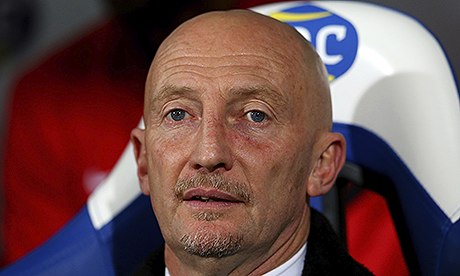
top level were apparent on his usually smiling features. Recent pictures – including this one, usually a bog-standard "manager shot" – show
a defeated man, albeit one who hadn’t yet surrendered. When even the involuntary parts of body language
betray a manager so quickly, doubts build about his ability to make effective
decisions; as the stress increased, it became increasingly apparent that Ian
Holloway’s future lay away from Selhurst Park.
Subscribe to:
Posts (Atom)