Stay tuned as we count down our Top 50 Australian Rules football players of all time here on Balanced Sports. We start our ticking clock next Monday with no. 50.
There's a good chance this list will not feature the following players, no matter how much we love them: Austin McCrabb, David Mensch, Ed Considine, Richard Umbers, Chris Naish or Garry Baker.

Tuesday, October 11, 2011


Monday, October 10, 2011
My Favourite Cricketer: Bob Woolmer, by Hendo
Test Match Sofa's Nigel Henderson (aka Hendo) takes a look back at one of cricket's tragedies in our next part of our continuing series My Favourite Cricketer.
I’m not in the habit of looking into other men’s eyes, but his really were exquisite. The cyan blue of a Caribbean sea, intense and deep, like two gorgeous lagoons. The perfect eyes to watch the ball right onto the bat and then dispatch it with the minimum of effort all the way along the ground to the extra cover boundary or coax it away, languidly, square of midwicket, always with immaculate balance.
That evening in 1975 when he stepped out the back of the Pavilion entrance on to the Oval forecourt after his magnificent match-saving 149 against Australia, was as close physically as I ever got to Bob Woolmer – the 12-year-old me was at the back of a six-deep crowd surging forward for autographs that police tried to part to allow him through to his sponsored car – but I wasn’t desperate for his signature. I just wanted to see him at short range and the fact that I did, and momentarily stared into those liquid eyes, must have left its mark for me to remember it more than 36 years after the event.
What I needed confirmed by looking into his eyes was not just his ability as a batsman but a sign of his kindliness – why it was important to me that my sporting heroes were also decent human beings perplexes me probably just as much as it does you; I don’t need that now – and that brief moment was enough to convince me. (I was glad to see, more than three decades later, that in the outpouring of grief after his tragic death in Jamaica, his basic decency was something that those who played with and against him and reported on his deeds were united in communicating).
 |
chicagoaddick.blogspot.com |
And among them, boyish, without a trace of arrogance and seemingly at ease in his own skin, Bob Woolmer, a sprightly medium pace bowler first and foremost but who showed enough promise with the bat to score an unbeaten fifty at No 7 on his county debut in 1968.
And it was his batting to which I was most attracted and for which I remember him most. I had to rake back through the cricketing archives to discover when he really made the leap from lower-middle order to the top of it, but it seems he was being auditioned for the move as early as the start of the 1971 season, when he batted at No 3 in the champion county’s traditional opening fixture against the MCC at Lord’s. Natal must have seen something in that classic technique that I grew to love, giving him the chance to bat at four or five in the Currie Cup during the winter of 1973-74 and the following summer Kent followed suit. When he finally made the England side, in 1975, it was on the back of two fine batting performances for Kent and the MCC against the touring Australians (a hat-trick in the second of those matches couldn’t have harmed his chances, either).
Opening for England eventually came by default, a year later. He had been used sporadically in that position in the summer by Kent and when that season’s international series against the West Indies had repelled the claims of Barry Wood, John Edrich, Brian Close and Mike Brearley, the selectors remembered his defiance from the Oval a year earlier, and asked him to step into the breach alongside David Steele.
How to describe his approach? He wasn’t spectacular and he wasn’t merely solid. This was an era long before the bludgeoner with a 3lb bat. He was a touch player, who stroked the ball even when it was propelled at him in violent fashion, and I so loved his style that I for several years was addicted to the Gray-Nicholls willow that he used.
And he was calm. My other abiding memory is from 1977’s Benson and Hedges Cup final against Gloucestershire. Wickets were falling all around him as Mike Proctor – inspired by his fans’ chants of “Kill, kill, kill” as he ran up – and Brian Brain ripped away the supporting cast of Clinton, Rowe, Asif and Ealham. But he pushed on until, on 64, he chipped a ball effortlessly off his legs and Julian Shackleton, at deep square leg right in front of me in the Grandstand, hardly had to move to take the catch.
I was bemused. He had timed the shot so well, and with such little apparent effort, I reasoned that he could, if he’d wanted, given it just the touch more leverage it required to send it spiralling over Shackleton’s head. Flawed genius, then? It was certainly the most graceful shot I had seen that had brought a wicket.
That season was probably his most successful in Test cricket; he hit 79, 120 and 137 in consecutive innings against Australia, but then he was lured away by Kerry Packer. How did I feel about that? Disappointed? Betrayed? Both probably. It felt like a talent not completely fulfilled.
When he returned to play for England at the beginning of the 1980s, he wasn’t the same, and there was a sense of disappointment again when he lined up for the South Africa rebel tour.
 |
| Courtesy: cricinfo.com |
The day he died is etched unpleasantly on my brain: I was at my terminal on The Times sports desk, when news came through on Sky Sports that he had been taken to hospital unconscious. I was sickening for pneumonia myself, so that may add to the toxicity of my memory, but something told me he was not going to get better. Within half an hour, it seemed, the announcement that he had not made it came through. The sadness went deep to my stomach. He was only 57; what else might he have achieved. Those gorgeous blue eyes had looked out upon a cricket field for the last time.
Hendo's written these highly-recommended works. Take a look,they're awesome reads.
Back to My Favourite Cricketer Homepage.
Wednesday, October 5, 2011
Death, taxes and Capello's England
Fabio Capello's England squad comes with several un-surprises: Rio Ferdinand has been omitted, as has Liverpool's Steven Gerrard. Forgive me, but I need a couple of minutes to deal with that overwhelming shock. (Picks self slowly off floor). Injury has rendered Ferndinand a poor imitation of his former commanding self; Gerrard has played two matches off the bench for the season.
Again, Fabio Capello has failed to select form over reputation. Darren Bent or Bobby Zamora could start as Wayne Rooney's forward partner, especially given Capello's apparent disdain for Andy Carroll's lifestyle. Though Phil Jones has made the squad, Chris Smalling will not feature; neither will the demonstrably lethal Daniel Sturridge.
It is time to accept that only in the Three Lions is change not inevitable. Though Macedonia have played well - above expectation and even hope - their squad is the inverse of the England squad. Their unit is organized, motivated, have fewer skills and less cash. Don't give me the rubbish that England aren't motivated, even after the night which still plagues both Steve McLaren and Scott Carson's careers. Montenegro, who've played their football independently from Serbia only since 2006, has much more to gain than their established English counterparts.
This reason is why players like Sturridge, Welbeck and Smalling - Gaby Agbonlahor, for crying out loud - had to be featured in this match; each has something to gain from the exposure. One win (at home to England or away at Switzerland) will see Montenegro, granted nationhood from Serbia in 2006 and with the same population to Sheffield, secure a playoff spot for the 2012 European football Championships.
Of this, be very sure: the Montenegrin players care more about this match than the Three Lions. This is why Capello must be certain of selections; probably it is why he has erred to conservatism. Whether said nationalistic fervour is enough to counter players of a higher skill-set is why the matches are played.

England will face a team inspired by achievement while themselves facing public expectation bordering on verbal assault. The empowerment brought about by positive reinforcement is more stirring than fear of failure. The proof is in the pundit's bugbear Andy Carroll, who is yet to reproduce his Tyneside form for new club or country.
As well as reinforcing the generational change England so badly needs (Michael Owen and Joe Cole still talk about call-ups!), playing a front three of Rooney, Sturridge and Welbeck would scare almost any defence. That triad's pace alone would terrify most centre-backs, let alone the finishing skills all have shown this year.
Once again, England under Capello has missed a trick - and denied younger players the chance to prove themselves before a major tournament. Why should we expect any different?
Monday, October 3, 2011
Sixty-Six Sigma: South Australia
by Ben Roberts with Matthew Wood
Openers: Michael Klinger and Aiden Blizzard
Klinger went from a popular choice for international selection to watching last year's bottom-feeders. South Australia's captain averaged only 23 with the bat last term despite having scored over 1200 runs the season before at 70. Probably at his age (31), he's not on his last chance but is closing. Having brought so much to the Redbacks, he deserves the faith - at least initially - of State coach Darren "The Puff-Adder" Berry.
Forming an ex-Victoria opening pair with The Corporal is Aiden Blizzard. A full season in 2010/11 (something he would unlikely of gotten in Victoria) saw him to average 34 with two centuries. Nothing amazing in these figures, but competition is hardly stifling.
Number Three: Tom Cooper
 |
| Courtesy: zimbio.com |
The Netherlands' own Tom Cooper is good enough to bat at number 3, but undersold his talent in 2010/11 by not converting his four half-centuries into big scores. Has globe trotted with the opportunity provided by his Dutch heritage, but remains eligible for Australian call-up. With the opportunities provided by such fortuitous citizenship, he could really benefit from a season or two playing county cricket. Not at all settled in the SA team, he will need to decide what he wants out of his career if he is to be a success.
Middle Order: Callum Ferguson and Daniel Harris
Ferguson is coming into the prime of his career and has delivered results at the limited over international level. With Australian cricket in danger of giving caps to the likes of David Warner*, this at least renders him a chance to make the Test lineup. His knee injury came at the most unfortunate time, but he is talented, young and still a top prospect. In the four matches he did play in 2010/11, he collected two centuries and has had a solid recent tour of Zimbabwe with the Australia A team.
Daniel Harris has built a lasting first-class career as the eleventh man picked for SA, recently the worst state side in Australia. His 2010/11 average of 36 was above his career mark of 31, so holds on to his middle order place. Should a loan system eventuate, Harris must fear for his spot behind more accomplished talents like John Hastings (given the history of Victorians and South Australians swapping - cf. Matthew Elliott, Paul Nobes, "Boof" Lehmann as well as coaches David Hookes and Darren Berry, don't rule this one out).
All-Rounder: Dan Christian
The now-former Australian selection panel must have had cotton wool in their ears any time they visited SA. They must also have avoided watching any cricket matches, despite the fated Hilditch, Jamie Cox and Greg Chappell residing in-state.
There can't be any other explanation for there complete ignorance of Dan Christian for the Australian limited over sides. Like James Hopes in Queensland, the all-rounder Christian often shoulders the load as his team battled and is not just suited to 50-over cricket despite his 2010/11 figures being below average.
Wicket-keeper: Tim Ludemann
Longtime incumbent - and Ashes representative - Graham Manou elected to call time on his first class career after the 2010/11 season. His understudy for the past three years, Tim Ludemann, has been solid but not spectacular. Ludemann gets the nod, but could be shifted easily. Another spot for potential loanees and with 'keepers prone to moving (cf. Gilchrist, Haddin, Wade) for opportunity, Ludemann should fear for his spot.
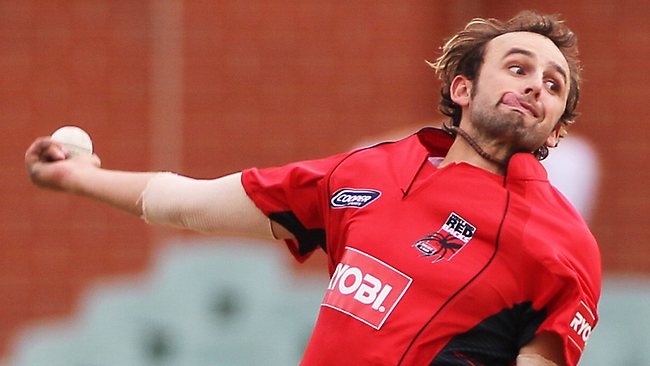
Spinner: Nathan Lyon
 |
| http://www.adelaidenow.com.au/ |
South Australia could field three of Australian spin bowling's "Next Big Things" - Cullen Bailey, Dan Cullen and Lyon. Two have international experience. Four matches for 12 wickets at 43 was clearly enough for him to be selected for the Australian team and this should ensure his position for this season at least, national call-ups notwithstanding. He and chief Australia rival Michael Beer (WA) offer varying styles, with Lyon able to attack and contain while Beer's abilities ultimately result from his gangle.
Pacemen: Peter George, Gary Putland, and Kane Richardson
Thanks to a (mostly) injury free 2010/11, Peter George was the leading bowler for SA. Unfortunately, each sentence regarding his career now must be prefaced with how his body stood up the previous season. He has fallen back into the pack since his Test debut in India a couple of seasons back, but should be watched carefully as his height provides a completely different look from Australia's current "hi-ho, hi-ho" pace attack.
Putland and Richardson only played five matches between them last year but their youth and speed makes them better selections than the older and well-travelled Ben Edmondson or Rob Cassell.
Who's locked in?
Dan Christian shoulders a massive load and deserves his spot as a regular. If fit, Peter George's great height is as bigger advantage as anyone has at the flat wicket Adelaide.
Callum Ferguson is a classy batsman, with enough grit to make the grade at the international level for the next 10 years.
What's disappointing?
Michael Klinger. At the start of last year, he would have been locked in, but now potentially looks at a final fling at making more of his career. Tom Cooper's career so far has been one of "coulda"; he is close to making that "could-woulda-shoulda".
There are a number of spots are available. Unlike Queensland though, fast bowlers should look to SA - Ben Edmondson and Rob Cassell, mediocre talents at best - look likely to get games. That's if those bowlers are happy to work at the Adelaide Oval.
Who's next up - or alternatively, who's loan bait?
Edmondson (RM), Cassell (RMF), Cameron Borgas (RHB), Aaron O'Brien (LHB/SLA), James Smith (RHB).
Back to Sixty-Six Sigma homepage.
Friday, September 30, 2011
Carlos Tevez - the bizarro Bosman
So with the latest Carlos Tevez saga in full flight - twelve individual articles posted on the Guardian's football site within the past 24 hours, nine of which made their front page - it's now time to ask what, if any, value contracts still retain in football. The cynics among us will automatically say only "to maintain a player's sell-on value". It could even be worse than that.
City's Argentine thorn could keep a snit of contract lawyers employed and happy for months. (Yes, I just made up a new collective noun and I'm quite proud of it)
Essentially, Tevez's alleged refusal to play amounts to an employee telling his boss "I'm not going to go into work because I middle management isn't using me the way I want". Try that today - I dare you - and see where it gets you.
Although it must be emphasised that Tevez's "misunderstanding" story has a whiff (and it may just be that) of truth, Manchester City have little recourse other than to suspend or fine their erstwhile captain. Both are money saving moves, rather than actions which recompense Sheikh Mansour for the star's apparent immaturity.
Player's contracts should have in them clauses which state clearly that the player must play when available and selected - or face suitable legal action. When said player has the talent and earns the sums that Tevez does, withholding pay has little effect. He is now almost irreparably damaged as a City commodity - and so will be available at a more cut-price rate.
The manner in which contracts are disregarded by players who think themselves underpaid or undervalued stinks of Collective Bargaining Minimalism that somewhere, Peter Costello is getting aroused. Before Kevin Rudd's 2007 landslide election victory, it was leaked that the then-Treasurer hoped to extend the nation's "Work Choices" bill so that everything other than minimum wage was negotiable.
Gradually and with only occasional outcry, footballers' contracts have essentially evolved into the reverse. Terms and salary are locked in, but outside that it appears the individual rather than - his nominal employer - has "hand". Again, this is hardly revelatory. But it's worth pointing out that, should Tevez be sacked from his employment contract, Manchester City would:
a) not see full return on the 25.5 million transfer fee they paid to acquire his services,
b) not receive any transfer fee when seeing him play for another club,
c) have paid his now-exorbitant wages for 2-plus years,
d) allow him to leave a city he disdains without financial penalty,
e) see him the most desired free-agent in football history, able to name his wages to play at a club of his choice.
It is in Manchester City's interests to sell him, yet by announcing (as they had to) his suspension they have effectively cleaved his resale value in half. Again, they are out of pocket. The contract that Tevez signed on agreeing to play for Manchester City now so favours the player that it's outmoded and essentially worthless.
It is time for footballer's contracts to more mirror standard employment deals. Were I to compromise my employer's profitability - especially by such great sums - I would expect to be dismissed. Additionally, if there were three replacements who could do my job at equal or better standards, I should fear. Whatever option they choose to pursue - beyond retracting some of his already-paid wages, which is sketchy legally - Manchester City come out behind on this deal.
Jean-Marc Bosman must be crying into his claret - his stand was needed to change the domination that clubs held over their playing staff. Accusations of slavery are of course ridiculous, but not so ridiculous that credible sources like Sepp Blatter aren't fooled. What Bosman did for player empowerment, Tevez has taken so far that he has become the inverse, a Bizarro Bosman whose actions damage player credibility more than aid it.
There should be enough middle ground (as opposed to, say, the NBA) for both sides to be satisfied. Can't we all just get along?
Thursday, September 29, 2011
My Favourite Cricketer: Herschelle Gibbs, by JLaw
In our continuing series "My Favourite Cricketer", JLaw of Wicket Maiden examines the flawed genius of Herschelle Gibbs.
It was only in 2010 - when I finished reading Herschelle Gibbs’s biography To the Point - that I noticed the shape of a bottle of Jack Daniels was remarkably similar to that of a cricket bat.
 |
| flickr.com/3661/3427128134_5aa42f1a09.jpg |
During the heyday of his career, my favourite cricketer, Herschelle Gibbs, was equally talented when it came to holding either object. These days – at the tender age of 37 – it’s just the willow which is still being yielded by this highly talented sportsman.
My appreciation for Gibbs goes back to my junior school days in the early nineties when he was perceived as a near demi-god at our school. He was a gifted sportsman with provincial and national colours in rugby, football and cricket – all before his grade 12 year. Despite having well below average academic results, Gibbs was the admiration for all the youngsters at school as he was already playing for the senior Western Province side shortly after his 16th birthday and was always destined for big things.
For me, Gibbs’ provincial debut in the 1989/90 season was less memorable for his performance with the bat, but rather for the fact that his call up was so unexpected that his name could not be printed on his shirt correctly in time for the match.
In those days, each individual letter of the player’s names were ironed on the shirt. I assume that the backroom staff had run out of letters that day as a freckled teenage Herschelle walked on the field with the word ‘Dibb’ printed on his back. Sometimes it’s tough being the junior in the side.
Despite failing to, uhm, stamp his name on that match, Gibbs went on to become one of the most successful batsmen in South African history, albeit with a lingering flavour of controversy.
But it is his off-field antics which have kept me equally entertained as his on-field exploits.
He had to wait until November 1996 to make his Test debut. It was an even longer wait as he was set to come in at number three against India at Eden Gardens, but a remarkable 236-run opening stand between Andrew Hudson (now South Africa selector) and Gary Kirsten (now South Africa coach) meant it was a nervous and elongated wait for Gibbs who eventually got in and made a cautious 31 off 112 balls.
I believe the period in which Gibbs really vindicated his continued selection in the South African national side came in 1999. In January that year he hit his maiden ODI ton against West Indies in Port Elizabeth and three months later, Gibbs smashed a sterling 211 not out in New Zealand – his first of two career double tons in the longer format of the game. The other came in 2003 when he made 228 against Pakistan at his beloved Newlands.
Then who could ever forget what was arguably Gibbs’ finest moment in a Proteas shirt – the 438 game.
A match that will live in the records for years to come as the best ODI ever played took place in Johannesburg on 12 March 2006 and Gibbs was the star of the moment. After Australia scored a then world record of 434/4 in 50 overs, South Africa did the improbable by scoring 438/9 with Gibbsentertaining the crowd in a knock of 175 from 111 balls including seven sixes and 21 boundaries.
 |
| http://www.nandamurifans.com/ |
After the match Gibbs was quoted as saying in The Guardian: “I don’t know where that innings came from. I don’t think I’ve played better.” It was later revealed in To the Point that Gibbs had broken team protocol the night before and went on an all night drinking bender before taking to the field with a hope of sobering up.
Gibbs later said he was very thankful South Africa lost the toss and were put in the field as it gave him a chance to avoid facing both the new ball and his coach Mickey Arthur.
It’s because of Gibbs’s ability in this case to drink hard and play hard that I am able to call him my favourite cricketer - and make the parallel between the holding of the bat and the holding of a bottle of Jack Daniels.
1999 was, however, also the year when Gibbs had his best chance to win a World Cup were it not for hisinfamous ‘You just dropped the World Cup’ moment when he ‘dropped’ Australia captain Steve Waugh who went on to score a century and force a win against South Africa.
But, for as much excellence as there was on the pitch, there was a controversial side to the career of Gibbs, perhaps going back to a 2001 tour to the West Indies when he was part of a group of Proteas cricketers who were caught smoking marijuana in a hotel room in Antigua.
There is of course the match-fixing cloud which will always hover over Gibbs’s career. Having admitted his involvement in the Hansie Cronje-led match-fixing scandal, Gibbs was banned from cricket for six months and could not tour India for six years due to a self-imposed banishment to avoid Indian police.
Adding to that, a few racist remarks in a 2007 Test against Pakistan, some scandalous affairs, drunk driving charges and at least one stint of rehab for alcohol abuse that we know of kept the name Herschelle Gibbs in the media.
While it’s been over two decades of ups and downs, Gibbs, in the twilight of his career, continues to be both a fear for opposition bowlers and a threat to opposition batsmen when he’s lurking at backward point.
Despite a name fail in his First Class debut, the name Herschelle Gibbs now will never be forgotten by cricket fans worldwide.
JLaw contributes regularly to Wicket Maiden and tweets at @justinlawrence.
Wednesday, September 28, 2011
Sixty-six Sigma: Victoria
by Ben Roberts and Matthew Wood
Openers: Aaron Finch & Robert Quiney;
Finch has had a breakout couple of years, more notably in the coloured clothing where he gained international honours. He also showed last year that he was valuable in the longer form. He recently toured Zimbabwe with the 'A' team and in the only first-class match he played in, he made a century. He needs to calm down but could be very valuable for the Victorians in 2011/12.
Neither Michael Hill or Ryan Carters, two highly-rated young players with opening pedigrees took enough advantage of Chris Rogers absence through injury last season to be easy starters. Father Time is catching Rogers and after his injury last year he has not been as prolific during the English Summer as in years past. Rob Quiney has emerged from some wilderness time a better batsman, head-wise.
After his flirtation with the Australian team a couple of years ago, the publicity went to his head and he lost form dramatically. He is one of the most versatile batsmen in Australia, batting as required up or down the order. Last year in a poor batting lineup he averaged 42 and earned back some respect.
No. 3: David Hussey
 |
| Source: flickr.com/photos/castle79/2568621771/ |
This is disappointing as he has been one of the Shield's great runmakers since making the trip East a decade ago, but selection for the national team is often as much luck as it is skill - just look at David Warner. Despite a below-average season last year, where he averaged just 40, he still deserves to be named among the best cricketers in Australia and (can) serves a purpose at number three for this side.
Middle Order: Cameron White & Glenn Maxwell
There weren't many positives that came from of a season where Victoria's captain was elevated to skipper Australia's T20 team and vice their and 50-over squad. How wrong were the voices that bleated prior to the season that White should be given another go in the Test side as a batsman. By seasons end White had been dropped from the 50-over team for poor form, and in the only three shield matches he played he averaged just 28 with the bat. He did lead the Australia 'A' team against the English astutely, making a century, but is back in the pecking order for Australian batsmen, and probably holds onto his Victorian spot by the 'skin' of his captaincy credentials.
Maxwell is an exciting prospect. He showed that he can play shots with some daring that pushes his case beyond that of Hill and Carters who seemed to seize up at the crease. He will need to temper his approach, but given time and some protection down the order he could be a great batsman for the state. From five innings in the shield last season he made two half centuries and one century.
All-Rounder: Andrew McDonald
Easily Victoria's spine upon which they need to build around. He was the best batsman in the state last year by a significant margin, with an average of 76 and three centuries struck at a rate of 84 runs per 100 balls. Couple this with his medium pace bowling that gets lost behind the front line talent at Victoria's disposal and you have one hell of a player.
Wicket-Keeper: Matthew Wade
The former Tasmanian made further advancement as one of his adopted state's key players, so much so that he has now been selected for higher honours behind Tim Paine and Brad Haddin. Of all the keepers completing every match in the Sheffield Shield last year, Wade was one of only three averaging greater than 30 with the bat. His wicket-keeping is of the highest order, making him unlikely to be replaced very soon.
Spinner: John Holland
At a time in Australia's cricket history where one only has to have rolled their fingers over a cricket ball to receive Test honours, it's amazing that Holland hasn't entered wider discussions over the past 18 months. Although injured at an inopportune time, he still played 7 matches last year and took 19 wickets at 42, as good as any finger spinner in Australia.
Pacemen: Peter Siddle, James Pattinson & Clint McKay
This is Victoria's strongest suit. The ability to team these three internationally honoured bowlers together will be probably something unlikely to happen this summer, but it does make the mouth water.
Siddle is an established member of the Australian team, and his hustling style is known to batsman as a difficult prospect particularly when conditions favour him. Both McKay and Pattinson are probably the two more naturally talented members of this trio, but had their season wrecked by injury last year. Both, who have received a small taste of international cricket, did perform in limited matches for Victoria. McKay captured 11 wickets in three matches; Pattinson seven in two.
Who's likely locked in for Victoria?
Andrew McDonald, with his record with both bat and ball, is guaranteed a place in the Victorian side. Although in his best use now may be more a shepherd's role at number three and despite a poorer year last year, David Hussey still is one of Australia's best batsmen. Wade as wicket-keeper/batsman and the three paceman are irreplaceable with the likely talent available for loan from other states.
What's disappointing for Victoria?
Well the top order batting, plenty of talent and potential, but a glut of good cricketers elsewhere could see anyone of White, Finch, Quiney, and Maxwell replaced if we are looking for the best 66 cricketers in the country at the moment.
The biggest disappointment is that bowling all-rounder John Hastings has no spot. His bowling is similar in nature to that of McDonald, and shades McDonald for effectiveness, it is not enough to dislodge McDonald who's batting was the best for the state last year. Therefore in this exercise, Limited over international representative 'The Duke' Hastings will be a prime candidate for being loaned to another state.
Of particular concern for Victoria should be their inability to convert centuries into really big scores. Only Andrew McDonald showed this last year, making 163. All others who scored hundreds topped out with David Hussey's 122.
Who's next up - or alternatively, who's loan bait?
Hastings (Allround), Darren Pattinson (RFM), Rogers (LHB), Hill (RHB), Carters (RHB).
Back to Sixty-Six Sigma homepage.
Back to Sixty-Six Sigma homepage.
Sixty-Six Sigma: The Optimal Sheffield Shield
by Ben Roberts
The Argus Review into the performance of the Australian cricket team came to the conclusion that Australian Test performance would be best suited by having the best 66 cricketers consistently playing First Class cricket. Why did it take us this long to work this one out?
The Argus Review into the performance of the Australian cricket team came to the conclusion that Australian Test performance would be best suited by having the best 66 cricketers consistently playing First Class cricket. Why did it take us this long to work this one out?
The report was clear to highlight that despite being a feeder competition for the national team, the primary focus of the Sheffield Shield had become anything but. Too many run-of-the-mill players now hold up the progress those with true potential for the world stage.
In order to hopefully foster a competitive league with more players deserving elevation to higher honours, it was recommended that the competition be liberated somewhat through the institution of a loan system. This would allow short term transfers of talent between states. We saw in the the recent English summer that when England skipper Andrew Strauss would not get the first-class practice prior to the first Test against India, he was loaned from home county Middlesex across to Somerset to face the tourists in a single match.
The premise of this series of articles will be to attempt to name the best XI for each state team. Once finalised we will analyse the resulting players missing out on a place in their contracted state and propose loans that could be made at the outset to hopefully have the 66 best Australian cricketers playing in the Sheffield Shield at one time.
Tuesday, September 27, 2011
Notes on leaving the bench
The Mail on Sunday made a big fuss about Frank Lampard leaving the Chelsea bench after being an unused substitute in Chelsea's win over Swansea City at the weekend. All anyone knows - except, perhaps, Frank Lampard - is that with only minutes left in the match, the England midfielder walked down the player's race.
Chances are that there was nothing in his actions; he thought it best to retreat to the rooms for treatment or something similar. It's been one of the most trying professional times for Lampard as he struggles with possible slips down the pecking order for club and country. A storm in china crockery of course, but if, just if, his actions were a protest at his removal from the Chelsea starting lineup - in which he's been a fixture since moving from West Ham - he's committed a protest of the immature and selfish.
A long time ago, in a galaxy far, far away, a former girlfriend of mine who played professional basketball told me how proud she was that she had quit the bench after being subbed in a big loss. I was astounded she'd done so; and asked how she'd react if a teammate had done likewise. She wasn't complimentary to this fictional teammate, only then realising that was how she was now perceived. She was so wrapped up in her own reality that the perceptions of her teammates didn't even register.
That explained a lot, because a lack of understanding about how teammates will react in certain situations indicates of a lack of team chemistry and that the needs of one are put above the needs of many. Sport is littered with similar examples, ranging from the Detroit Pistons' unnecessary player strike (the coach was going to be fired anyway) to citing examples of opponents failing to shake hands. As a player - or manager - your voice is important and, contrary to occasional opinion, heard. It's just not the only voice a coach has to listen to.
Teenagers see the importance of making regular statements - with clothes, music and in many other facets of life. Making statements just be heard, especially leaving the bench to make a protest, is a juvenile act made by people used to getting their own way. I don't believe Frank Lampard is one of those players; here's hoping he returns to the Chelsea side in coming weeks.
Chances are that there was nothing in his actions; he thought it best to retreat to the rooms for treatment or something similar. It's been one of the most trying professional times for Lampard as he struggles with possible slips down the pecking order for club and country. A storm in china crockery of course, but if, just if, his actions were a protest at his removal from the Chelsea starting lineup - in which he's been a fixture since moving from West Ham - he's committed a protest of the immature and selfish.
 |
| courtesy: dailymail.co.uk |
That explained a lot, because a lack of understanding about how teammates will react in certain situations indicates of a lack of team chemistry and that the needs of one are put above the needs of many. Sport is littered with similar examples, ranging from the Detroit Pistons' unnecessary player strike (the coach was going to be fired anyway) to citing examples of opponents failing to shake hands. As a player - or manager - your voice is important and, contrary to occasional opinion, heard. It's just not the only voice a coach has to listen to.
Teenagers see the importance of making regular statements - with clothes, music and in many other facets of life. Making statements just be heard, especially leaving the bench to make a protest, is a juvenile act made by people used to getting their own way. I don't believe Frank Lampard is one of those players; here's hoping he returns to the Chelsea side in coming weeks.
Monday, September 26, 2011
Book review: Man in the Middle, by John Amaechi
A re-post from our affiliate book review site, Books with Balls.
John Amaechi's NBA career comprised a series of "What if" moments. What if he hadn't been spotted in the street by a basketball talent scout? What if he went to a different college? What if he hadn't turned down $17 million guaranteed from the Lakers to stay in Orlando for one thirtieth the salary?
John Amaechi's NBA career comprised a series of "What if" moments. What if he hadn't been spotted in the street by a basketball talent scout? What if he went to a different college? What if he hadn't turned down $17 million guaranteed from the Lakers to stay in Orlando for one thirtieth the salary?
In his memoir "Man in the Middle", he adds one more: what if he had stepped out of the closet during his basketball career?
When England wicketkeeper Steven Davies came out this year, his actions were seen as heroic and a positive step in the battle to fight bigotry in the testosterone-fuelled major leagues.
When Amaechi published his autobiography in 2007, it was met with disdain from Tim Hardaway and comments from stars like Charles Barkley and LeBron James which were equal parts helpful and harmful. The truth is that no matter how much it may have helped others, John Amaechi would have been seriously disadvantaged - or unable even to play in the League - by admitting his sexuality. Telling a teammate would almost certainly result in pariah status and significantly lessen his chances of making a difference in the world.
 |
| courtesy: barnesandnoble.com |
Where some deny themselves snacks, business opportunities or even a normal social life to play in the NBA, Amaechi denied himself so much more.
A nerdy kid encouraged to take up basketball in his late teens, Amaechi worked hard to go from Manchester to the NBA via high school in Ohio and a couple of colleges (Vanderbilt and Penn State). First discovering his true sexual orientation at Penn State, he kept it a secret for nearly a decade before coming out to a counsellor from his alma mater while struggling to live with crippling loneliness playing in Greece.
His book isn't a tale of victories, stats or achievements. He was good player in certain situations, but not a star; his book is a tale of a man who enjoyed basketball, but found it a means to an end. He seems more settled and comfortable now, excised from a me-first environment and running his business, Animus Consulting.
There's a certain amount of egotism - but surely Amaechi has more to be proud of than the average basketball star. His most telling statistical indicator is not a matter of average, but of luck - he scored the first basket of the year 2000. While at college, he was active in the Big Brothers, Big Sisters program and basically adopted a bunch of kids coming from unfortunate backgrounds. He did likewise in Orlando - leading, along with a bunch of enjoyable teammates, to his infamous rejection of the Lakers' millions.
Basketball autobiographies are often a glimpse into the psyche of the athlete, no matter how flat-batted they attempt to be. For example, Larry Bird's Drive is without question the most boring autobiography I've ever read - but this indicates much of the man. He is boringly obsessed with basketball. Bird the player was admirable - Bird the man, not so much. Drive, like Bird on anything other than hoops, never says anything worth reading. Amaechi is the polar opposite - basketball provides a background to which he nods occasionally, but his life seems so much broader.
You never get away from Amaechi's sensitive - and frequently pretentious - nature. But to deny either would bear false witness of the man. Any pretentiousness isn't overpowering - just his manner. But certainly, you can see how he wasn't universally liked (especially by Utah Jazz coach Jerry Sloan) simply because he refused to adhere to the overwhelming jock mentality of regular basketball stars. Where others pay lip service to the importance of basketball, Amaechi does not.
Man in the Middle is an easy read. It's rewarding, as well. Like many sports stars, his perspective has become his reality - events large for him sometimes not seen as such by others - but his perspective is panoramic, rather than focused intently on basketball. In fact, Man in the Middle is one of the first books in a long while that I've made time to read. Footballs.
Subscribe to:
Posts (Atom)