Showing posts with label Father-Son rule. Show all posts

Wednesday, September 19, 2012

Vale, Matthew Scarlett

Matthew Scarlett has retired from AFL football.  By doing so, we must farewell a brilliant - if genuinely odd - champion of the sport.  He is joined in retirement by Premiership teammates Joel Corey and David Wojcinski.  The trio - Scarlett especially - leave behind many fond memories of the wonderful Cats era of 2007-2012.

And as Scarlett ambles into the Torquay half-light, the accompanying sound you hear is the death rattle of greatest era in Geelong Football Club's history.  Any player in the 2007 and 2009 Premiership sides was replaceable, bar him.  In fact, when the Cats won the 2011 flag to make it their third in five, many of the original entertainers had already been superseded: Cam Mooney, Darren Milburn, Tom Harley.  Even Little Gary.  The only legatees of a team that was both truly great and startlingly deep are James Bartel, Joel Selwood, Corey Enright and - for another year, anyway - Paul Chapman.

Scarlett the Younger came to the Cats in the 1997 draft.  I had the pleasure of witnessing his first game, in the last round of 1998, where he played Matthew Lloyd straight up.  He was overmatched by the spearhead ascendant, but fought gamely and was rarely - if ever - beaten by the Lloyd again.  By 2000, Scarlett was integral, the ultimate answer to Geelong's perpetual full-back problem.
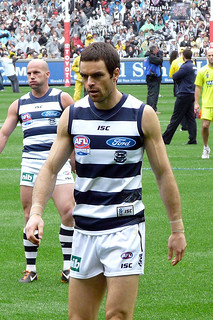
flickr.com/photos/jamesdphotography
He started as a resolute stopper but as his younger teammates matured, so did his game.  No longer required only to defend, Scarlett developed into the game's most effective offensive full-back, without any decrease in defensive responsibility (or result).  Several factors helped this evolution, including a possession-heavy game, a swarm of tacklers, the Cats' zonal marking and outstanding teammates like Tom Harley, Darren Milburn, Matthew Egan and now Harry Taylor.

It was this ability to produce wave after wave of attack while not sacrificing positional defence that made Scarlett the best full-back of all time.  No full-back has combined attack and defence so perfectly.  He was precise in disposal, had the ability to gut-run and understood when to do so and the bodily strength to wrangle down opposing power forwards.  He was also clutch.  Ask Buddy Franklin, who from 2008 to 2011 dominated Geelong defenders - until it was Scarlett's turn to stand him.

Or ask St. Kilda.

For over a hundred years, full-backs were nothing but stoppers.  The player selected in that position in the AFL's Team of the Century in 1996, Steven Silvagni, could barely kick forty metres.  Let alone run, bounce and deliver a pinpoint pass.  The position changed because of Scarlett and his contemporary Dustin Fletcher - full-backs are now so much more than taggers who stand next to the goals.  Although their methods differed - and, obviously, my preference was Scarlett's - the influence they exerted across the entire ground rather than just within 35 metres of the goals, make them the best the game has seen.

No-one can replicate what Matthew Scarlett has done for his club, nor could they redefine the position the way he did.  He was the ultimate full-back.

Wednesday, September 12, 2012

Change the Father-Son rule

There great red sandy plains are rumbling.  It appears Melbourne Football Club will have to use the 3rd overall selection in this year's AFL draft to select Jack Viney, the son of former captain Todd.

Melbourne
Viney, courtesy: The Age
Before 2007, the promising sons of former club greats were available pre-draft to their father's club at the cost of that club's third-round selection.  That system changed to a "bid" system in 2007, where, should another club guarantees Viney selection in a certain round - say, the first - then the Demons have to match that offer and select the player with their own pick in the same round.  Melbourne has the third pick in this year's draft - meaning if another club values Jack Viney as a first-rounder, the Demons have to pick him third or lose him.

The "bid" system was implemented in response to Geelong adding Tom Hawkins via the old rule.  The power forward would almost certainly have been drafted first overall and arrived at a club already boasting Father-Son picks Gary Ablett Jr, Nathan Ablett, Matthew Scarlett and Mark Blake.  The Cats - who had decided consciously to re-embrace their past and locality -  were seen to be favoured so much that the rule was changed (never mind that the Abletts would have been third-round picks at best, while Scarlett and Blake probably wouldn't have been drafted if not their connexion to the Cats)*.

The Cats were rewarded for embracing their history.  Alongside the five listed above, they have also selected the sons of Andrew Bews, Terry Callan, Michael Woolnough, Garry Fletcher and Larry Donohue.  Of those five, four were busts and Bews is far from the final product.

Gary Ablett Jr, courtesy Wikipedia
The old rule was shouted down when some clubs got jealous - and with ample justification.  Adelaide is yet to select a Father-Son player in twenty-plus years of drafting, while Fremantle has only Brett Peake from seventeen.  A standard system, still at a significant cost - say, the old third-round pick - is fair, just as long as interstate clubs are able to participate as well.  However, drawing players from the SANFL and WAFL is more complex - nobody wants another Bryce Gibbs fiasco.  Perhaps an adequate compromise could be a total of games (200?) in which they play the majority (135-150?) with one of one "feeder" clubs.

The current rule places all the advantage in the hands of opposing teams, rather than the team who should benefit from their past.  At best, a bidding team gets a draft pick at market value.  At worst, they force the "parent" club into the contrived position of potentially mortgaging a part of their future against their past greats - a tricky situation.  The only sons now selected are generally "can't miss" prospects like Mitch Wallis, Joe Daniher and Jack Viney.  Without the Father-Son rule in 1997, the Cats wouldn't have unearthed the greatest full-back in history**.

The league shouldn't penalise clubs for drafting family.  It runs opposite to the family atmosphere the AFL has so successfully created.  History should be celebrated, rather than becoming a burden - it's great that the Western Bulldogs Footscray fans can see Liberatore and Wallace combine again, while the sight of Scarlett to Bews to Little Gary to Hawkins is a great callback to the free-flowing Cats of the1980s.

It isn't a retrograde step to look back fondly on history.  Embracing one's past is a concept that underlies a healthy collective - so it's time for the AFL to allow clubs to do so without penalty.

* You got me, I'm a Geelong supporter - but have felt this way since the rule was changed.
** Yes, I'm biased, but if you want I can give you a dozen reasons why.