Showing posts with label Doctor Who. Show all posts

Friday, October 25, 2013

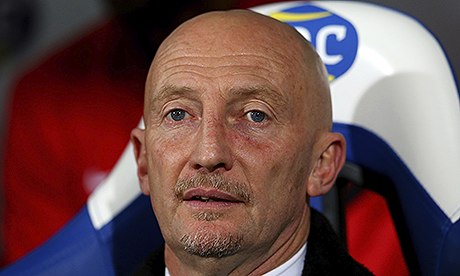
Ian Holloway: Don't you think he looks tired?

“Six little words that could bring down a government … don’t you think she looks tired?”

Those words and a couple of questionable decisions ousted the fictional Harriet Jones from the Prime Ministership of Great Britain.  So powerful is one’s appearance that all it takes is speculative criticism and fading appearance to lose a grip on authority.

In related news, everyone’s favourite jumble-a-quote man Ian Holloway has left Crystal Palace by mutual consent after winning only one of his team’s eight Premier League games so far this season.  Former Bristol City manager Keith Millen will take over as interim boss as the club investigates possible new blood; names mentioned so far have included former Stoke City manager Tony Pulis, a re-hired Neil Warnock and Western Sydney Wanderers manager Tony Popovic.

This may genuinely be one of those rare situations in football where the term mutual consent isn’t simply a kinder synonym for sacked.  A man whose straightforward nature and Worzel-type accent sometimes drew attention away from a keen football mind, Holloway was visibly exhausted only three months into the season and as he failed to balance a squad that boasted plenty of players but only a few of even an average level.  His flowing, offensive tactics have plenty of merit in the Championship but have now failed twice to transport to Premier League standard.

The travails of managing a club unprepared for life at the top level were apparent on his usually smiling features.  Recent pictures – including this one, usually a bog-standard "manager shot" – show a defeated man, albeit one who hadn’t yet surrendered.  When even the involuntary parts of body language betray a manager so quickly, doubts build about his ability to make effective decisions; as the stress increased, it became increasingly apparent that Ian Holloway’s future lay away from Selhurst Park.

Friday, August 10, 2012

Some regeneration advice for Chelsea from Doctor Who

Patrick Troughton as Doctor Who
Courtesy: bandbent.wordpress.com
“Life depends on change, renewal”.

These were some of the first words spoken by the second Doctor Who, all the way back in 1966. They were needed because the original actor who played the Doctor, William Hartnell, had left the series and moved on to a retirement home for the terminally crotchety; he was replaced by a younger, fitter, happier – at least initially – actor, Patrick Troughton.

The character of The Doctor, from the eponymous series – starting again in only a matter of weeks – has (mostly) enjoyed a fifty year television existence because when Hartnell's illnesses became too great for the program, they simply subbed in another actor and wrote it into the plot. The Doctor's appearance and mannerisms changed markedly, but his innate character of fairness, equality and just being generally good has remained through eleven actors and half a century. The invention of “regeneration” was so simple and elegant that it allowed a successful program to embrace, and therefore survive, radical change.

This same sort of regeneration is currently in process in West London at Chelsea. Over the summer the Blues cornered the market in tricksy, creative types as they acquired starlets Oscar, Marko Marin and the Hazard brothers, Eden and Thorgan. When combined with last season's best buys, Gary Cahill and Juan Mata, the Blues have replaced their cantankerous old stagers with much more watchable stars.

This is a regeneration with leaguewide implications. The Blues still boasts five of the six most important aspects of the successful last decade – their names are Abramovich, Terry, Lampard, Cole and Cech. Only Drogba has departed. The character of this team doesn't so much depends on this quintet but is actually entirely derived from them: they have the strongest personalities and are the best leaders, the rest of the team will follow or be damned.

Because of this, no matter how important Mata or Hazard become, and despite the obvious cosmetic changes, Chelsea's performance in 2012-13 will revolve around its more venerable elements.

Let's harken back to Who for a moment. Acclimatising to a new Doctor usually took a couple of episodes simply because the characterisation varied so greatly between actors; a new boy was finally accepted as The Doctor (capital T, capital D) after claiming the role with a great performance in a strong story. The same applies at Stamford Bridge. The sheds belong unquestionably to Terry because of his “Mr. Chelsea” aura, his past performances and the memories of success. This has a twofold effect – it promotes team pride but it's hard to argue that it also doesn't lend itself to embracing necessary change. The reinvigoration won't be complete until an alpha dog emerges from this new batch.

For the Blues to walk, rather than reel, into the future, the old salts have to lead by example one last time and embrace regeneration not just of the playing squad, but of the team's leadership group.

Chelsea won't change definitively unless one of Eden Hazard, Fernando Torres, Daniel Sturridge or Mata takes over. While his performances last year justify him the title, Mata's personality may be too mild-mannered to wrest control of the team. With Torres' funk stretching back to the Tennant era, this almost automatically leaves the confident Hazard the best candidate.

The regeneration of body has all but taken. Now the same must occur at the head.

Tuesday, January 24, 2012

Here's something we prepared earlier: Brad Haddin - The Schizoid Man

Originally published on the Sight Screen, on Sunday 22nd January.


It’s not really surprising, given he’s been Australia’s first choice wicketkeeper in all formats of the game for nearly five years now.  “Victorian” Matthew Wade, (rather than Tasmanian Tim Paine) now looms largest in his rear view mirror, and Haddin has admitted to feelings of stress and overwork.  Media scrutiny can’t have helped these feelings of exhaustion as in Australian batting and fielding teams that have been uniformly inconsistent he is now considered a weak link.

If truth be told, on form alone Brad Haddin doesn’t deserve to stay in the Australian team.  He has been blessed with exquisite timing (a century against England in the first Ashes Test last year, coupled with potentially career-ending finger injuries to Paine) and more batting talent than any of his nearest rivals.

Creative commons
However, he and Shaun Marsh seem to be the only Australians not to benefit from Micky Arthur’s ascension to the role of national coach.  He started promisingly, with a very watchful 20-odd in the first innings at Melbourne, but followed this with scores of 6, 0 and most recently a second-ball duck in the Big Bash.  He seems torn between the new responsible batsmanship apparently favoured by his countrymen and the voices in his head that tell him to just get out there and smack the ball. 

Sometimes we talk of men out of their time; it appears Haddin was born five years too late.  A decade ago, he would have been the perfect late-order hitter for Australia.  Now, he has become the most obvious and awkward symptom of a worldwide cricketing malaise, where patience is something played on the computer.  His keeping has suffered and his batting stinks of a man in two minds.  Arguing with another person can be tiring, but constantly debating with oneself amidst a climate of fear can be utterly soul-destroying.  It’s little wonder he’s exhausted.

Sometimes talent isn’t enough.  Now more than ever, teams are conscious of how well a player fits into their side – talented players now often make way for lesser mortals in the name of “team balance”.   Comparing the batsmanship of Australia’s keeping options (Haddin with a First Class average of 39, Wade with 40), results pretty much in a wash – except Haddin is a match winner/loser, while Wade contributes reliably but in a less game-changing vein. 

When contrasting their work behind the stumps, no matter how good each usually is, one must plump for the Victorian simply because of his incumbent rival’s absolute lack of form (and footwork).  It is said of footballers that when their “legs go”, their career becomes instantly unrecoverable.  With the exception of leaden-footed dervish Chris Gayle, the same is true of batsmen and keepers: Haddin’s footwork is nearly a decade past it’s use-by date.

However, the middle of a tour is an inopportune time to replace such a significant figure.  Haddin’s status as vice-captain also presumes to his position’s safety.  But the next Australian series – in the West Indies – should be the time in which John Inverarity and his brethren throw name both in the touring party.  By then, Shane Watson may have returned to the lineup and Haddin’s leadership credentials won’t have quite the same pull; his form alone will testify in his defence.

Both Wade and Haddin are supremely talented individuals, and for the moment, selection simply comes down to a matter of taste.  Does one favour matchless eye or preferable technique?  Proven matchwinner or runs in the (First Class) bank?  Haddin could save his career with a century at one of his favoured roads pitches in Adelaide; but admissions of fatigue are usually signs of severe trouble

Monday, August 22, 2011

Mourinho's greatest failing a lack of discipline - but not from him

Jose Mourinho has many gifts. For organisation, for having team buy into a philosophy, for quick quips and irritation. It's perhaps fitting that a master of hyperbole has been pilloried by the more rampant sensationalists in the British media concerning his antics during and after the Spanish Supercup.

courtesy: topnews.in
As the four Clasicos in seventeen days last season proved, these teams have no love for each other - on or off the pitch. After their loss in the Champions' League Semi-Final in (April/May), Mourinho made statements which, if he had his time again, would probably re-consider. Barcelona thought about legal action, but opted against it.

After a horrendous tackle by Marcelo on Barcelona new boy Cesc Fabregas, benches cleared. Mourinho is now under scrutiny for an incident involving Barcelona assistant Tito Villanova (bear in mind this analysis does come from the Daily Mail, well known for sensationalism). The Sun - also known for siutational amplification - also suggested Mourinho is approaching Real's tolerance threshold. Even the more moderate Daily Telegraph and The Independent questioned The Special One's tenure at the Bernabeu.

Comments branding Barcelona "a small team" didn't help and, alongside his paranoiac mania following their Champions' League exit, contribute to an image of a man either on the edge or who plays mind games at a black belt level. His comments more and more mimic those of dictators - strong, usually charismatic leaders with a firm grasp on a tiny part of the world - but from the outside viewed as small-time.

courtesy: tardis.wikia.com
More accurately, his words resemble Davros' - "Once more my Daleks will rule the universe.  Once more they will become the Su-preeeeeme Beeeeinnnngggs!".  If only it wasn't for that pesky Doctor Messi/Xavi/Iniesta.

In today's Guardian, a spokesman for Los Merengues' manager says his role in the stoush was "defending Real Madrid's interests". The Independent - and Paul Hayward - have asked if Jose is still worth his antics. When each match between the two best teams in football descends into a melee, it is a fair question.

Even Real Madrid, a club not known for patience and lenience with their managers, would be rash to fire the man who has transformed them from also-rans into an outfit who will challenge Barcelona. The side has apparently improved markedly over the offseason, fuelled by more spending (Fabio Coentrao and Nuri Sahin) and another year's acclimation to Mourinho's tactics. In the match in question, most observers had them slightly edging the match until defeated by a typically classy Messi goal.

Jose may feel pressure to succeed and consequently just be acting out more. This is unlikely given his past posts and the high expectations he must have shouldered there. He may feel the mindset of his squad is so fragile it can't bear a defeat to Barcelona without attendant, media-diverting controversy. Maybe his ego has become so large that he's lost some perspective. Any increase in his antics is due to a combination of all three factors.

It would be folly to ignore the lack of discipline and leadership Jose Mourinho has received from the Real Madrid front office. Perhaps more than anything else, this has empowered Mourinho to say and do what he likes. Given his results so far, it would be wrong if he were made to fear for his job. But he should be made to respect discipline - UEFA's, La Liga's or from Perez himself.

Since his Chelsea days at least, Mourinho's modus operandi has been to instill a siege mentality about his players, defending them from media scrutiny and removing any pressure from his boys by deflecting or absorbing it himself. By doing so, he's produced remarkably successful units at Porto, Chelsea, Inter Milan and now Real. At the Bernabeu, however, once former General Manager and blatant Jose-antagonist Jorge Valdano was removed, he's received only minimal leadership from the front office. He has not been censured for his actions, some of which should have desperately deserved it.

Indeed by removing Valdano, Mourinho's only internal source of dissent, Real President Florentino Perez has actually served as an enabler. Corporate, family or political leadership - real leadership - comes not from money, but from making tough decisions. In this, Florentino Perez has failed as Real Madrid President. While Jose Mourinho is mandated to bring success to Real Madrid on the pitch, it is Perez's responsibility to make sure he does so in a manner worthy of his institution.

To draw parallels from politics, were Perez the head of a government and failed to adequately discipline a general he would risk his own career. In a non-entertainment business role - well, just look at what happened at the News of the World. When people whose job it is to get results don't get guidance from above their practices can slip into the unorthodox, unpleasant and sometimes the illegal.

Jose Mourinho hasn't done anything illegal during his status at Real. What he has done, though, is get (some) results and inflame an already-heated rivalry by being boorish. If Florentino Perez is happy to make that tradeoff, theirs shall be a match made in heaven. The only alternative is for Perez to man up and act like the leader his position says he should be.

Friday, September 10, 2010

The Very Powerful and the Very Stupid


“The very powerful and the very stupid have one thing in common – instead of altering their views to fit the facts, they alter the facts to fit their views. Which can be very uncomfortable if you happen to be one of the facts which needs altering”.

Doctor Who, played by Tom Baker in “The Face of Evil” (1977)


Mohammed Asif's reported request for asylum in England throws the role of players allegedly involved in spot-fixing into stark contrast. Gone are the callow days of cricket, farewell to “innocent until proven guilty”. No doubt Asif's suddenly found himself in more trouble than he could have ever imagined but an plea for safety of this sort really gives one an idea of what trouble these potentially misguided and undoubtedly unfortunate men will face at home.

When the safety of players is threatened due to on-field performance – or lack thereof – the first name mentioned is usually AndrĂ©s Escobar, the Colombian who was shot dead in 1994 after his own goal at the FIFA World Cup. It is thought that his own goal was the catalyst for heavy gambling losses sustained by drug warlords who then took their revenge on the Atletico National defender. Hansie Cronje was also subjected to death threats as a result of his role in the “tempted by Satan” affair of 2000 while mystery still surrounds the 2007 death of Bob Woolmer at the ICC World Cup. That Woolmer, the retiring coach of Pakistan, was to publish a tell-all memoir detailing gambling's arm-in-arm relationship with Pakistani cricket can hardly have eased suspicions of a gambling-driven murder.

That our athletes are subjected to such stresses makes me very, very sad. There's no question that each person seduced by gamblers, be it for information, point shaving/spot fixing or match fixing deserves to be punished to the full extent of the laws for that sport. If that's a flat ban, then so be it. Should the laws dictate fines and suspensions, then apply them to the fullest. But the laws need to be enforced by the police and the governing bodies and not by individuals. Taking one's frustration out on a person who's wronged you rarely helps a situation and tends only to complicate matters – but sporting pride or indeed national pride engenders such fierce parochialism that it becomes impossible to talk with a devotee in rational terms. A case of “white line fever” can develop remarkably quickly into the more serious “white line foaming at the mouth” and finally result in “white line dead-on-arrival”.

No doubt Mohammed Asif fears for his safety. He lives in a country in which disease, death and destruction are commonplace yet has risen to become one of the world's best fast bowlers and he's done this amidst violence on a scale that most of us could only have nightmares about. If he fears for his safety, you can be sure he has ample reason. To take money from gamblers means that you are always in their pocket – they can always approach you again, and if you ever refuse the option forever remains for them to “out” you. Or “off” you. And if exposed, you risk the scorn (at best) and the vengeful ire (at worst) of your country's sporting faithful. So no matter what your economic situation, to take money from these people is naive at best, clinically stupid at worst.

As the good Doctor tells us in the opening quote, the very stupid may think that gambler's money is just easy cash and this obviously is not the case. A fool isn't necessarily someone who doesn't see risk – that simply makes them unfortunate or unintelligent – a fool is someone who justifies that risk as worthwhile. And the very powerful will always have that power. Like any good gambler, the powerful ensure they hold all the cards before being dealt in. If only we could say the same for the very stupid.