Showing posts with label obituary. Show all posts

Sunday, December 30, 2012

Obituary: Remembering Tony Greig

Few players have impacted the worldwide direction of cricket.  Or, to put it another way, while many cricketers turn a game by dint of skill or attitude, precious few shape cricket's big picture. 

For all his talent, memories of the great Sachin Tendulkar will highlight his nonpareil ability with the willow.  However, the One Day revolution occurred during his peak and he did not compel it, but merely embraced theis new style of batsmanship.  This revolution was authored primarily by a tiny, almost forgotten wicketkeeper from a sleepy island and his tactically aggressive captain.

In contrast, Anthony William Greig was a man who changed the way we regard the game –a South African who wanted to play Test cricket during the apartheid years and did so.  Then, he led England and finally took on the role as perhaps the first truly modern professional cricket player in the world.   

Tony Greig was the ultimate pragmatist.

Pragmatism requires clarity of vision and of thought: it is a process of identifying problems and solving them simply and brutally.  With Greig, this manifested in his combative and versatile approach to the game.  This attitude saw him graduate from Western Province to Sussex, England and then the captaincy of his (first) adopted country.

Another of the traits of the results-focused is strength of will.  Hewas the first to challenge Lillee and Thomson during their Ashes campaign of 1974-75; two years later, his grit – and big ton at Kolkata – and subsequently led the first victorious MCC squad to India since his hero, Douglas Jardine.  His leadership style was so obviously influenced by Jardine’s that he may as well have worn the Harlequin cap: calculating and yet noble as defined by his own distinct moral code.

His captaincy was astute and forthright.  He deployed a thirtysomething David Steele at the top of the order and coaxed Boycott from his self-imposed exile, while focusing England first on making England  difficult to beat.  His final act as a recognised player was signing with Packer and World Series Cricket, a significant coup for the nascent league.  Leaving the establishment for the betterment of cricket players' collective financial future and serving as Packer's chief overseas recruiter made him a cricket figure of the utmost importance.

The utilitarian is always questioned both aesthetically and morally.  Greig’s reasons weren’t necessarily always the most wholesome – let’s not beat about that fact – but he bore the ultimate mark of the pragmatist: coming out on top more often than not.  Tony Greig made effective decisions that led to his benefit and that of others – and what more could one ask from a leader?

Greig did not go quietly into the night.  Six months – almost to the day – before his death, he delivered a stirring – if controversial – Cowdrey Lecture on the Spirit of Cricket.  In the eyes of some, he implored India to take spiritual leadership of a game it practically leases to the rest of the world; others saw his presentation as further patriarchalism from a constant critic.

It would hardly have been Tony Greig if he didn’t address issues directly.

He will be remembered.  He will be missed.

Tuesday, June 5, 2012

Obituary: Remembering Charlie Sutton

Image: Wikimedia commons
Charlie Sutton, the only man to coach the Western Bulldogs – née Footscray – to an AFL Premiership, has died at the age of 88. A man whose life exemplified pride in club and origin, he was born during the last of Footscray's successful VFA years before entering the VFL. Recruited to the Dogs from Spotswood Citizens, he embodied local and club spirit for seven decades, captaining, coaching and leading the boardroom as the club struggled first to emerge, and then to survive.

He earned renown as an uncompromising, iron-fisted back pocket. In an era where almost everyone ran in straight lines, regardless of human obstacle, Sutton's compact stature and ruthless attitude made him feared. He was the epitome of the back-pocket plumber, with no airs, graces or teeth.

Concentrating solely on his powerlifter physique and inexorable approach is to see only half the player. While his attitude and size defined his playing style, it didn't dictate his skill, which was formidable; when representing Victorian, he formed with Bernie Smith perhaps the greatest back-pocket duo the game has seen.

It was when he took over as coach that Footscray's story changed. His leadership and a bright bunch of recruits – Jack Collins, Brownlow medallist Peter Box and, crucially, Ted Whitten – brought the Dogs their sole Grand Final win of 1954. He taught toughness, responsibility and vim – traits with which the fans could identify. In winning the flag, the Dogs defeated powerhouses Geelong and the formidable Norm Smith-coached Melbourne, who were to win of 5 of the next 6 Premierships.

In a familiar story, it's probable that Sutton was replaced as coach for financial reasons. One of two transcendent stars in an amateur league, Whitten would be offered more financial and career opportunities outside Melbourne than the Bulldogs could provide for him as just a player. Serving as captain-coach doubled a player's match payment; the appeal to Whitten would have been obvious. No matter: Charlie would later serve as club President, omnipresent and omniscient to all matters Footscray.

Sutton coached the Dogs for three years after the flag to be succeeded by his protégé, the player he thought the best ever. Whitten is popularly considered the prototypical Bulldog, a boy who grew up in the shadows of the Western Oval and joined, then led, the only club he ever could. In doing so, he created a lineage that begat champions Doug Hawkins, Rohan Smith and Brad Johnson. While it's most public face, Whitten wasn't the progenitor of this dynasty, but Sutton.

Had it not been for Charlie Sutton, Whitten may have retired at age 21; if not for Charlie Sutton, EJ almost certainly wouldn't have grown into the man – the icon – he became. Charlie was tough, but honest and caring. E.J. Whitten was just a bigger, more athletic – and perhaps more eloquent – version.

Sutton was amongst the first inductees to the AFL Hall of Fame; and when in 2010 the Bulldogs created their own Asgaard, the first two honoured were Whitten and Sutton, inseparable again. No consideration was given to any others, nor should there have been. Their ground is named after one, while their best player each year receives a medal named for the other.

Charlie and Ted, forever Footscray Bulldogs 1 and 1A.

Perhaps Charlie Sutton is best defined by that 1954 Premiership cup. In 2008, the Bulldogs finished third on the back of great seasons from Adam Cooney and Johnson. Before the finals began coach Rodney Eade called a late-night team meeting in the depths of the MCG. When the meeting concluded, the players were led onto the surface to see a gnomelike figure in the centre, illuminated by the lights. It was Sutton, holding the 1954 cup. At age 84, he inspired half a group of cynical footballers to tears.

Charlie Sutton began the legacy of Bulldog champions who were men of the people. Players, and characters, to whom sons of the West could relate. No-one had a bad word to say about Sutton; the same applies to Whitten, Dempsey, Grant, Hawkins and Johnson. That in itself is a remarkable achievement. He will be remembered; he will be missed.

Thursday, May 19, 2011

Tuesday, May 17, 2011

Obituary: Remembering Bobby Davis

Today the tributes flow for Bob Davis, "The Geelong Flyer", as well they should. Davis passed away yesterday at the age of 82. With it, he leaves behind a legacy as Geelong's favourite son.


The reason Bob Davis is so fondly remembered isn't his footballing ability, though he had loads. Neither is it his coaching, which delivered in 1963 Corio Bay's last flag for the twentieth century. It wasn't World of Sport, "Fair Dinkum Unbelievable", League Teams or the Three Wise Monkeys. It was his lifetime love for Geelong Football Club. Bobby was the essence of a one-club man, totally aware of the incredible gift the Cats were to the city of Greater Geelong.

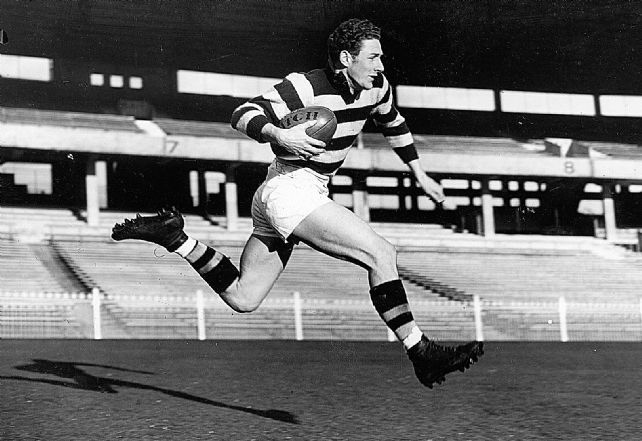
It would be unfair to gloss over his influential play and coaching. As a half-forward flanker, his athleticism was unparalleled and he boasted a devastating long kick. He represented his state with flair and distinction. Any rumours suggesting the Cat teams of those years weren't tough are completely unfounded - no-one won in that era without being hard. He captained, coached - starting at 26 - and won a Best & Fairest award before calling time on a 189-game career. Perhaps the greatest compliment paid to him is that the iconic image of him, in full stream with football tucked under arm, is one of the defining images of that era of Aussie Rules.


There's a pleasing symmetry in that during his coaching period US President John F. Kennedy declared "Ask not what your country can do for you, but what you can do for your country", because that was Bob's attitude to the Kardinia Park faithful. After taking over the reins as Geelong coach, he brought Polly Farmer to Geelong and used Polly's unique skill-set to kickstart a running game which echoed back to Hickey's slick, speedy 1951-52-53 unit; teams in which Bob Davis was a key member.


Bob Davis defined Geelong Football Club for over sixty years. During that time, he was an entertainer both on and off the oval. Alongside Jack Dyer and Lou Richards in League Teams, Davis had access to almost every home in Victoria in a format-defining show which with the modern proliferation of media sources will never again be replicated. His - and his comrades' - impact on football commentary shows should make (Davis protégé) Sam Newman, Eddie McGuire and the Cats' next best born entertainer, Billy Brownless, offer up daily prayers of thanks. There was no laddish behaviour or uncouthness, only three blokes having fun talking about football.


Throughout almost his entire adult life, Bobby was the first source for comment on all matters Geelong: from the brawl with Hawthorn in 1985 to near-bankruptcy in the early 2000s and finally, memorably, awarding Tom Harley the 2009 Premiership Cup and celebrating with "the boys". He was conscious of the blessing the win would be not only to the players, coaches and administrators of Geelong Football Club but also the boon it would prove to the entire region. The city of Geelong, the AFL community and a lot of Victoria will mourn his passing.


Bob Davis, dead at eighty-two. He will be remembered. He will be missed.

Image courtesy: geelongadvertiser.com.au

For The Age's photo gallery honouring Bobby Davis, click here.