Monday, November 14, 2011

The South African conspiracy

by Ben Roberts

I may have been reading too many Tom Clancy military/espionage thrillers but it struck me as I was walking Zoe the dog on an overcast yet humid Melbourne Sunday morning. I was grappling with an over active mind desperately trying to come to terms with the collapse of the Australian team in Cape Town. My focus has been limited in its direction of anger. Tired of simply shaking my head at the immature Phillip Hughes' selection, my anger more justifiably has been directed at the elder Brad Haddin, who is having more and more 'seniors moments', breaking only momentarily to lament the 'man crush' Australian cricket seems to have with the hopelessly inconsistent Mitchell Johnson.

But then as I waited patiently for Zoe to investigate for the 75th time in five minutes that potentially another dog exists in this universe I realised how hopelessly misdirected the Australian cricket team has been in its focus for too long. Sun Tzu in 'The Art of War' teaches that as part of a successful campaign you must 'know your enemy', I submit that for at least 40 years (maybe more) Australian cricket has not, and thus stands little chance of ever winning its war with the cricketing world.

Two fallacies seem to intertwine here. Firstly we continue to focus our attention on the cyclical Ashes campaigns that pit our warriors against the 'Old Enemy' in England. Nothing is more important we tell ourselves than beating our old colonial masters at their own game. Secondly we live in the 'knowledge' that South Africans are 'chokers' and will never land the final punch. But in reality I believe England are not the enemy, and more often than not a nation labelled as 'chokers' has landed the punches that have weakened Australian cricket most, albeit surreptitiously.

Australia exited Sri Lanka in hope. A new captain, a new support regime coming, and a number of players with smiles on their faces just happy to be playing cricket. This continued at least for a day into the test at Cape Town, but as we know came crashing down in even more embarrassing fashion.

Of course the rubber finally hit the road for Australian cricket when they lost in such embarrassing circumstances to the English at home last summer. This was it, the lowest we could fall, but in reality was it the English or South Africans in disguise? It was no secret that Messrs Strauss, Trott, Prior, and Pieterson with a host of non-first team selections were born (and in some instances reach adulthood) in the nation of the rainbow flag. Australia's media tried in vain to create a flap about it, but in these days of the dollar being mightier than loyalty, and that it has been going on for years, there was little justification. But regardless of the legitimacy of playing rights, these men all emanated from South Africa, and drank the water over there.

Take yourself back then to early 1994 when the Australian team visited the post-apartheid nation for the first time in 35 years. We knew that our latest superstar was a bit of a lout and taken to streaks of arrogance, but we only for the first time realised that he was capable of such abuse towards a harmless opponent. Daryll Cullinan had (and still has) a mouth on him, but Andrew Hudson was as quiet as a church mouse as a player, yet somehow Warne decided that both players needed the rough side of his tongue. Our lionhearted gentle giant in Mervyn Hughes was taken to acts of abuse on the field toward opponents, yet at the Wanderers ground his anger spilled over into the player's race. A visit to South Africa brought out the worst of these two cricketers.

Only a few months previously at the Sydney Cricket Ground had South Africa so easily taken the career of Damien Martyn away. Despite the failings of the entire batting lineup it was he who took the blame and had his career stamped with being impetuous, almost leading to its death.

In 1992 Australia hosted the World Cup as incumbent champions. In 1987 they had been the upstarts who had toppled the best in the world and created momentum that saw them rise to competitiveness again in world cricket. This World Cup would be where Australia continued that progression, in front of its own adoring fans, but it was not to be. South Africa was one of the obstacles that Australia failed to clear in its demise, losing by nine wickets and having their own former import in Kepler Wessels take man of the match over the nation for which began his international career.

The last time Australian cricket was close to being as bad as it is now was of course the mid 1980s. Allan Border was grumpy, Dean Jones and Steve Waugh inconsistent, and Kim Hughes was bawling his eyes out. While not laden with anywhere near the talent to defeat the mighty West Indian teams they should not have been that bad. Why were they? Well Dr Ali Bachar and his open cheque book for rebellious play in the sporting pariah state probably has more than its fair share of blame. Heart and spine ripped out of the nations playing stocks the Australians lost in a test series to New Zealand; need description go further?

Prior to the period of outcasting from all international sport that South Africa went through they were able to take the bragging rights from Australia with one of the most dominant performances in test cricket history. Completely exhausted from proceedings in India the Australians flew into South Africa to receive one hell of a battering at the hands of Graeme Pollock, Peter Pollock, Barry Richards, and Michael Proctor, all cricketers whom, in one of the games greatest tragedies, had only limited international exposure. To lose all four tests comprehensively pushed Australia to the brink of sacking its captain Bill Lawry; the next series against Illingworth's England only needed to nudge for them to be over.

Sibling rivalry exists between Australia and South Africa. Both former colonial conquest trying to shake off the stamp of their former masters with one officially having shaken it with much bloodshed, the other remaining loyal and protected. Both nations with a history darker than one would desire but only one having felt the collective and polarised wrath of the wider world. South Africa as a proud nation has much to gain through success over Australia on the sporting field. While we fiddle with our clashes with England, the true 'Rome' will continue to burn.

Patrick Cummins is the future - Or not.

Patrick Cummins is the future.

No, hang on, maybe he's not. It's Josh Hazelwood. Tall, quick, can get it to wobble about a bit. Yes, definitely Josh Hazelwood.

Or perhaps it's James Pattinson. You know, English Darren's brother. Surely he's going to lead the Australian attack into the next decade, he's already played in the coloured clothing for us. I've changed my mind, we should embrace him as our spearhead.

But then where does that leave Peter George? And Mitch Starc? Or Nathan Coulter-Nile, Jayde Herrick, Trent Copeland and Burt Cockley?

Australia has a surfeit of youthful fast bowling talent at present. Not just young fast bowlers, but - on current evidence - good ones. This is a source of much-needed encouragement given recent events in the Baggy Green as defeats to pretty much everyone again conjure memories of all the West Indies lost in their regression from behemoth to basket-case.

Cricket in Australia is far from being completely turned around - in fact, it still may not even be going in the right direction. But CA's done everything it can - commissioning a report to put down in ink what any observer already knew. And the country has raw fast bowling talent to choose from - and it is that which is most crucial to a successful cricket side. The oldest of the fast bowlers named above are 25-year olds Copeland and Herrick.

Why so excited? Every successful postwar cricket team has had pace firepower in abundance. The Invincibles steamed through England behind Lindwall, Miller and Johnston; England of the fifties unleashed Statham, Trueman, Bedser and "Typhoon" Tyson; the West Indies speed vanguard often left their batsmen with little to do and Australia's dominant decades came as a result of the toil of Lillee, Thomson, McGrath and Gillespie.

Fast bowling talent wins games, not bowlers who send it down fast. And there's a difference between the two: Patrick Patterson was outrageously quick, had one of the great intimidatory attitudes, won a few of games for Jamaica and the West Indies, but never amounted to much. The same could be said for Brett Lee - you always felt he should have been better than he was.

There hasn't been this many exciting young Skippy flingers since the mid-eighties where from 1985-1988, Merv Hughes, Craig McDermott, Tony Dodemaide, Chris Matthews (!), Bruce Reid and Dave Gilbert were all young and clamoured for Test selection.

Both the West Indies and Australia have eloquently proved that when fast bowling talent makes way for people who bowl fast (*cough* Mitchell Johnson *cough*), teams quickly begin to lose matches. Most importantly, Pace talent means time not batting is spent attacking a position, rather than defending one. A quality pace platoon also excites onlookers and relieves pressure on their run-scorers. On a broader scale, it also infinitely strengthens batting on a national scale and means Moises Henriques will never play for Australia again.

England's transformation from also-ran to world champion came on the back of talented fast bowlers the ilk of Flintoff, Simon Jones, Bresnan, Finn, Tremlett and Anderson: each is/was able to combine discipline and an ability to make the ball "talk" with swing, seam or bounce. With a combination of some of the talent above, Aussie fans hope the same will happen in the Antipodes.

Australian punters (no, not that one) are excited about nascent fast bowling talent because since that fateful Sydney Test of 2007, the country's bowlers have lacked a leader. The plan was for Stuart Clark to hand over to "Notch" Johnson and Ben Hilfenhaus, which worked about as effectively as a a K-Tel nostril hair trimmer. The hierarchy hopes for a leader to whom they can turn when in trouble: a guy who gets the ball in the right spots to either restrict runs or take wickets.

Any of the current tyros may, in time, be that guy. But to expect Cummins - or anyone else, for that matter - to be a sort of proto-Mohammed Amir is unreasonable, unrealistic and more likely to produce a Lee than a McGrath.

The central board must keep two simple, everyday truths in mind: You almost never find what you're looking for until you stop searching and anointing young, unproven leaders rarely works. This is why Cummins, Copeland, Hazelwood or Pattinson shouldn't be anointed as the next leader of Australia's bowling attack until they have earned that position.

All of our past leaders have had to learn from experience: McDermott, while in his ostensible prime surrendered his Test berth to Dodemaide and Chris Matthews. McGrath emerged only after McDermott's injury - when absolutely noone saw it coming, least of all the West Indies lower order. The term "King-maker" is the epitome of a self-aggrandization, used only by the extraordinary vain and is based upon the flawed principal of anointing unproven "chosen ones" at an early age. Leaders emerge as circumstances allow.

More appropriately, leaders emerge when they conquer those circumstances. McDermott had to conquer immaturity and the stigma of being a ginger kid. Lillee overcame a crippling back injury - twice. Shane Warne fought an unlikely combination of playboy lifestyle and massive girth. McGrath had to rid himself of that horrible haircut.

It's possible, perhaps even likely, that Cummins, Hazelwood, Pattinson and Copeland will all be top-draw seamers. Especially, calling wunderkind Cummins a saviour and future leader is placing remarkable expectations on young, still-developing shoulders. Let him learn. Let him grow into his frame, his profession and international cricket.

This post was originally published on The Sight Screen.

Friday, November 11, 2011

Newcastle United: to survive or thrive?

Newcastle United has turned from second-tier basket case to Premier League overachiever in the space of two years. It is no doubt thanks to owner Mike Ashley, managers past and present (Chris Hughton and Alan Pardew) and perhaps most encouragingly, the skills and snout of chief scout Graham Carr.

Carr, the father of comic Alan Carr, has scoured France and allowed the club to bring in excellent players at cost-effective prices. The two key names secured upon return to the Premier League were Cheick Tiote and Hatem Ben-Arfa; they have since been joined by Sylvan Marveaux of Rennes and, perhaps most beneficially, France International midfielder Yohan Cabaye, late of Lille.

Courtesy: guardian.co.uk
While there are many Francophones now residing Tyneside, there's more than just that to the Newcastle French Connection. Newcastle's transfer dealings so imitated those of Ligue 1 club Lyon that Newcastle blogger Kris Heneage immortalized the link in this post two days ago. In it, he describes Lyon President Jean-Michel Aulas' planning behind a successful football club, business and pitch-wise.

The principles laid out are sound in theory, but would be difficult to implement in practice. But this isn't Ashley's - or Aulas' - problem, but that of their manager. The rules are business-smart and also give supporters consistency in expectation.  However, the points could doom a club into setting their own level, as if achievement is desirable, but merely a by-product.

Indeed, in many ways  - especially satisfying alleged "problem players" - Newcastle seem to have implemented these statutes more effectively than Olympique Lyonnais. The Toon Army sits in third place in the Premier League, but is still yet to play the Manchester twins, City and United, as well as Chelsea. It's probable that Tiote and Cabaye will have more illustrious suitors - Manchester United could maybe use them both - and the monies received for Andy Carroll make that deal look like a magnificent decision from the boardroom.

Does this platform work? As a league superpower - as Lyon are, but Newcastle aren't - unquestionably. It also helps if your city is a beautiful, luxuriant metropolis in the south of France. Can the same be said of the a chilly outpost in England's northeast?

It would stand to reason that every club obeys a subset of these rules. Every player, outside perhaps Lionel Messi, has his price. Cristiano Ronaldo's was 80 million pounds, Fernando Torres' about two-thirds of that. Sir Alex Ferguson could perhaps even get a bunch of rocks and $20 for Michael Carrick. Even when the money offered is silly; it would be idiotic to refuse it.

But basing a club's economy significantly on the sale of their best players - even when already possessing replacements - can make a club more fiscally secure in the short term, at least as long as the overall talent level is maintained.  Should the scouting fail or injuries hit - c.f. Wigan Athletic - the club could face an uphill battle to meet even modest expectation. From a mid-table side, the model also, however, fails to capture the imagination.  This inspiration is so important in sport, but now may become a thing of the past.  In many cases unbridled, fantastical hopes for one's team are now a thing for Football Manager games rather than reality.


Reducing a club's "achievement ceiling" means setting a level where they can expect to be consistent EPL performers barring unforeseen circumstances. This is what adept businesspeople do: control those circumstances under their control.  But if a club constantly loses their best talent, the best result they can expect is for a strong Cup run and top-ten finish.

Would supporters trade a good Cup run and, best-case, a Europa League campaign for the hopes that accompany retaining their best players?  Good question.  Certainly the pointy-heads in accounting would prefer this model; but fans' hopes are given an upper boundary - for better or worse.  Now re-born after a period in the Championship, NUFC supporters might be the best ones to answer this question: would they trade this new team of Cabaye, Marveaux, Tiote and Ben-Arfa for a golden age of Michael Owen, Mark Viduka and Alan Smith?  The full truth probably won't be evident until that time when (if?) these new Toon stars are enticed to pastures new.

Thursday, November 10, 2011

My Favourite Cricketer: Andy Bichel, by Nicko Hancock

In Balanced Sports' & World Cricket Watch's continuing series, we invite the best cricket writers and bloggers to explain what made certain cricketers their favourite.  For The Sledge's Nicko Hancock, that man is Andy Bichel - the best twelfth man in history.

I consider myself lucky to be born in 1989. It means that I grew up under the wing of some truly wonderful childhood influences: Fireman Sam, Postman Pat, and the Greg Blewett/Justin Langer opening combination.
As a kid, your choices are made for you by people who’ve lived more, who know better. When you’re a kid, still in an unfinished, malleable form, your elders impart wisdom and cliché and knowledge to you, like they’re branding a bull with the obvious. Quoth the schtick:

“Each day, the sun rises and sets.”
“The Earth isn’t flat.”
“Don’t drink orange juice after brushing your teeth.”
“Nice guys always finish last.”

I took this at face value, like a bank statement. But in the early 2000s, as I sprouted and spotted and haired, I learnt that sometimes nice guys don’t finish last.  They finish twelfth. Most of the time. And when they don’t, they typically bowl first change.

Such were the life and times of my teenage cricketing hero! And not ‘hero’ in the violent, sword-wielding way, although he could bruise a batsman; Steve Waugh wrote that my hero might have suffered in his career because of his generous and giving nature. He was a big, burly, blonde pace bowler from Queensland who played first class cricket for fifteen years.

To me, he was the Smiling Assassin, and to Adam Gilchrist, he was known simply as Midas. His name was Andy Bichel, and for reasons I’m sure you’ll soon understand, he is my favourite cricketer.

A Certain Level of Legitimacy
Writing about Mr. Bichel requires description buffered by wordplay: to see him play cricket, any of his nineteen tests or sixty-seven one day internationals, was to see a man whose body language and facial expressions betrayed everything about him, especially how badly he wanted to be there.

Andy Bichel bowled briskly. He batted stoically. He fielded with the intensity of a Labrador chasing a tennis ball, and he was always grinning, ear to ear, like a cat who has gotten away with it.

Finally! An international cricketer who was happy to be there. For whom "12th man" wasn't an insult. And he was the 12th man a lot, because, unluckily for him, he was the perfect twelfth man: valuable on multiple levels.
I don't know how many people took his presence on the team sheet as a comfort. I did.

Andy Bichel and Michael Bevan
Throughout the early naughties he could be seen carrying drinks, towels, and replacement gloves to the people who had been selected ahead of him. But he did it with a bounce in his step, his white teeth shown through a MacGyver grin. To me, it meant that he was somehow 'like me'; enthused and powered purely by the prospect of playing for Australia. It made me think of him as working-class, practically street-level, because you could see his enthusiasm for cricket written on his face, and as a teenager, I think I needed to see that from somebody who'd “made it”, who was out there, playing in the team that every Aussie kid wants to play in.

An outstanding state player for Queensland for fifteen years, he peaked as an international cricketer in the 2003 World Cup, outshining his more accomplished team mates in Glenn McGrath and Brett Lee. When Australia played England in the group stage, Bichel took 7/20 off his ten overs to limit England to 204, and when Australia's batsmen capitulated to 8/135 during their chase, Bichel was there to salvage the match with Michael Bevan, showing batting prowess that took most people by surprise.

And then, in the Super Six stage of the Cup, Australia slumped to 7/84 against New Zealand, before Bichel and Bevan again salvaged the innings. Bevan hit 56; Bichel top-scored with 64, then took 1/15 off five as 
Australia won a match they were losing for three quarters by 96 runs.

The team was behind him; Adam Gilchrist wrote that, "it didn't hurt that such a well-liked guy, who'd missed so many opportunities, was the one doing the damage."

Me? I was just happy he'd been picked. My hero. The bloke whom, during a wet test match against Zimbabwe, would slide into the crease using his pads as slides. The same guy who stood at third man at the MCG, his back turned to the crowd, leading them through his warm up.  He tapped his thigh; “we’re doing the gluts,” he called out.

I think people have forgotten how good he was. He made his ODI and test debuts in 1997, both in Australia, both against the West Indies. In the test match, he opened the bowling with Glenn McGrath in a game I didn’t see in which Michael Bevan took ten wickets. He was there at the centenary test, when Steve Waugh dressed up the Australian test team in replica caps and we thrashed England and I watched every day. And in 2003, he lead an Australian bowling attack minus McGrath, Lee, Gillespie, and instead containing Nathan Bracken, Brad Williams and Ian Harvey to the TVS Cup, against India, in India. In the final, he ripped out a vicious off cutter to remove Sachin Tendulkar, and I collected the newspaper clippings.

A year after his heroic sixteen wickets and 117 runs in the 2003 World Cup, he’d lost his Cricket Australia contact. Instead, he set his sights locally, and in the 2004-2005 Australian domestic season, he took a Queensland record sixty first class wickets in a year, and a twelve months later he was named Pura Cup Player of the Year, for his 452 runs at nearly 35 and his 50 wickets at 26 and, one assumes, for taking the last wicket in a final that Queensland won.

I always felt that Bichel had a certain level of legitimacy because to me he was a working-class hero who always looked like he was putting in as much as he had to offer; perhaps he'd just finished a day labouring on a construction site, and knocked off just in time to join the Australian team. I always got that impression of Bichel; it always seemed to me that he would have to make up time to his foreman.

And the stories of Bic are atypical of the man: being told he was 12th man for a test match and then helping Brett Lee work through some crucial kinks in his technique; standing up for Adam Gilchrist when South African crowds abused him with rumours his wife had been sleeping with Michael Slater; turning Darren Lehmann's $100 into two grand at a casino in the Northern Territory (?); tearing in at training with a smile on his face at every damn session; to quote Steve Waugh, "the guy was a dream team man with quality and character in abundance."

Breaking Both Ways

Athletes give us two things: firstly, the ability to believe in someone, to foster that unconditional confidence in their ability. The faith a Collingwood supporter has in Dane Swan: "He'll kick us clear. Swannie'll do it." Or an Essendon fan's faith that with James Hird as skipper everything would be fine. That mid-1990s belief in Steve Waugh: "She'll be right. Tugga's coming in at number five."

Secondly, sportsmen allow us to leave our nine-to-five lives behind for a spot of escapism. You get to live their highs and their lows. That's the most important part of the bargain.

Andy, to me, fit both of those qualities. When the Aussies lost quick wickets or were a shambles in the field I would never dare write them off until Bic had had his say. That was my faith in him. Andy Bichel, with his good-naturedness and his ceaseless work ethic, was to me a sign that those "good bloke" qualities, that I so wanted to embody myself, could lead to success. That was my outlet for escapism. I could never feel the same about Ricky Ponting, or Brian Lara, or Sachin Tendulkar because I did not have the almost effortless talent they had.

Forget Australia's next "star spinner" or "extraordinary number three"; I wonder who'll be the next Andy Bichel?

Watch every episode of The Sledge at The Sledge TV.

Wednesday, November 9, 2011

Why England can beat Spain

As the Iberians land on English shores, they bring with them a remarkable record. Since February 2007, la Furia Roja has played 71 matches for 62 wins, four draws and five losses; they score an average of 2.25 goals per game. That's an 87% win ratio. For some brief perspective, the all-powerful Barcelona side of 2010-11 won just under 74 percent of their matches.

Spain should have no reason to fear. But they find themselves matched against an opponent of whom they should be extremely mindful.

Why such anglocentric sentiments coming from a critic of both Fabio Capello and the English football hierarchy? It is encouraging for the men in white that the gaffer has called up a (relatively) youthful squad including first-timers Jack Rodwell and Daniel Sturridge. However, Three Lion optimism shouldn't come from any potential debutant but how the match suits England's ageing or faded stars.

The conditions both teams find themselves under generally sees England perform better than any other set. There are a minimum of expectation, a (relatively) understated buildup - for English football - and a self-inflicted crisis surrounding John Terry. Thursday's match should be appealing to partisan and neutrals alike because it gives those England players who have for so long disappointed the chance to perform on a high stage without pressure.

Aside from deserving trio Kyle Walker, Rodwell and Sturridge, Capello's most recent squad features staid, expected names: Lescott, Cole, Terry, Lampard, Rooney. It also includes speedy, tricksy wingers Adam Johnson and Theo Walcott and the (relatively) precise Stewart Downing. In comparing the squad there is a gap in quality between the players in the Spanish squad and those who will represent England but it is hardly a chasm. A larger gap, however, lies in the empowerment of those players and their ability to play as a team.

The psychological benefits of playing as vast underdogs on a big, hopeful stage should be enough to stir a performance out of players who have tempted us with occasional performances only to revert to type in later matches; guys like Frank Lampard, Glen Johnson and Walcott. If they are allowed to play with freedom, this game could be a years-delayed coming out party: (relatively) few have doubted English talent - just the application and heart thereof.

Tactically, wingers Sturridge, Walcott and Johnson could prove decisive as the Red Fury exhibit perhaps their greatest weakness against speed merchants on the flanks. Full backs Puyol, Monreal, Ramos and Alba all have obvious quality but, like most, are vulnerable to pace. Sturridge in particular should be a monty to start as his Stamford Bridge form continues to impress.
Spain v England, 2009: courtesy: myfootballfacts.com
It's in matches like this Thursday's that the Three Lions seem to do well: clashes where excitable expectation gives way to a pessimistic realism. Even though understatement and English football rarely go together, there has been a gathering mood of "blah" about recent Three Lions excursions as weary pundits refuse to be tempted into notable proclamations. This play into the hands of Capello and his men.

Don't be surprised if England defeat Spain on Thursday. They should have all the tools to do so - talent, vocal crowds and the perfect scenario to highlight the talents of underachieving stars. Spain are still favourites - 87.3 percent! - but the match is not the foregone conclusion many suggest.

Monday, November 7, 2011

International Rules series dying a slow death

After yet another International Rules series ended with a violence on field and scoreboard, we must now ask if the series has a future. The movement for it's abolition is gaining strength after a week which must have been painful for IR advocates like Ron Barassi.

While the games are undeniably similar, it's popular fallacy that Australian football evolved from Gaelic football. Both sports require remarkable endurance and skill. It seemed logical that games so isolated yet so similar should breed a hybrid competition; both sports feature "All-Ireland" or "All-Australian" teams, rewarding each sport's best players but don't give those elite a team to play against.

The International Rules series was founded to give GAA and AFL players the chance to represent their country in competitions which don't provide that opportunity. With over six years of violence - and multiple hiatuses - the GAA and AFL's so-called best don't deserve that opportunity any more.

As commentators noted during the most recent match on the Gold Coast, the series has become a farce. It no longer represents the best interests of Australia or Ireland. Those countries, both feisty at the best of times, don't need "representation" of this sort.

www.flickr.com/photos/jimmyharris/59309854/
From an Australian point of view, the International Rules series was aimed to give the best players in Australia the chance to represent their country. For over a decade now this has been a mockery as All-Australians make themselves unavailable for selection, either through press statement or ridiculous suspension.

How was the side that played the most recent matches in any way or shape inclusive of the best in the country? It was a team captained by Melbourne skipper Brad Green, who essentially inherited that position by being that club's most senior player. His year was hardly a model of leadership; his first year at the top will probably be best remembered for the side's 186-point roll-over at Geelong and the subsequent sacking of Dean Bailey. Alongside a frankly mediocre captain, would Matt Suckling, Easton Wood or Zac Smith make anyone's All-Australian ballots?

For the Australians, what was instituted as an opportunity for the elite has changed into a representative match devoid of honour. Playing to win is fine, and therefore sides should be picked accordingly. However, rewarding several of our league's most average talents is hardly high honour. Representing one's country should be the highest accolade a sport can bestow - indeed, it is the very (only?) reason for this series - and thus should go to the country's best. That the honour isn't wanted by the best, only signifies the lack of regard in which the competition is held.

It's also worth pointing out that those representing their country should do so with the nation's best interests at heart. A series aimed at building friendships with the potential to span continents should be played as such - highly competitive but in the spirit of the football "friendly". After last Friday's match, would any of the Irish and Australians settled down for a beer together?

For some reason, the games just seem to breed hate.

The game has become a disgrace to both codes: just watch for the number of cheap shots. With there being no apparent consequence for indiscretions other than yellow cards and IR suspensions, players are relatively free to infringe the law and spirit of the game. Should the series be played again, any suspensions for unsportsmanlike play should carry over to the next year's GAA or AFL competition and be adjudged by that league's disciplinary panel.

This may instill further club opposition towards the series and which may kill the sport. If clubs in either country don't sanction their players for unduly rough play, then the series as it stands doesn't deserve to survive.

The greatest single detractor for the game are ludicrous IR suspensions - like the one given to Matthew Scarlett - which ban players from further International games. The reputation of a nascent sport has been so brutally blackened by such legislative decisions, never mind those like Brendan Fevola's 2006 bar fight.

It's also damning that, as an ardent Aussie Rules supporter and someone who would like to see the International format succeed, there have been so few memorable moments from the series' twelve years. In truth, apart from the fights, only two stand out: Mick Malthouse trying without luck to get Dale Thomas to play defensively in 2008 and Nathan Buckley's "over" in 1999 to win the second match for Australia. And I'm not even a Collingwood fan. That the prevailing memories of a series with great potential is of fisticuffs speaks volumes.

Should the series return in 2012, there should be major changes. The competition once again should be aimed at the best players in the country, otherwise the accolade is meaningless. Secondly, and perhaps crucially, both sides should agree to appoint ambassadorial coaches and captains for their squads whose brief is to ensure the glorification of the game, rather than it's decline. For Australia, it seems Chris Judd and Kevin Sheedy would be perfect men for the task.

The series deserves one last chance. The Galahs of 1967 deserve to see their legacy survive. But to do so, it needs vastly revamped rules and citizenship. It isn't asking for much.

Friday, November 4, 2011

Rooney must play forward for United to succeed

Courtesy: Wikipedia Commons
Wayne Rooney's move into the midfield has won him plaudits. He played in a central role against Everton last Saturday and again in midweek when United hosted Romanian minnows Otelul Galati in the Champions League. It's no secret he is United's best player, comfortably leads the squad in "bastard factor", possesses the best creative skills of anyone on the team and, alongside the slowly-self-inflating Anderson, demonstrates easily the best passing range and accuracy.

Those same plaudits shouldn't be levied on Sir Alex Ferguson for deploying him in the middle of the park. Sir Alex, understandably, when faced with starting Michael Carrick and Darren Fletcher again as creative-in-name-only hubs, opted for the Scouser and the Brazilian in midfield, in hopes of kick-starting a faltering squad. Fletcher remains the team's best midfield negator - it must be galling for SAF to think that his second best option is his star striker.

In this, his twenty-fifth anniversary of taking control of England's most demonic football club, Sir Alex should have earned the right to experiment and the respect of both journalists and blogosphere to cut him some slack. But moving Rooney further back the pitch is robbing Peter to pay Paul in a very real - and ultimately self-defeating - sense. With Rooney shielding the defence from downpitch, there aren't the quality talented options forward of the ball able to capitalise on his industry and creative skills.

As a midfielder, he plays very good long balls to width players Nani, Ashley Young and Antonio Valencia only to see a forward corps of Berbatov, Owen (!) and Chicharito (for all his wonderful goalscoring prowess) haven't been able to take advantage of the right spaces. Both Berbatov and Hernandez are great "fox in the box" types and Berbatov's linkup play has been languidly fluid in the past, but he appears utterly shorn of confidence and guile. More poignantly, when Danny Welbeck returns, he is unlikely to combine well with Berbatov or Owen - the in-form England man's best hopes for a successful partnership rest on Rooney and the Little Pea.

As crazy as it would have sounded six weeks ago, Manchester United needs Wayne Rooney up front more than it does in midfield. Given a dearth of World Class mids, how is this the case? The answer lies in health: Tom Cleverley is still to return fully from injury, Darren Fletcher continues to recover from illness/injury/zombification and Ryan Giggs has featured as often as one would expect any other 38-year old to play. Last year, much of United's creativity came from the wing play of Nani and, when healthy, Valencia. It's time to entrust them - and new boy Young - with reinvigorating United's staid and stagnant offense.

Ferguson hasn't taken this decision lightly and he isn't channelling Claudio Ranieri. He's fully aware that best results are obtained when playing your best player in his best position, ie. where he can do the most damage. Perhaps the difficulty is in that still no-one knows what Wayne Rooney's best position is - including Wayne Rooney. It's unquestionably as a forward, but of what type? As target man, trequartista or playing closely off said target man? For United he is too often the locus of focus; for England he has played best working with bulkiers player like Emile Heskey. When allowed to do his thing, he plays spectacular football - and did so earlier this season in partnership with Welbeck.

No matter what reasons exist for the switch, this is likely to be a short-term move for England's best player. When the United squad regains full fitness, Ferguson may be able to pull his Rooney out of the dike. United's depth, so vaunted only weeks ago, remains untested and possibly even fragile at the highest levels. Manchester City gain breathing space with every steam-rolled scalp they collect. If year twenty-five is to bring about title thirteen, Rooney must play forward.

Thursday, November 3, 2011

My Favourite Cricketer: Justin Langer, by Sarah C Robinson

In continuing our series "My Favourite Cricketer", Sarah C Robinson of the excellent Slowly Learning the Offside Rule writes about Australia's most contradictory opener, Justin Langer.

As an England cricket fan, there is one rule: Thou shall not support an Aussie.

And so, this is my confession. I have sinned. My favourite cricketer is an Australian batsman. It is the often underappreciated Justin Langer.

For me, nothing summarises Langer’s career better than Telemachus Brown’s song ‘(Wrong About) Justin Langer’ in which a couple argue about his career. The singer says “All I argued was Langer wasn’t my favourite player... The way you looked at me like we were gonna end. It’s all my fault, it was my very own clanger. I’ll admit I was wrong about Justin Langer.”

It was the 2nd April 2006, and Justin Langer was playing in his 100th Test match. For a man who has always spoken about how much wearing the Baggy Green cap means to him, it was one of the greatest honours to have played for Australia that many times. His parents had flown from Perth to Johannesburg to watch.

A Ntini bouncer hit him on his right earpiece, and he immediately collapsed to the ground. He was led offthe pitch bleeding and taken to hospital. The injury was described as a ‘significant concussion’ and he was warned he should not take the field again, in case a ball hit his head a second time. Another blow could be life-threatening.

Langer was all too aware of the danger, and he himself knew he was in no condition to bat. He was vomiting, his head was throbbing and he had spent most of the game in his room.  Nevertheless, on the last day he dragged himself from his bed and headed to the Wanderers.

As Australian wickets tumbled in the second innings, captain Ricky Ponting suddenly became aware of the fact that he’d lost Langer. "I started looking for him, and found him with his whites on, and his pads, his arm guard, his helmet," Ponting said. "He was running laps in the change room, trying to convince himself that he was suddenly OK.” Ponting told Langer that he could not bat under any circumstances even if that meant Australia losing. Langer said the chance of him being hit on the head again was slim and that he would bat if needed.

In the end, Australia won by two wickets and Ponting never had to make the decision to end the match before Langer could take himself out to the field. Langer is convinced that he would have batted if needed. Ponting argues he would not have let him do it.

Courtesy: www.india-server.com
This story, more than any other, reminds me of the passion and determination Justin Langer has. He didn’t just want to play for his country. He was obsessed with playing for his country – and winning.

Justin Langer is often underappreciated. He played alongside some of the greatest players the world has seen, including Waugh and Warne, and he perhaps will never be remembered as a true great of the game. But his role in the side was vital. He was a stable figure at the top of the innings, not always the most aesthetically pleasing, but stubborn and determined nonetheless. He played in 105 Test matches for Australia at an average of 45.27 with twenty-three 100s and thirty 50s.

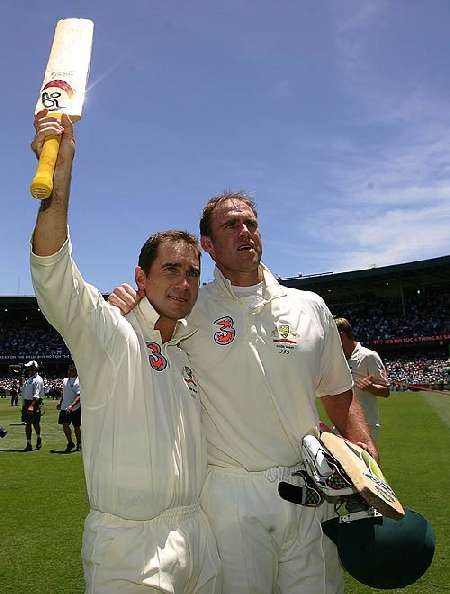
After making his Test debut, he only played eight Tests in six years. For some, this would be enough reason to give up on the dream of playing international cricket, but Langer battled through, batting consistently for Western Australia. He eventually formed the second best opening partnership in Test match history with Matthew Hayden, scoring 5,655 runs between them in 113 innings (second only to Gordon Greenidge and Desmond Haynes). 

From 2006-2009, he also played county cricket in England for Somerset, and gained the respect of his teammates and spectators alike. He captained the side for two years, and helped them to secure a place in the Twenty20 Champions League in 2009.

During this period, I had the honour of meeting him three times. On every occasion, he was generous with his time, likable and friendly. On the first occasion, after he had signed my scorecard, I asked him for a photograph. He obliged, but while signing some more autographs, he turned to me again and asked if I would like a second photograph, this time without him wearing his sunglasses. Somehow, I managed to say yes and so have two photos with him from that day. They always say you should never meet your heroes, but it was an absolute pleasure to meet him. If possible, I admired him even more.

Courtesy: The Age
Langer is a man of contradictions. He likes the quiet of meditation and yoga, and enjoys gardening. And yet he also has a passion for boxing and used to train with an ex-SAS soldier. His book Seeing the Sunrise, published in 2008, is one of the most inspiring books I have ever read. It is full of motivational stories from his playing career and a very fascinating read.

When he finally retired in 2007, after helping to win the Ashes 5-0, he was emotional. "The reason it's so hard is that I don't want to let it go,” he said. “I don't want to stop playing for Australia. It's emotional, I feel sad about it but I know in my heart it's the right thing to do. To me, it's not just a game. It's been the vehicle that I've learned how to handle success, how to handle criticism, how to handle failure, how to fight back from adversity. I've learned about mateship, I've learned about leadership - it's never been just a game for me.”

It is likely many people in Australia never thought Langer would make it as a consistent Test match player, and definitely not that he would play in over 100 Tests. As it turned out, his playing career is full of fantastic knocks and he proved to be a vital member of the Australian cricket team. He is one of the most determined cricketers to have played cricket. Representing his country was the ultimate accolade, and he worked as hard as he possibly could to achieve it.

Langer, to me, is more than just a cricketer. He is a reminder that you can achieve anything you want if you work really hard. Not only that, he is one of the nicest men involved in cricket.

I’m certain a lot of people admit that they were wrong about Justin Langer.

Sarah C Robinson writes at Slowly Learning the Offside Rule and tweets at @SarahCRobinson

Wednesday, November 2, 2011

Neymar to Real Madrid - but why?

It is rumoured that Santos star Neymar will join Spanish giants Real Madrid next offseason, finally consummating a courtship of two years. The Brazilian, recently tipped by Pele as the next "best player in the world", is thought to have agreed a transfer worth somewhere in the region of €53 million. The deal is likely to slap him firmly amongst the elite of footballing salaries.

Such powerful economic impetus for a move notwithstanding, it's worth asking why Neymar has (allegedly) chosen to sign for Real Madrid. The reasons he'd want to play for los blancos are obvious and plentiful: there are no larger clubs; though questions still remain about their level of debt, it's thought Real have the cash to fulfill Santos' expansive financial requests; they have the ability to glorify Neymar both fiscally and with fan-love; and reasonably expect multiple years of contention for the La Liga and Champions' League titles.

Though good reasons, they should all be dwarfed by one contrary reason: that Neymar will find it exponentially more difficult to realise his immense potential at Real than at many - perhaps any - other large clubs. His star burns bright, but will it continue to do so amongst so many others?

Courtesy: tntmagazine.com
Real's collection of attacking talent is probably the greatest in the world: from Cristiano Ronaldo, through Angel di Maria, Karim Benzema, Gonzalo Higuain, Kaka, Mesut Ozil - the list goes on. Neymar likely replaces Benzema or Higuain, but it's hardly a given. Also, competition for the "alpha dog" role will bring out either the best, or the worst in Ronaldo.

To quote a famous Time Lord, where better to hide a tree than a forest?

The Galactico model favoured by current Real Madrid president Florentino Perez acquires global superstars at exorbitant costs to in theory create an unstoppable sporting juggernaut powered by goals and replica jersey sales. It has been moderately successful, but recently inferior to Barcelona's homeslice talent. Certain galacticos have been successes; others ... less so.

Though football's list of richest clubs still includes Real, Barca, Juventus and the EPL's aristocracy - those now most readily reaching for their hip pockets are upstart clubs fuelled by natural resources like Anzhi Makhachkala, Manchester City and Paris Saint Germain. At any of the world's biggest and richest clubs, Neymar would be the feature attraction, allowed to develop and blossom into a player for the ages. Then he could move to "dream club" Real.

Cristiano Ronaldo needed time to develop into "the guy" at Manchester United; Messi only became fully appreciated after Ronaldinho exited the Camp Nou. Everywhere, except perhaps for at the Spanish giants, Neymar would get that time and opportunity.

Where better to shroud a star than amongst others?

Tuesday, November 1, 2011

Sixty-Six Sigma: New South Wales

Ben Roberts and Matthew Wood

Openers: Phil Hughes and Nick Maddinson

Dislodging the Australian past in Simon Katich and Phil Jacques was not easy, yet both youngsters look likely to have exciting Australian futures. If Katich opens, he deserves this position as he could well still be in Australia's top dozen most effective cricketers.

Maddinson is still only 19 years old, and has flown under the radar with colleagues like Khawaja, Hughes and Warner taking more spotlight. In seven matches last year he averaged just under 40 and struck two centuries. With such depth of talent in NSW it's easy to take a gamble on a player but Maddinson is a talent.

Hughes torments us as fans of Australia, but deep in our hardened hearts, below all the frustrations we know he can do it. Although not an exceptional season in 2010/11 he still scored 628 runs at 41. A prolonged stay in first class ranks would help the young man but is unlikely in this fast paced world of cricket.

When - if - Hughes receives a national call-up, he'll be replaced by Katich or David Warner, who broke into the Sheffield Shield team on the back of some enormous scores in the 'Futures League' under-23 competition last season. In three matches for NSW he compiled 275 runs at 45 with a century that gave hope he could indeed put what is a great eye and timing to use in longer formats.

Number Three: Usman Khawaja

The loudest cheer for an Australian cricketer in season 2010/11 was heard at the SCG in the final Test, yet Usman Khawaja merely walked off the ground in his first Test match having scored only 30-odd. But it was not the innings in particular, nor the match that was cheered, it was that finally some hope had been injected into a flagging Australian side that brought all to their feet.

Khawaja has the makings of the country's premier batsman, having the best technique and head for the job. His stints with Derbyshire and Australia A over the winter before the Sri Lanka tour were not characterised with success, but he knows how to bat and should return better than ever.

Middle Order: Simon Katich and Michael Clarke

Katich could be this generation's version of Steve Waugh - a player who has pared down his game again and again so as to make himself difficult to get out. His shuffle across his stumps should belie this, but yet he is rarely caught in front. He started as a wristy West Aussie, made his Test debut as such in 2001 and will finish his career alongside Bill Lawry as great left-handed, run-accumulating barnacles. Even though he's 36, it's likely he deserves a spot in NSW, if not Australia and shows no sign of retiring any time soon.

Australian captain Clarke recently scored a long-awaited century in national colours while in Sri Lanka. In between that and the one 18 months before in New Zealand, there had been many ground out fifties but nothing more. He is reinventing himself with the increased responsibility as more of an Border-type, gritty batsman and has eschewed the natural flair he entered public opinion with. To carry the comparisons perhaps a little too far, Clarke began as Walters and will end as Border, perhaps a function of the necessity of him of batting too high in the order.

All-Rounder: Shane Watson

Though it goes against everything we may have believed three years ago, Australia's best cricketer for almost two years has been Mr Furlong, Shane Watson. There is little point in discussing the national opener more than simply he is put in at number six rather than higher in the batting order to give the bloke a break!

When Clarke and Watson are away playing for Australia, a combination of Ben Rohrer, Moises Henriques and Steve Smith will take their places. It's likely Smith will play for Australia at some stage, but Henriques, despite big raps from a young age is likely to remain a First Class player only.

Wicket-keeper: Brad Haddin

Although Haddin's status as no. 1 'keeper for the national team is shaky, he's still without question the best 'keeper in New South Wales and could decimate Shield attacks with a Warner-like eye until he turns 40. His form is waning both with the bat and the gloves, and he's not a commanding presence like Ian Healy or even the more perfunctory Adam Gilchrist.

Young Victorian convert Peter Nevill deputises for Haddin and the gap in quality is a self-evident truth in simply looking at the pair. Nevill is functional, Haddin has the gifts but not the concentration or technique.

Spinner: Steve O'Keeffe

You know the philosophical questions that are designed to open the mind? Like 'what is the sound of one hand clapping'? Here is a new one: If Kevin Pietersen has a perceived weakness against left arm finger spinners, and Steve O'Keeffe is a left arm finger spinner and captures his wicket in the lead up tour match, why was Xavier Doherty selected? My mind is opened wide, yet I am not one jot more enlightened!

O'Keeffe is a genuine top-class spinner. He has been branded with the Mark of Hilditch Cain, apparently stamped on his forehead with "higher honours - limited overs only". It is suggested that the new panel review his shield statistics from last season (5 matches, 22 wickets at 20) and comment. These stats, let alone solid batting and a good leadership (he captained them in their last Shield match against Victoria) NSW's spinning position is his in front of pseudo-spinners Smith and Beau Casson.

Pacemen: Patrick Cummins, Doug Bollinger, and Trent Copeland

flickr.com/photos/81602598@N00/2342153225
Doug the rug gets some leeway despite a poor season in 2010/11. He is a damaging bowler when 100% fit and still worth a look in the national setup.

Copeland is exciting because he is different. For too long Australia has been developing the tearaway bowlers in the hope of unearthing another Brett Lee, seeming uncaring that Lee's First Class and Test stats are embarrassing when compared to those of Jason Gillespie and Glenn McGrath. Copeland is a quality bowler who knows his limitations and plays within himself. He attacks by playing good cricket in the mould of Stuart Clark and McGrath and fully deserved his call up to the Australian team after 2010/11.

Cummins beats out Henriques, Mitch Starc, Josh Hazelwood and Mark Cameron for the third paceman's role and may beat out Bollinger for Test duties. It's likely that two of these three will for the foreseeable future be playing Test cricket or injured, so a depth of fast bowling promise is both needed and available. In fact, in two years, the Australian fast bowling lineup could conceivably all come from New South Wales.

Who's locked in?

The greatest threat to New South Wales' players is not likely to be a lack of talent but of Australian recognition. For so long it was tacitly (until the advent of David Hookes) suggested that an Australian cap was presented alongside a New South Wales cap. Though some of those New South Welshman may not have deserved their calls-up (*cough* Anthony Stuart *cough*), there is little doubt that New South Wales has the greatest reserves of natural cricketing talent in Australia.

What's disappointing?

The the following players are available but not selected:

Phil Jacques, Rohrer, Nathan Hauritz, Smith, Nevill, Henriques, Starc, Cameron, Hazelwood, Nathan Bracken, Stuart Clark, Casson, Burt Cockley and Brett Lee. Batsman Peter Forrest saw the writing on the wall took his leave moved to Queensland for this season.

Who's next up - or alternatively, who's loan bait?

Of the fourteen names listed above, nine have played for Australia and though it's heavy with bowlers, would compete against most shield squads. New South Wales could farm out plenty of their players to get games in a loan system.