Showing posts with label Tim Cahill. Show all posts

Thursday, July 26, 2012

Tim Cahill joins New York Red Bulls

Tim Cahill MLS
Courtesy: montrealgazette.com
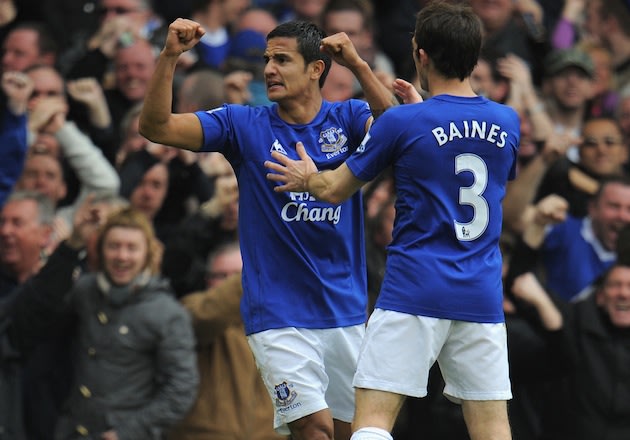
The New York Red Bulls have (all-but) signed Australian Tim Cahill from English Premier League side Everton. He joins MLS after eight successful years on Merseyside as a attacking-minded midfielder. He's the kind of player who can – and will – succeed enormously in MLS.

The time was right for him to move on. As one of the youngest members of the the Socceroo Golden Generation, it was time for him to follow his ageing brethren in leaving a major league for a more fiscally rewarding one. Already this summer, his head was turned by enticements from Al-Nasr of the Saudi Professional league, among others. After a down 2011-12, Everton manager David Moyes obviously thought it best to sanction the move.

Other factors play into Cahill's eagerness to shift continents. Meaningful minutes – despite his stature, not guaranteed as a Toffee – should cement his spot in the Aussie midfield at the World Cup in Brazil in two years' time; any impact he makes will also be the first any Australian has had on MLS, hopefully making Cahill a trail blazer for Aussies chasing a step up from the A-League.

Despite this move suggesting Cahill sees himself more as a big fish in a smaller pond, RBNY secured a major bargain with the acquisition. He remains one of the best headers of the ball in world football, and still ghosts into the box like he trademarked the phrase. These traits should combine well with the silk of Thierry Henry and further strengthen New York's MLS Cup push. Cahill's relative youth and a move back into the midfield (he's played out of position as a striker for much of the past two seasons) make him not only a bargain but potentially a league-wide star.

Tuesday, January 17, 2012

Everton failing to paper over the cracks

It’s time to talk about money.  To be precise, about Everton FC owner Bill Kenright’s lack thereof. 

One of England’s great clubs has begun the slow decline that accompanies a squad’s ageing and find themselves in eleventh position.  They are in no threat of relegation, but the club faces a greater existential crisis than any other club with a similarly storied history.

The Toffees have been on the market – if not officially, certainly on the sly – for much of the past decade.  Kenwright has attempted to fund assaults on the Champions League, but lately manager David Moyes’ spending money has become increasingly scarce.  Over the past two years, impact players have rarely made the sojourn to Goodison Park and Moyes has repeatedly squeezed blood from young, cheap stones like Seamus Coleman and Ross Barkley.

Much has been made of Everton’s fiscal situation, as well it might.  Moyes has been able to propel small, limited – and often injured – squads to outstanding achievement in the past.  He and a small band of loyal overachievers have been able to mask a fraught balance sheet.  He has been the Premiership’s MacGyver manager – able to create ingenious macguffin lineups out of little more than what he finds in his pocket.

As things now stand, more apparently than at any time in the past decade, the Toffees lack bite on the field.  Mikel Arteta has left the building; the ghosting runs of Tim Cahill now fail to deliver goals and Marouane Fellaini is no longer thought of as a potential World-Class prospect.  Their players have all been solid, but the Blues need more – the element of magic exists now more in the computers of their accountants than on the field.  Their top scorer in all competitions this season is left back Leighton Baines.

Great Premiership players have become simply good ones.  Over the past two seasons, the players who’ve tried to fill the practically-vacant striker position include the ageing, hamstrung Louis Saha and the underwhelming trio of Jermaine Beckford, Denis Stracqualursi and Victor Anichebe.  Papering over the offensive cracks in the Everton lineup has become a full-time occupation.

This hardly speaks for Moyes’ management skills and he is still held in incredibly high regard by football people all over the British Isles.  However, the regeneration required for clubs to keep themselves at the top level has eluded the Toffees.  Disconcertingly, there is every chance their best attacking player is the on-loan Landon Donovan and their best player overall his USA teammate Tim Howard. 

Unless this dearth of upper echelon talent is rectified, their run as Premier League overachievers will almost certainly end soon.

Wednesday, August 10, 2011

Socceroos balanced in defeating Wales


The Socceroos' upcoming World Cup campaign looks on firm ground. This morning's friendly against Wales showed the evident class of both sides' top players, but a workmanlike Australia were the superior team against a side whose Premier League pedigree belies it's FIFA ranking of 119.

courtesy: soccerwallpaper.mackafe.com
Up front, Tim Cahill and Scott McDonald (remember him?) pulled the strings for the Socceroos, while for extended periods the Aussies were able to nullify Wales' influential wide men Craig Bellamy and Gareth Bale.

McDonald, who still hasn't scored after 26 Socceroo caps, has never been faulted for effort in Australian gold and this was again the case today. He was busy up front and with Tim Cahill had a role to play in both goals. Given his 5'9 frame, leading the line in what amounted to a 4-4-1-1 hardly accentuated his gifts, but he regularly puts in Tevez-like endeavour, if without the pursuant goals.

More encouragement took the form of the central midfield matchup, where Neil Kilkenny of local Bristol City and Serie B's best bargain, Carl Valeri, more than matched the talent and experience of Aaron Ramsey and David Vaughn respectively.

It was hardly an exquisite spectacle - more an unkempt tussle in which the Australians collected themselves more quickly than their opposition. They pulled away when perpetually underrated right-back Luke Wilkshire first thundered a long-range shot against Wayne Hennessey's upright and minutes later delivered a pinpoint cross that Cahill powered into the bottom right corner.

He also curtailed Welsh WMD Bale, while the less experienced combination of Matt McKay and Michael Zullo were able to somewhat negate Bellamy's influence on the left. When Wilkshire was pulled at half time, the opposition flankers were far more able to shape the game.

As The Age's Michael Lynch has pointed out on Twitter, the blend of youth and experience should hearten the Green and Gold army.

The team is defensively sound, with Michael Zullo, Matthew Spiranovic and Rhys Williams all impressing. Williams' presence was impressive, while Spiranovic made a habit of being in the right place at the right time. McKay, though unlikely to have damaged his prospects of moving to Rangers, showed again some David Carney-esque tendencies at left back: good going forward, but was often beaten for pace and lateral movement by (very good 'uns) Craig Bellamy and Bale.

It was after Zullo, Wilkshire and Neill had all been withdrawn that a miscommunication at a set piece left Wales right-back Darcy Blake alone to score.

All appears positive for the Socceroos behind the ball. The midfield, though for the meantime shorn of the class of Bresciano and Kewell, is bustling, harrying and athletic. It is only going forward that the Socceroos don't have a good mix of experience and exuberance. When Robbie Kruse put home the rebound from a McDonald's shot, it served to contrast his fortunes with those of McDonald: when the Middlesbrough man scores his first Socceroo goal, it must be written that the earth will open and swallow him whole.

There is hope in Kruse's ability to find the net and McDonald's endeavour can begin to capitalise on delivery which has improved markedly since Osieck took over from Pim Verbeek. The team is still disconcertingly reliant on attacking midfielders Cahill and Holman to score. But this, after the Germany matches and a valiant Asian Cup, is encouragement enough for now.

Wednesday, March 30, 2011

A new coach, a new beginning

Australia under Holger Osieck are proving a very different proposition than their time under the overly-watchful eye of Pim Verbeek. Where the Dutchman was cautious to a (large) fault, the German has endowed Australia with sensible selection policy, good play from his A-League complement and even the occasional 4-4-2 formation. He is the Anti-Pim and the players seem to be responding.

Of course the Socceroos have since the days of Terry Venables been able to compete - and sometimes win - against good opposition. Under Verbeek they managed several creditable results but it was obvious to fans that Verbeek's skill lay not in winning matches, but saving them. It seemed he thought success came not through craftsmanship but took the opposite, utilitarian direction. Perhaps, like Roy Hodgson's alleged Liverpool crimes, he is better at producing draws than either wins or losses.

As a manager, there isn't a better opportunity infuse your breed of football into a team than to prove it's efficacy against a bogey-side. Yesterday's win in Moenchengladbach was just that - further validation of Osieck's appointment and Australian management's insistence on a manger who could nurture growth in the Socceroo squad.

When Australia lined up against Germany in Durban for their first World Cup match, they fielded a 4-6-0 formation with the main intent being damage control. In that formation both Richard Garcia - in his first competitive international - and Tim Cahill played out of position and turned in almost career-worst nights. The Socceroos were soundly defeated 4-0 and any hopes of making the second round from the Group of Terminal Illness were quashed. The Green and Gold army scoffed at an obvious lack of trust - and received a performance, hamstrung by a complete absence of forwards, could be read one of two ways. The cautious would suggest the inoffensive formation actually prevented even more of a mauling; those favouring a more balanced lineup would just suggest players don't perform when they're not trusted.

Yesterday - in enemy, rather than neutral, territory - the Socceroos stayed with a 4-4-2 the entire match, having both the resilience and chutzpah to absorb German forays and then return the attack. The result was 2-1 and only the most miserly would deny Australia's achievement against a strong Teutonic team. Osieck's stock is rising after an impressive Asian Cup campaign and should he continue to drink from Guus Hiddink's "You can do anything" juice, the Socceroos will continue to remain challenging for a Top-20 berth in the FIFA World Rankings.

Thursday, September 9, 2010

Holman adds another string to Australia's bow

When I first saw Brett Holman play for the Socceroos several years ago against Uruguay, I thought he was lucky to have made the team. If he and Carl Valeri represented the “new” generation of Australian footballers, the post “Golden Generation” Socceroos could well be in serious trouble. Touted as Australia's attacking hub for the the coming era, he ran around like a crazy person yet was ineffective off the ball, didn't threaten with either pass or dribble and it appeared he was taught his finishing skills by Gary Neville. What was evident however was his stamina and enthusiasm as he played off primary striker Scott McDonald, then of Celtic, another talented “skippy” yet to make his mark on the international stage.

But since that warm-up match for the 2007 Asian Cup in Sydney, Holman has moved clubs (to AZ Alkmaar) and through persistence achieved a solid international footing. One can argue that with Luke Wilkshire, the headless chicken of the past was one of Australia's best at the recent World Cup and provided the highlight of South Africa 2010 for the Green and Gold Army with his 25-yard goal against Serbia. His only drawback for the tournament was then-manager Pim Verbeek's reluctance to pair him and Tim Cahill together, fearing a duplicity of talent.

His record for Australia still isn't great statistically but Holman has scored in three of his last five matches – including against Poland in a startling cameo on Tuesday – bringing his international goal tally up to 5. Against Asian competition who won't have his combination of power, pace and stamina he looms alongside Cahill's aerial ability as Australia's trump card going into the 2011 Asian Cup. This in turn allows new coach Holger Osieck to add a second string to an Aussie bow which under Verbeek consisted only of high crosses into the box by the Socceroo “bomb squad”. Australia will for once have a creative dynamo with the ball on the floor as well as the dominant box presences of Cahill & Joshua Kennedy. The key now is to ensure that these three are suitably ready and meshed to provide that combination.

The re-retirement of old stager Scott Chipperfield robs Australia of a forward threat that replacements Tommy Oar & David Carney may initially struggle to match. This means a squad replete with staid midfielders may again need a spark – one which Holman is now perfectly capable of providing on a regular basis.