Showing posts with label Everton. Show all posts

Thursday, December 12, 2013

Wilfried Zaha: Destination West Bromwich

Wilfried Zaha, Manchester United's most exciting (and most underutilised) acquisition of 2013, seems likely to be loaned out to another Premier League club this winter. The clubs associated include Everton (surprise, surprise), Newcastle United and, predictably, former club Crystal Palace.

United fans were initially excited by Zaha’s unharnessed horsepower, but his inability to break into David Moyes’ convulsant first team sees Red Devil fans enticed by what he might be, rather than what he will contribute to 2013-14. That probably means seeing him temporarily don blue or black and white.

A good argument is made by NBC’s Pro Soccer Talk that Everton might be an agreeable loan destination: the Toffees might be able to take points from other teams competing for the top four while getting the young England international the competition he needs to develop. A bonus comes in the form of manager Roberto Martinez, who dating back to his days at Swansea has nonpareil form at turning loan players into monsters.

What this theory fails to account for is that Everton, driven by a compelling foursome of loanees (Gareth Barry, Gerard Delofeu, Romelu Lukaku and possibly Zaha), might themselves muster enough points to keep United from Champions League qualification. Although it seems less likely, the same might be said of Newcastle United.

While Everton, Newcastle and Palace seem the most likely Zaha destinations, an under-the-radar option might exist. West Bromwich Albion boast a coach-turned-manager in Steve Clarke who managed the club to an upper half EPL finish last year and who has with Roy Hodgson turned a former yo-yo team into a solid Premiership club – albeit one that still appears to lack goals. Clarke also used temp man Romelu Lukaku in a devastating manner last year, has developed young winger Saido Berahino into a wonderful international prospect.

The Baggies sit fifteenth in the table and seem to have based much of their recruitment on maximizing returns from good, but not great players. The addition of Lukaku – who lopes around the field with the speed and manner of a big cat hunting – last term provided a physical weapon capable of freezing opposing defenses and creating space for midfielders like James Morrison. Were West Brom able to rotate Scott Sinclair, Berahino and Zaha, their forward corps would be perhaps more fascinating viewing than even the Man U Moyespocalypse.

Whether the Baggies have the available squad space and finances to make such a deal work remains questionable, but the club is certainly an option worth considering. It might make West Brom better, it would almost certainly make Wilfried Zaha better and would give fans of each side even more to tune in to.

Tuesday, November 5, 2013

Lloris injury highlights need for soccer concussion protocols

When Hugo Lloris shrugged off the Tottenham training staff and put himself back into Sunday’s game against Everton to save  the decisive penalty, public reaction moved quickly from curiosity to disbelief and then to rampant rationalization. 

The shot-stopper had recently concussed by an errant knee by Toffee forward Romelu Lukaku and despite his save, we must now ask whether players should input into such decisions.

Lloris, captain of France and number one at White Hart Lane, essentially pulled rank on educated medical professionals and convinced manager Andre Villas-Boas he was fine to continue despite obviously losing consciousness. It’s a fair bet Lloris couldn’t have named the President of France, the date or even his name and thus been assessed as having a (probably mild) head injury. 

Plaudits are often paid to those who play on despite injury. This is not one of those times. Alongside dizziness, visual dysfunction and sometimes vomiting, one cardinal sign of head trauma is reduced executive function (decision making).

Automatically, klaxons sound: if a player with diminished cognitive capacity has the loudest voice in whether he continues playing, serious consequences are close at hand. The decision must rest with medical professionals alone, usually by applying a concussion assessment tool. Altered executive function may result in the concussed player’s condition worsening, or him putting himself or other players at further risk. The best solution would be to remove such a player from the game and, if necessary, adding a fourth substitution mediated by the umpire.

British jockeys and NFL players have strict rules in place for the management of head injuries; if an athlete can’t pass the famed “concussion protocols”, they don’t play. The same must apply to football players both during and after matches – even though there’s less chance of such catastrophic impact, it can and does happen.

The reasons are simple. While manager Villas-Boas stated the final call rested with him, he is only sort-of right. The final tactical decision may rest with the manager, but had further injury occurred either to Lloris or another player due to Lloris’ reduced capacity then liability rests with the medical team. Ergo, the ultimate decision has to be made by trained healthcare providers rather than a coach or a motivated player with faculties perhaps already below 100%. Despite Spurs' protestations that they did clear the player, the time taken to do so on Sunday - in comparison with kayoed NFL players - seemed remarkably short even considering the circumstances.

The support staff for a club want the team to win just as much as players and coaches do. However, they must also balance this with the wellbeing of the individuals. While one would hope coaches and players also have player welfare foremost at heart, several past examples suggest this may not always be the case. With head injuries, especially in light of the recent spate of Chronic Traumatic Encephalopathy diagnoses, safer is better than sooner.

Wednesday, March 13, 2013

Moyes all set to continue at Everton

With Everton’s demise at the hands of Wigan in their FA Cup Quarter Final, the future of David Moyes has been cast into doubt.  During his long and successful tenure at Goodison Park, the Scot has been lauded as an exemplary manager who consistently compelled teams to overachieve in spite of a modest budget.

However, this success has been juxtaposed against a stark lack of results when it comes to the final hurdle.  
During his reign, the Toffees stumbled against a good Villarreal team during the 2005-06 Champions League Qualifiers, fell in the 2009 FA Cup Final and, despite a great start to a relatively-open season, look like missing out on a top-four position this term.  (It must be said, however, that Everton owner Bill Kenwright is almost certainly stoked with Moyes’ ability to generate top-third finishes.)

Moyes’ name has been linked with jobs as high profile and varied as Tottenham Hotspur, Scotland and even Manchester United.  However, opportunities to “progress” to a club with a larger budget are intrinsically linked with quantifiable success (ie. Trophies and Champions’ League berths), which means there are now pundits questioning whether Everton’s rather staid tactics are actually suited to success in one-off, crucial matches.

Managerial hiring is now trending towards younger, more adventurous managers.  Liverpool took a punt last year on Brendan Rodgers (perhaps after missing out on Roberto Martinez, a man constantly in demand despite Wigan Athletic’s constantly underwhelming league position) and Moyes was reportedly considered for the Spurs position before they opted for a younger, sexier look with AndrĂ© Villas-Boas.  Ugly-but-effective Young Thing Paul Lambert was snaffled quickly by a club with pretentions. 

Though effective, Moyes’ methods are now distinctly unfashionable, limiting British-based positions.
The Everton manager has become typecast.  He is Tom Baker, Raymond Burr, a beardless Chuck Norris; pigeonholed as someone who achieves much with … not much.  With a record such as his, would Daniel Levy, the Glazers or Stan Kroenke trust him with acquiring bright young things to advance their teams?

But there’s a certain job security that comes with inertia.  There’s no sense in Moyes moving on at this point in time: his straightforward style and more straightforward manner might make management opportunities scarce at wealthier teams.  He succeeds at Everton with less money spent than at clubs like Stoke City or Queens Park Rangers, and in so doing shepherds his men closer to success than might otherwise be possible.  Both manager and club have continued to find new ways of filling a leaky bucket – almost, but not quite, to the brim.  A Toffee flirtation with a PYT probably wouldn’t be to their best advantage (remember the Owen-Coyle-to-Arsenal malarkey?), considering Kenwright seeks success without expense.

He – and Everton – are both victim/beneficiaries of success lacking the ultimate prize.

It’s doubtful that there is reciprocal interest between Moyes and outside clubs.  Any real suitor would need more standing and disposable dosh than he already has at his disposal (narrowing the field substantially), while - like so many shallow beauties - so-called “glamour clubs” demand a partner as sexy as they think they are (removing most of the others).

David Moyes may be many things, but sexy isn’t one of them.  He is well suited to Goodison Park, Liverpool in general, and to Everton.  Man and club are a match for the job at hand.

Monday, October 1, 2012

Three things: Where have all the good teams gone?


Are there any great teams in this league?

Table-toppers Chelsea, while capable of sparkling, appear to lack real depth in their midfield. Nonetheless, they remain the team to beat. Manchester City have flattered to deceive so far this season; cross-town nemeses United have struggled mightly, losing at home to Tottenham Hotspur for the first time in Tom Cleverley's lifetime. Arsenal, while appearing more solid than at any time during the past half-dozen years, have only two wins in six.

On results thus far, the league has seven good teams and no great ones. The results may show not so much in English competition – where someone has to win, perhaps even by default – but in Europe.

So far, the most impressive teams in the league have been Everton (see below) and West Bromwich Albion, two clubs who have embraced the possibilities that fiscal conservatism brings.

Six games is a large enough sample size to begin drawing conclusions. The top teams are not performing to their peaks, meaning that a run of good form from a deep team is enough to split the entire competition open.


Everton: no need for Moneyball

David Moyes has long been admired for his ability to conjure great performances from teams which appear as deep as a toddler's wading pool. Over the past half-decade, he's almost exclusively worked on a sell-to-buy program. The team he's assembled over the past year is no different: Mikel Arteta now plays for Arsenal, but begat Nikica Jelavic, while Jack Rodwell's Manchester City jaunt allowed the purchases of Kevin Mirallas and Bryan Oviedo.

Moyes has always been the smartest accumulator of talent in the league and the Toffees now stand at second on the table because of it. Moneyball, thanks to Kenny Dalglish's ill-fated purchases at Liverpool now seems to a verboten concept in the English Premier League: the acquisition of Stewart Downing championed by his oustanding “converted crosses” ratio while at Aston Villa.

Moneyball, the concept, was not about finding statistics which provided the edge but a novel concept of assessing players and their worth in individual situations; finding players that others didn't value. It was about value for money – and Moyes doesn't need it, because his hit rate with acquisitions is so very high. At a reported 19 million pounds, Downing could exemplify little value. Value for money often comes at a lower cost – something Moyes is accustomed to dealing with.


Andre Villas-Boas knows what he's doing

Despite some odd actions, Andre Villas-Boas is a man who knows where his towel is. Despite a vastly different team to the one that Harry Redknapp took into Europe three years straight, there's every possibility that his team is in fact superior to that iteration. Spurs' squad has a leaner, trimmer appearance this season.

Moussa Dembele has justified the interest of Manchesters United and City, Clint Dempsey was perfectly positioned to succeed at a club almost, but not quite, exactly good enough to qualify for the Champions' League and Emmanuel Adebayor is the perfect point man for AVB's offensive schemes. All of this was accomplished while ridding the squad of significant baggage and wages.

Spurs' win at United on Saturday is without question the largest of his English managerial career and shows signs that Spurs can become a viable fifth (or sixth) option in the chase for the Champions League. The squad has depth, balance, youth and experience. They appear to be establishing an identity based upon their smooth midfield. Now all they need is another striker.

Thursday, July 26, 2012

Tim Cahill joins New York Red Bulls

Tim Cahill MLS
Courtesy: montrealgazette.com
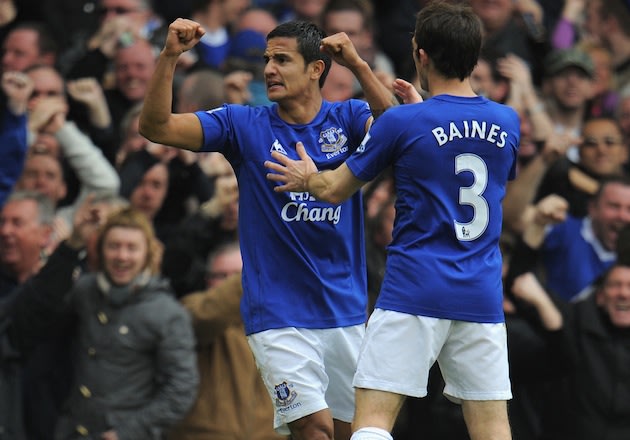
The New York Red Bulls have (all-but) signed Australian Tim Cahill from English Premier League side Everton. He joins MLS after eight successful years on Merseyside as a attacking-minded midfielder. He's the kind of player who can – and will – succeed enormously in MLS.

The time was right for him to move on. As one of the youngest members of the the Socceroo Golden Generation, it was time for him to follow his ageing brethren in leaving a major league for a more fiscally rewarding one. Already this summer, his head was turned by enticements from Al-Nasr of the Saudi Professional league, among others. After a down 2011-12, Everton manager David Moyes obviously thought it best to sanction the move.

Other factors play into Cahill's eagerness to shift continents. Meaningful minutes – despite his stature, not guaranteed as a Toffee – should cement his spot in the Aussie midfield at the World Cup in Brazil in two years' time; any impact he makes will also be the first any Australian has had on MLS, hopefully making Cahill a trail blazer for Aussies chasing a step up from the A-League.

Despite this move suggesting Cahill sees himself more as a big fish in a smaller pond, RBNY secured a major bargain with the acquisition. He remains one of the best headers of the ball in world football, and still ghosts into the box like he trademarked the phrase. These traits should combine well with the silk of Thierry Henry and further strengthen New York's MLS Cup push. Cahill's relative youth and a move back into the midfield (he's played out of position as a striker for much of the past two seasons) make him not only a bargain but potentially a league-wide star.

Tuesday, March 13, 2012

Redknapp's logical successor

Let's just assume, despite apparent misgivings, that Harry Redknapp will manage England at this year's European Championships. The common-sense logic is that England will likely qualify for the second round and then be eliminated. Such things were written in stone, long ago.

Were he to go, however, who would replace him at Spurs? Noises have been made about summoning Jose Mourinho from Real Madrid to helm next season's increasingly-improbable Champions' League push, while other names thrown forth into the vacuum include Fabio Capello, Rafael Benitez and David Moyes.

Interestingly, the Spurs personnel actually quite suit a manager like Andre Villas-Boas, but it's unlikely AVB would get such a high-profile position immediately after his Chelsea flame-out. This should elicit nervous Liverpudlian glances towards Fleet Street's rumour-mongers.

If Jose's not coming – and he's not, there should be little doubt that David Moyes is the best fit for the Spurs job.

Harking back a moment to Villas-Boas, there are myriad reasons for his dismissal but the greatest was an initial refusal to adapt his tactics to his players. This doesn't apply for Moyes, who for the vast majority of his decade-long tenure at Goodison Park has employed with success either a flat 4-4-2 or a 4-4-1-1. He would have to make little or no adaptation, but simply deploy a superior playing group. To prove his efficacy, he need look no further than a player that Spurs now own – South African Steven Pienaar.

His maintenance of Everton as one of the league's more efficient defensive teams speaks volumes, as does his ability to bring together a cohesive dressing room and his noted ability to work well on a budget. Spurs could certainly benefit from all four of these selling points – in fact, combining Moyes' defensive schemes with the offensive talent on hand at White Hart Lane is an exciting prospect.

This remains pure speculation, and it's no sure thing that Moyes would agree to a contract at Spurs. However, it remains the most tantalising option should Redknapp be seconded into national service.

Friday, January 20, 2012

3 Reasons "Second" teams in the "Second" Division won't work

Andre Villas-Boas has been roundly criticised by Football League supporters this week for suggesting he’d like Chelsea’s B team to compete in the nation’s second tier.  Unfortunately for him and his club, Villas-Boas’ recent press statements have seen him become something of a mini-sensation magnet and he seems to spend more time now rebutting sly criticism than providing novel insights into the league.


Basing a second team in a competition further down the League tree would be of immense benefit to the parent club, as they could shuffle players in and out of their lineups to get game time as required.  Barcelona, amongst other clubs, uses such a model in the Liga Adelante; while the practice has become so treasured in Australia’s AFL that most clubs are now in a hurry to set up  their own subsidiary club.  However in England, it is almost unworkable – if not for the logistics, but the fans. 

Red tape hurdles include the strict nature of the English League “tree” – Everton boss David Moyes said this morning he tried five years ago to get a youthful Everton B team experience playing against grown men in the Conference (England’s fourth division).  However, he was told any new club would have to start in the lowest division – the ninth tier – and work their way up as have some more famous foundling clubs like AFC Wimbledon and FC United of Manchester 

More problematic are the fans.  English fans, starting with respected and popular Football League blog The Seventy Two, object to their clubs being disadvantaged to suit the mega-rich.  And fair enough too: apart from somewhat minimising the raison d'etre of those clubs whose First XIs compete in the Championship, the League has a rich history and the landscape would change forever (but not necessarily for the worse, mind you). For the Football League to undergo such a radical re-shape simply for the benefit of Chelsea/Man United/Man City/Arsenal youth players would be a devalue English football for the benefit of a few superwealthy clubs.

Finally, there is one great difference between a Barcelona B team and a potential Chelsea B squad – the current Barcelona B team features a squad with two two – international players (Jonathon dos Santos, of Mexico and Luis Gustavo Ledes of Portugal).  The team Chelsea of 2012 would send to the Championship includes overseas talents like Patrick van Aanholt, Nicolas Anelka and Alex.  The EPL reliance on overseas talent would make such a prospect unworkable and stunt the growth of true English player development. 


I can’t see why Andre Villas-Boas wouldn’t want Chelsea B team to play in the Championship.  As a manager focused mainly on results in the short and mid-term, it would be perfect.  But unfortunately it’s a concept which will have to remain strictly Iberian.

Tuesday, January 17, 2012

Everton failing to paper over the cracks

It’s time to talk about money.  To be precise, about Everton FC owner Bill Kenright’s lack thereof. 

One of England’s great clubs has begun the slow decline that accompanies a squad’s ageing and find themselves in eleventh position.  They are in no threat of relegation, but the club faces a greater existential crisis than any other club with a similarly storied history.

The Toffees have been on the market – if not officially, certainly on the sly – for much of the past decade.  Kenwright has attempted to fund assaults on the Champions League, but lately manager David Moyes’ spending money has become increasingly scarce.  Over the past two years, impact players have rarely made the sojourn to Goodison Park and Moyes has repeatedly squeezed blood from young, cheap stones like Seamus Coleman and Ross Barkley.

Much has been made of Everton’s fiscal situation, as well it might.  Moyes has been able to propel small, limited – and often injured – squads to outstanding achievement in the past.  He and a small band of loyal overachievers have been able to mask a fraught balance sheet.  He has been the Premiership’s MacGyver manager – able to create ingenious macguffin lineups out of little more than what he finds in his pocket.

As things now stand, more apparently than at any time in the past decade, the Toffees lack bite on the field.  Mikel Arteta has left the building; the ghosting runs of Tim Cahill now fail to deliver goals and Marouane Fellaini is no longer thought of as a potential World-Class prospect.  Their players have all been solid, but the Blues need more – the element of magic exists now more in the computers of their accountants than on the field.  Their top scorer in all competitions this season is left back Leighton Baines.

Great Premiership players have become simply good ones.  Over the past two seasons, the players who’ve tried to fill the practically-vacant striker position include the ageing, hamstrung Louis Saha and the underwhelming trio of Jermaine Beckford, Denis Stracqualursi and Victor Anichebe.  Papering over the offensive cracks in the Everton lineup has become a full-time occupation.

This hardly speaks for Moyes’ management skills and he is still held in incredibly high regard by football people all over the British Isles.  However, the regeneration required for clubs to keep themselves at the top level has eluded the Toffees.  Disconcertingly, there is every chance their best attacking player is the on-loan Landon Donovan and their best player overall his USA teammate Tim Howard. 

Unless this dearth of upper echelon talent is rectified, their run as Premier League overachievers will almost certainly end soon.

Tuesday, August 16, 2011

EPL: Where the goals come from

"Attacking midfielders" - eg. Samir Nasri or Adel Taarabt - categorized as forwards.
Click image to enlarge.

The table above describes where each team relied upon for scoring in last season's English Premier League.  For example, league Champions Manchester United scored 73.08% of their goals through their forwards - a corps including league-high scorer Dimitar Berbatov, Javier Hernandez and Wayne Rooney.  That they were in the bottom three for goals from midfielders stands testament to the age of last season's key players Paul Scholes and Ryan Giggs.

It is interesting to note that clubs noted for a passing game - such as Wigan or at times West Brom - were balanced out for goals from midfield by clubs such as Birmingham, who simply didn't have anyone outside central midfielder Craig Gardner on whom they could rely to hit the net with regularity.  It is of course no surprise to see that clubs who required set pieces to score (I'm looking at you Stoke City) had higher rates of goals scored by defenders.  

Given defenders' propensity scoring from corner and free kick situations, we can infer that with the exception of Birmingham, the relegated teams last season had extreme difficulty scoring from set pieces as West Ham managed only 7% of their goals from defenders, while Blackpool bottomed out of the division at just under 5.5%.

A large difference can be seen in the promoted teams.  While Cities Norwich and Swansea both prefer to attack with the ball on the ground, QPR can't ever be mistaken for a team of Xavis.  Manager Neil Warnock's M.O. is to get the ball to Adel Taarabt at all costs, who then attempts to create havoc.  This is displayed in him creating or scoring 47% of all QPR's goals last term.  A simple reason for them being my pick to go down - they, like Charlie Adam and Blackpool last year just don't have enough diversified offensive firepower.

Monday, August 9, 2010

Everton FC: When will a big club poach David Moyes?

Under David Moyes and his limited budgets, Everton have maintained a solid record in the Premier League. Consistent in their contention for European places, Everton have regularly won against Big Four teams under his tutelage. He's been manager since 2004 – to give you an idea of how long that is, that was the Season of Arsenal's Invincibles – and though his results, purchases and reputation are nearly beyond reproach, he's not been heard of in reference to either Big Four jobs available during his Toffee reign.

Occasionally touted as the successor to Sir Alex Ferguson at Manchester United, as much for his Scots blood and ability to throw the odd tanty as for his results, Moyes has worked well as manager of a second level club and has probably overachieved. That consideratiion for big jobs hasn't come straight away because those “big” jobs have only come up at Chelsea and Liverpool. Chelsea under Abramovich wants glamour, while the move to Liverpool from Everton is about as likely as Moyes' next job being the Prime Minister of Kenya.

In Sir Alex Ferguson or Arsene Wenger were to call it a day, would he get consideration? Given his understated demeanour there may be fears he's too low-key for such a big job. Low key isn't necessarily bad, it's just a different modus operandi than you would expect at a United or and Arsenal. Other muttered concerns include him “finding his level” in that second level with Harry Redknapp and Martin O'Neill and whether he has the requisite European experience to succeed at a big club.

Of all the EPL managers, Moyes is probably the most deserving of that big break. But this doesn't mean he will automatically receive it – there's no waiting your turn in football. One bad season could spoil eight years of hard work and good results. One bad season could mean his next job is in the relegation spots, the Championship or, heaven forbid, the SPL. The example of David O'Leary still hits home hard: linked with Premier League jobs as recently as Portsmouth last year but now finds himself managing in the United Arab Emirates simply to stay in work.

Perhaps one day his talent will be recognised for what it is but the guess is here that he will be at Everton for a good few years yet.