Player
|
Games
|
Minutes
|
GS
|
GA
|
Plus/minus
|
Scored/90
|
Conc/90
|
Team GD
|
Guzan
|
14
|
1260
|
16
|
16
|
0
|
1.143
|
1.143
|
0
|
Baker
|
8
|
643
|
10
|
11
|
-1
|
1.400
|
1.540
|
0
|
Vlaar
|
14
|
1215
|
14
|
14
|
0
|
1.037
|
1.037
|
0
|
Luna
|
11
|
945
|
12
|
12
|
0
|
1.143
|
1.143
|
0
|
Lowton
|
7
|
560
|
9
|
8
|
1
|
1.446
|
1.286
|
0
|
El Ahmadi
|
13
|
1017
|
13
|
13
|
0
|
1.150
|
1.150
|
0
|
Westwood
|
12
|
1073
|
11
|
14
|
-3
|
0.923
|
1.174
|
0
|
Delph
|
12
|
1023
|
14
|
14
|
0
|
1.232
|
1.232
|
0
|
Weimann
|
13
|
946
|
11
|
12
|
-1
|
1.047
|
1.142
|
0
|
Agbonlahor
|
11
|
893
|
11
|
12
|
-1
|
1.109
|
1.209
|
0
|
Benteke
|
12
|
929
|
10
|
12
|
-2
|
0.969
|
1.163
|
0
|
Clark
|
12
|
945
|
15
|
10
|
5
|
1.429
|
0.952
|
0
|
Bacuna
|
12
|
992
|
11
|
11
|
0
|
0.998
|
0.998
|
0
|
Okore
|
3
|
167
|
1
|
3
|
-2
|
0.539
|
1.617
|
0
|
Tonev
|
10
|
374
|
3
|
3
|
0
|
0.722
|
0.722
|
0
|
Helenius
|
3
|
49
|
0
|
1
|
-1
|
0.000
|
1.837
|
0
|
Kozak
|
10
|
574
|
9
|
7
|
2
|
1.411
|
1.098
|
0
|
Sylla
|
6
|
358
|
5
|
4
|
1
|
1.257
|
1.006
|
0
|
Bowery
|
3
|
27
|
0
|
0
|
0
|
0.000
|
0.000
|
0
|
Albrighton
|
1
|
19
|
0
|
0
|
0
|
0.000
|
0.000
|
0
|

Showing posts with label Man Utd. Show all posts
Showing posts with label Man Utd. Show all posts
Friday, December 6, 2013
Plus/minus: Aston Villa, Cardiff City, Manchester United, Southampton, Tottenham, 6th December 2013
Aston Villa


Friday, August 17, 2012
What Robin van Persie could mean to Manchester United
With Arsenal captain Robin van Persie
certain to sign for Manchester United, the balance of power in the
English Premier League shifts again towards the country's northwest.
Despite Arsenal's best efforts to provide him with support in the
form of the
deepest squad of his tenure at the Emirates, van Persie's quest
for self-actualisation through silverware now continues at Old
Trafford.
Manchester United supporters will be
happy with the purchase: it cements their position as a destination
club, goals are always welcome and the transfer fee – despite
reaching a rumoured ₤24
million – is quite justifiable should the van Persie provide
even three years of quality play.
He will (likely) start at the pointy
end of Sir Alex Ferguson's preferred one-striker formations, the
4-4-1-1 or 4-2-3-1. This means, despite
ink suggesting other centre-forwards will be marginalised, it
seems far more likely that fellow new signing Shinji Kagawa or
established wide men like Ashley Young will be most affected. With
Kagawa, Tom Cleverley, youngster Nick Powell, Rooney and Young all
probably best employed behind the striker, pessimists suggest the
club has too many players in competition for one role.
That Ferguson purchased Kagawa this
summer, Young last year, as well as advancing Cleverley, suggests the
United manager favours a mobile, multifocal attack where numerous
players are able to threaten opposing defences. This flexibility
fits
with his formation preference, which ostensibly affords better
support for an creaking central midfield from a mobile forward corps.
When attacking, the mosquito-fleet forwards can then run at defences
rather than depending upon glamour balls to isolated target men.
United's best play this century came
from 2007-2009 with a fluid 4-3-3. When they effectively replaced
the versatile Cristiano Ronaldo with the more orthodox Dimitar
Berbatov, an element of that interoperability was lost.
Although he was hardly
a failure, it was perhaps a sense of tactical straightforwardness
which led to Berbatov's purchase in 2008. In spite of a reported ₤30
million price tag, Berbatov was rarely deployed in big matches and
almost never by himself: his lack of acumen and (apparently)
inclination reducing his effectiveness in the critical poacher's
role. Berbatov's languor and uncanny lead-up play has always been
suited best to the 4-4-2. As United have attempted to increase their
flexibility, Berbatov has become a bench fixture. van Persie is not
nearly so limited.
Although sometimes very effective –
c.f. Martin O'Neill's success at Aston Villa and Sunderland – it is
tactical naïveté
to suggest that “defenders defend, attackers attack and midfielders
link the two”. When competing against the best clubs in the world,
such simplicity is quickly rendered obsolete, and the flat, age-old
4-4-2 formation is now utilised less
and less in truly elite teams.
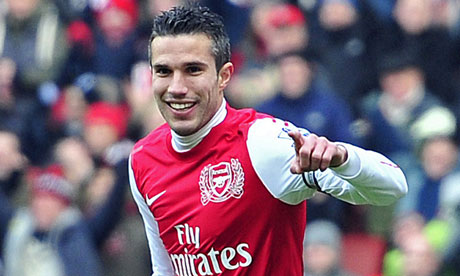 |
| Courtesy: guardian.co.uk |
The lessons taught by Champions League
drubbings against Barcelona may have been learnt. Messi, Xavi and
Iniesta, the three most important players in what was popularly
acknowledged as the best team in recent memory, all prefer to operate
centrally. Of course there are differences and these changes may
just be a stall until Ferguson develops or acquires a supertalented
central hub. Ferguson may opt to shuffle – no-one really knows
what the old fox has in mind: signing Robin van Persie could simply
be the managerial equivalent of a mid-life crisis sports car.
However, optimists could perhaps see
him as
the final step in United's journey towards fully embracing a more
fluid tactical system.
Tuesday, March 27, 2012
Don't judge a league by its elite
As football has become more and more
corporate, the existence of elite cliques of teams in almost all the
major four Europeans leagues have become an accepted part of the
European football culture. While from time to time over the last
fifteen years these subsections have been occasionally disrupted,
it's not worth arguing against the balance of European football power
being held by a maximum of four clubs in four leagues.
The same clubs almost always take part
in the Champions League. While class is routinely (and
tediously) said to be permanent, it would be more true to suggest
that the established plutocracy is everlasting.
Considering well-earned prize money,
league TV rights deals (especially
pertinent in Spain), Champions' League income and large stadia,
the wealthy club shave such a fiscal leg-up, that those clubs once
(still?) associated with a European
football superleague are essentially playing in a different
league to their club opponents. This leads, especially in England,
to clubs flush with imported players: in each of their last
Champions' League matches, EPL clubs boasted a total of 12 players
who had played with their club's juniors. Only four of those players
– Ryan Giggs, Kieran Gibbs, Wojcieh Szczesny and Joe Hart – were
starters.
Based on the past few seasons, the best
clubs in the world have been Barcelona, Real Madrid, Bayern Munich
and, if you tilt your head to the left and squint reeeal hard,
Manchester United. However, these clubs seem to have birthrights
allowing them access to European football and the money to buy
players that most/all other teams in their respective countries
envision only in their stickiest dreams. Barcelona, Real Madrid,
Bayern and United now don't accurately represent their respective
leagues but sit somewhere in the third standard deviation, part of a superelite that may as well play in a bloody
superleague. (An idea that's never totally put to bed, by the way.)
Even though individual rights deals,
league finances and priority on junior development makes this an
exercise in apples and oranges, the strength of each league's
mid-table sides must be evaluated to provide an accurate comparison.
Perhaps now it's time to evaluate a league primarily by those squads
in the middle of the pack, with both
their achievement at home and abroad. Given the regular
passage of players from mid-table teams to the elite, this also
seems to best describe the league as
a whole, rather than just paint a portrait of those paragon clubs.
Talk
to a evangelising school principal and he will try to convince you
that the best student in the class represents the quality of his
teachers, amenities, tributary schools and leadership. However, this
is often proved incorrect by assessing those students in the meaty
part of the bell-curve. Money unlocks many doors, both in the
education system and the football world. How students,
teachers, clubs and players perform without that cash most
accurately reveals the truth.
Thursday, December 8, 2011
United's centre-back crisis: Free the youth
Sir Alex Ferguson has to deal with elimination from the Champions' League during the Group stages for only the second time in a decade. He will chase his thirteenth Premier League title and first Europa League wins without his best defender, after it was confirmed today that centre-half Nemanja Vidic will miss the rest of the season after rupturing his anterior cruciate ligament.
First up for the Manchester United manager is to decide on a new first-choice pair of central defenders. In channelling former mind-games patsy Rafael Benitez, he has experimented with rotating his players and the club has featured several partnerships already this season. After the Red Devils' 6-1 tonking at the hands of arch-rivals Manchester City - and injury to the elegant Chris Smalling - Ferguson elected to return to defensive basics by frequently deploying Vidic and Ferdinand.
Eighteen months ago, this coupling was probably the world's best. Wile still effective this season they have hardly been the domineering force of years past this season: Ferdinand has obviously slowed and now Vidic will be out for the foreseeable future. With Smalling and Phil Jones playing well this season, Ferdinand attracting transfer interest - most notably from the Chicago Fire and Spurs - and now Vidic, the future beckons for a callow Red Devil defence.
There are four available central defenders from Ferguson to choose a first-choice pair from.: Ferdinand, Jones, Smalling and Ferguson project/bugbear Jonny Evans. One this is for certain: barring indiscipline, the youthful trio will likely feature in some capacity in each of United's remaining games due to Ferdinand's china-plate legs and back. The possible combinations are as follows:
Ferdinand and Smalling:
Features the assured ball-player in Ferdinand and the man Ferguson recruited to succeed him. The manager seems to think either Vidic or Ferdinand is needed in the lineup to compete against the best offences in Europe and indeed, the Premiership, while Smalling seems to be more comfortable as a designated defender than Jones. This partnership has a lot to offer, and could be the one deployed for games against "big" opposition.
Ferdinand and Jones:
Jones has been used in many capacities already in his first season at Old Trafford: on the right, as a defensive midfielder, at right back, as a barnstorming box-to-box midfielder and finally as a roaming centre-back. Given his newfound (since the City loss) conservatism, it's likely Ferguson covets this versatility and won't want to tie him down to one particular role. Jones could be the only Englishman capable of playing as the libero role, but it's unlikely he'll receive the freedom to do so with United's current staid mindset.
Ferdinand and Evans:
Good grief, no. It's not that either are ad players - in my opinion, Evans is moderately underrated - but both lack legspeed and appear increasingly prone to defensive errors.
Evans and Smalling:
Perhaps more likely than one would first think. Evans has a certain combative nature perhaps lacking in the which the more reserved Smalling. He's also more positionally aware in the defensive game than Jones, however doesn't bring the distribution - or engine - of his younger compatriots. His propensity for dismissal is his greatest technical hole. If SAF prefers to pair a np-frills defender with a distributor rather than two more defensive backs, this may be his best bet.
Evans and Jones:
Given a certain stickiness of foot from Evans and Jones' natural offensive game, this partnership is perhaps one of the least likely possible combinations. This partnership would require Ferguson to open the floodgates, which, considering the disabled list currently features playmakers Cleverley, Anderson, Berbatov and Chicharito, is hardly likely.
Smalling and Jones:
Eight weeks ago this was the centre-back combination of the future. Now, even after Smalling's injury and Ferguson using Jones everywhere between Rooney and De Gea, this still reeks of potential. What is less certain, though, is if that potential will be realised as a centre-half combination. It would require empowerment from the gaffer akin to saying "Boys, you're my club's future, do what you do best". Ferguson has a history of doing this - c.f. You can't win anything with kids - but it's usually more calculated and occurs at the season's start.
While each combination has positives and negatives, it behoves Ferguson to employ his two prized young defenders at the positions they were bought to play. For United to progress - not this season, but next and beyond - Smalling and Jones must be given the chance to step up
First up for the Manchester United manager is to decide on a new first-choice pair of central defenders. In channelling former mind-games patsy Rafael Benitez, he has experimented with rotating his players and the club has featured several partnerships already this season. After the Red Devils' 6-1 tonking at the hands of arch-rivals Manchester City - and injury to the elegant Chris Smalling - Ferguson elected to return to defensive basics by frequently deploying Vidic and Ferdinand.
Eighteen months ago, this coupling was probably the world's best. Wile still effective this season they have hardly been the domineering force of years past this season: Ferdinand has obviously slowed and now Vidic will be out for the foreseeable future. With Smalling and Phil Jones playing well this season, Ferdinand attracting transfer interest - most notably from the Chicago Fire and Spurs - and now Vidic, the future beckons for a callow Red Devil defence.
There are four available central defenders from Ferguson to choose a first-choice pair from.: Ferdinand, Jones, Smalling and Ferguson project/bugbear Jonny Evans. One this is for certain: barring indiscipline, the youthful trio will likely feature in some capacity in each of United's remaining games due to Ferdinand's china-plate legs and back. The possible combinations are as follows:
Ferdinand and Smalling:
Features the assured ball-player in Ferdinand and the man Ferguson recruited to succeed him. The manager seems to think either Vidic or Ferdinand is needed in the lineup to compete against the best offences in Europe and indeed, the Premiership, while Smalling seems to be more comfortable as a designated defender than Jones. This partnership has a lot to offer, and could be the one deployed for games against "big" opposition.
Ferdinand and Jones:
Jones has been used in many capacities already in his first season at Old Trafford: on the right, as a defensive midfielder, at right back, as a barnstorming box-to-box midfielder and finally as a roaming centre-back. Given his newfound (since the City loss) conservatism, it's likely Ferguson covets this versatility and won't want to tie him down to one particular role. Jones could be the only Englishman capable of playing as the libero role, but it's unlikely he'll receive the freedom to do so with United's current staid mindset.
Ferdinand and Evans:
Good grief, no. It's not that either are ad players - in my opinion, Evans is moderately underrated - but both lack legspeed and appear increasingly prone to defensive errors.
Evans and Smalling:
Perhaps more likely than one would first think. Evans has a certain combative nature perhaps lacking in the which the more reserved Smalling. He's also more positionally aware in the defensive game than Jones, however doesn't bring the distribution - or engine - of his younger compatriots. His propensity for dismissal is his greatest technical hole. If SAF prefers to pair a np-frills defender with a distributor rather than two more defensive backs, this may be his best bet.
Evans and Jones:
Given a certain stickiness of foot from Evans and Jones' natural offensive game, this partnership is perhaps one of the least likely possible combinations. This partnership would require Ferguson to open the floodgates, which, considering the disabled list currently features playmakers Cleverley, Anderson, Berbatov and Chicharito, is hardly likely.
Smalling and Jones:
Eight weeks ago this was the centre-back combination of the future. Now, even after Smalling's injury and Ferguson using Jones everywhere between Rooney and De Gea, this still reeks of potential. What is less certain, though, is if that potential will be realised as a centre-half combination. It would require empowerment from the gaffer akin to saying "Boys, you're my club's future, do what you do best". Ferguson has a history of doing this - c.f. You can't win anything with kids - but it's usually more calculated and occurs at the season's start.
While each combination has positives and negatives, it behoves Ferguson to employ his two prized young defenders at the positions they were bought to play. For United to progress - not this season, but next and beyond - Smalling and Jones must be given the chance to step up
Friday, November 4, 2011
Rooney must play forward for United to succeed
 |
| Courtesy: Wikipedia Commons |
Wayne Rooney's move into the midfield has won him plaudits. He played in a central role against Everton last Saturday and again in midweek when United hosted Romanian minnows Otelul Galati in the Champions League. It's no secret he is United's best player, comfortably leads the squad in "bastard factor", possesses the best creative skills of anyone on the team and, alongside the slowly-self-inflating Anderson, demonstrates easily the best passing range and accuracy.
Those same plaudits shouldn't be levied on Sir Alex Ferguson for deploying him in the middle of the park. Sir Alex, understandably, when faced with starting Michael Carrick and Darren Fletcher again as creative-in-name-only hubs, opted for the Scouser and the Brazilian in midfield, in hopes of kick-starting a faltering squad. Fletcher remains the team's best midfield negator - it must be galling for SAF to think that his second best option is his star striker.
In this, his twenty-fifth anniversary of taking control of England's most demonic football club, Sir Alex should have earned the right to experiment and the respect of both journalists and blogosphere to cut him some slack. But moving Rooney further back the pitch is robbing Peter to pay Paul in a very real - and ultimately self-defeating - sense. With Rooney shielding the defence from downpitch, there aren't the quality talented options forward of the ball able to capitalise on his industry and creative skills.
As a midfielder, he plays very good long balls to width players Nani, Ashley Young and Antonio Valencia only to see a forward corps of Berbatov, Owen (!) and Chicharito (for all his wonderful goalscoring prowess) haven't been able to take advantage of the right spaces. Both Berbatov and Hernandez are great "fox in the box" types and Berbatov's linkup play has been languidly fluid in the past, but he appears utterly shorn of confidence and guile. More poignantly, when Danny Welbeck returns, he is unlikely to combine well with Berbatov or Owen - the in-form England man's best hopes for a successful partnership rest on Rooney and the Little Pea.
As crazy as it would have sounded six weeks ago, Manchester United needs Wayne Rooney up front more than it does in midfield. Given a dearth of World Class mids, how is this the case? The answer lies in health: Tom Cleverley is still to return fully from injury, Darren Fletcher continues to recover from illness/injury/zombification and Ryan Giggs has featured as often as one would expect any other 38-year old to play. Last year, much of United's creativity came from the wing play of Nani and, when healthy, Valencia. It's time to entrust them - and new boy Young - with reinvigorating United's staid and stagnant offense.
Ferguson hasn't taken this decision lightly and he isn't channelling Claudio Ranieri. He's fully aware that best results are obtained when playing your best player in his best position, ie. where he can do the most damage. Perhaps the difficulty is in that still no-one knows what Wayne Rooney's best position is - including Wayne Rooney. It's unquestionably as a forward, but of what type? As target man, trequartista or playing closely off said target man? For United he is too often the locus of focus; for England he has played best working with bulkiers player like Emile Heskey. When allowed to do his thing, he plays spectacular football - and did so earlier this season in partnership with Welbeck.
No matter what reasons exist for the switch, this is likely to be a short-term move for England's best player. When the United squad regains full fitness, Ferguson may be able to pull his Rooney out of the dike. United's depth, so vaunted only weeks ago, remains untested and possibly even fragile at the highest levels. Manchester City gain breathing space with every steam-rolled scalp they collect. If year twenty-five is to bring about title thirteen, Rooney must play forward.
Subscribe to:
Posts (Atom)