Showing posts with label tactics. Show all posts

Friday, August 17, 2012

What Robin van Persie could mean to Manchester United

With Arsenal captain Robin van Persie certain to sign for Manchester United, the balance of power in the English Premier League shifts again towards the country's northwest. Despite Arsenal's best efforts to provide him with support in the form of the deepest squad of his tenure at the Emirates, van Persie's quest for self-actualisation through silverware now continues at Old Trafford.

Manchester United supporters will be happy with the purchase: it cements their position as a destination club, goals are always welcome and the transfer fee – despite reaching a rumoured 24 million – is quite justifiable should the van Persie provide even three years of quality play.

He will (likely) start at the pointy end of Sir Alex Ferguson's preferred one-striker formations, the 4-4-1-1 or 4-2-3-1. This means, despite ink suggesting other centre-forwards will be marginalised, it seems far more likely that fellow new signing Shinji Kagawa or established wide men like Ashley Young will be most affected. With Kagawa, Tom Cleverley, youngster Nick Powell, Rooney and Young all probably best employed behind the striker, pessimists suggest the club has too many players in competition for one role.

That Ferguson purchased Kagawa this summer, Young last year, as well as advancing Cleverley, suggests the United manager favours a mobile, multifocal attack where numerous players are able to threaten opposing defences. This flexibility fits with his formation preference, which ostensibly affords better support for an creaking central midfield from a mobile forward corps. When attacking, the mosquito-fleet forwards can then run at defences rather than depending upon glamour balls to isolated target men.

United's best play this century came from 2007-2009 with a fluid 4-3-3. When they effectively replaced the versatile Cristiano Ronaldo with the more orthodox Dimitar Berbatov, an element of that interoperability was lost.

Although he was hardly a failure, it was perhaps a sense of tactical straightforwardness which led to Berbatov's purchase in 2008. In spite of a reported 30 million price tag, Berbatov was rarely deployed in big matches and almost never by himself: his lack of acumen and (apparently) inclination reducing his effectiveness in the critical poacher's role. Berbatov's languor and uncanny lead-up play has always been suited best to the 4-4-2. As United have attempted to increase their flexibility, Berbatov has become a bench fixture. van Persie is not nearly so limited.

Although sometimes very effective – c.f. Martin O'Neill's success at Aston Villa and Sunderland – it is tactical naïveté to suggest that “defenders defend, attackers attack and midfielders link the two”. When competing against the best clubs in the world, such simplicity is quickly rendered obsolete, and the flat, age-old 4-4-2 formation is now utilised less and less in truly elite teams.
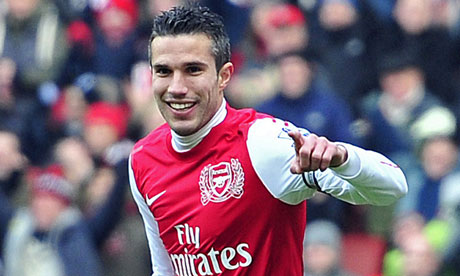
Courtesy: guardian.co.uk
The lessons taught by Champions League drubbings against Barcelona may have been learnt. Messi, Xavi and Iniesta, the three most important players in what was popularly acknowledged as the best team in recent memory, all prefer to operate centrally. Of course there are differences and these changes may just be a stall until Ferguson develops or acquires a supertalented central hub. Ferguson may opt to shuffle – no-one really knows what the old fox has in mind: signing Robin van Persie could simply be the managerial equivalent of a mid-life crisis sports car.

However, optimists could perhaps see him as the final step in United's journey towards fully embracing a more fluid tactical system.

Friday, April 27, 2012

The death of Barcelona?

Consecutive defeats to Real Madrid and Chelsea decry this season's Barcelona bandwagon is coming to a faltering and much-needed rest. That hiatus could be temporary or permanent, depending on new coach Tito Villanova's methods; manager in excelsis Josep “Pep” Guardiola confirmed today that he would not return to helm Barca in 2012-13.

There are reasons aplenty behind Barca's slip from the peak of Iberian – and world – football. Some are obvious, such as a squad which struggled to replace injured defenders, the disease of more, Guardiola's almost inevitable burnout and brutal opposition playing solely to absorb the pressure created by Barcelona's passing and then rebound. Key elements Xavi, Carles Puyol and Eric Abidal succumbed to chronic injury and pure bad fortune.

Perhaps the most important latent reason for their “drop” in form this season was that their game barely changed throughout the four years of Guardiola's reign. Why would you change such beautiful football? Guardiola's Barca evokes memories of the Game of Thrones scenes involving the swordmaster Syrio Forel, who in a world of broadsword hackery sees the sword as a weapon capable of beauty as well as efficacy. Forel saw swordplay at a more advanced and exquisite level than his peers.

Courtesy: thesun.co.uk
The past four years of Barcelona football, 2008-09 and 2009-10 especially, has borne witness to such an advanced philosophy. They are the Forel of world football, with a mode and method far in advance of their rivals. However, as anyone who has read/seen the first installment of Game of Thrones will attest, this hardly makes such learning untouchable.

The problem with employing such an advanced method in the age of video is simple: others observe. In any pro sport, what works one year rarely works the following because others catch on, catch up and overtake. When the peloton can take advantage of tools like Synergy Sports and Opta Joe, a sporting thought-leader needs to constantly evolve its game plan on a conscious and subliminal level. Not only do clubs need to do better the basic elements of what they do, but they also need to expand upon those components.

Although a “Naomi Campbell” – a thing of terrifying beauty – Barcelona's modus operandi remained at a stillpoint which enabled dissection and planning.

The counter-argument of “If it ain't broke” has merit. If Barcelona played to their best, they would still defeat every other team in the world without a qualm. It places the squad in a vacuum, reducing competition to a pub discussion “with all things equal”. We watch sport because things aren't equal. The Bell Jar doesn't require a team who has had success at every level to reach their potential each new day amidst injury, form slumps and personal crisis. The continued growth of Barca's game may have provided alternatives on which to fall back during these times.

If a club or player attempts to expand – not re-shape completely – their game, those efforts are never detrimental. Rare is the club who truly succeeds by paring their repertoire back to the basic elements and focusing their play through only one locus. There must be alternate “looks” or second and third avenues down which to play. Over the past year Barcelona haven't provided many different looks; it's compelling testament to their greatness that they were so successful.

It interesting to note that their original Plan B – the Zlatan Zeppelin – arrived and departed within a year. Purchases over the past two years have been like-for-like: Villa, Mascherano, Sanchez and Fabregas. They sold different players like Oriol Romeu and Bojan – committing firmly to the pass-and-move. The instant players wore down or Messi (heaven forbid) was to be injured, the Barcelona underbelly would become instantly exposed. Taking advantage of this glimpse of vulnerability would still need a combination of hard work, skills and brains; but for certain clubs, a victory would now be possible.

Should he want to regain the Spanish crown, Villanova should maintain the same techniques that achieved such Barcelona grace. However, he also needs to make changes significant enough to both tactically outpoint Los Blancos and revitalise his charges. In 21st century football, homogeneity is the ultimate enemy. Change, for its own sake, is needed at the Camp Nou.

An old adage posits that without losing, winning is meaningless. This iteration of Barcelona, as excellent as they are, will now instinctively place more value on their wins.