Showing posts with label Spain. Show all posts

Wednesday, March 5, 2014

An elegy for Carles Puyol, part one

For my sister.

Central defenders come in many shapes, sizes and styles – they range from ball-carriers tall and elegant to frenetic barnstormers. There are plenty of variants between. However, the people’s choice award for centre-backs goes to the broad-chested titan – ideally with head wrapped in loosely woven cotton – whose Heimdall-like presence exists only to safeguard their territory from imps of the dark.

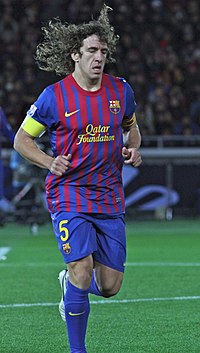
This week, one of those defenders is moving on as Carles Puyol has announced that he will leave the only club he as an adult has known.  
en.wikipedia.org
Puyol was described by theScore as the lion to Gerard Pique’s gazelle; a great shaggy mane belying a forty-axe-handle front. Were it not for him, Spain would certainly not have the first of their two European championships and, with the confidence gained therein, maybe the World Cup and second Euro crown. He was that team’s leader as he had been at Barcelona for a decade.

It is therefore difficult to see immediately who will feel less complete without the other – Barca without Puyol, or the player without the club.

The Heimdall defender stands vigilant and resolute at the entry to Asgard. It is this quality that provokes such a confidence in a club’s support that they, more than a player in any other position, fuse with the club and the two entities become indivisible.

It is no coincidence that the Heimdall defender captains his side. The very concept of the club is meshed so intimately with that centre-back that the player becomes the defining representation of club. John Terry is “Mr. Chelsea” for that same reason. Watching Nemanja Vidic at Inter is likely to feel very odd indeed*.

While many of these players aren’t in fact one-club men, de-fusing them from the club with which they are so readily identified becomes impossible. Part of that comes down to the emotional connection they share with their supporters – I have no desire to see Carles Puyol in any uniform that doesn’t rely heavily on wide blue and burgundy stripes.

Even though I don’t want to see Carles Puyol play for another club, if his choice is to move, I would fully support him. His devotion to Barcelona, outstanding play and nonpareil hair mean he deserves whatever football destination he chooses. In the (extremely) unlikely even he should cross the breach to stand alongside Spain counterpart Sergio Ramos at Real Madrid, Carles Puyol would lose none of my appreciation for all that he has given.

Carles Puyol’s career feels complete. He has worked and he has won. He has nothing left to prove. However, such things often have little impact on when a career ends. Should he want to continue his career at any other club – perhaps on a valedictory tour of MLS with NYCFC – then he should do so with all of our gratitude.

*While these two players are perhaps the best modern comparisons for Carles Puyol and what he represents to their club, it is interesting to note that precisely zero transfer rumours have followed Puyol and he has never been implicated in anything remotely tawdry. Can you imagine Terry or Vidic’s reactions to the play in those heated Barca-Real games of a few years back?

Friday, June 29, 2012

Euro 2012 Final preview

As we regard the Euro 2012 final, it's apparent that we will watch the tournament's two most irresistible sides. Spain have for four years been the international game's standard, a gestalt of tiki-taka, creation and industry. Italy, too, have been utterly compelling; where Spain have over a dozen world-class talents to call upon, arguably the Azzurri boast only a handful – their achievement has come primarily through unity, adaptability and system.

To some observers, their group clash was the best match of the tournament. Since then, the Italians have moved from unknown quantity to having a real puncher's chance at taking the Championship.

Italy manager Cesare Prandelli went into the tournament expecting to play a 4-4-2 with players rotating through a midfield diamond but opted for an unfamiliar 3-5-2 in Italy's opening matches against Spain and Croatia. When this proved only functional versus the Croats, Prandelli went back to his favoured formation which consequently produced sterling results against England and Germany. How they'll line up on Sunday is still unknown, neither formation would surprise.

Tactically, Italy are likely to attempt to free their key midfielders Andrea Pirlo and Daniele De Rossi. De Rossi plays deeper and has struggled to play the full ninety minutes on occasion; Pirlo, the team's creative hub, has been the tournament's best – if not necessarily it's most important – player. The only suggestion Italy may opt for the 3-5-2 again is to offer this duo more protection from a Spanish philosophy based almost entirely upon retrieving possession as soon as it is lost.

Almost to a man, Spain are circuitous, dutiful pests. They discombobulate opponents with tricksy approach patterns amid waves of possession seemingly engineered by Phil Spector. Possession is both weapon and targe; a plastic object moulded and shaped into beautiful creation.

Spain are likely to stick to their favoured 4-3-2-1. Their only question is whether to opt for a true centre-forward or keep Cesc Fabregas out of position as a False 9. With his choices in the semi-final – Alvaro Negredo, who was only mediocre before being subbed early for Fabregas – del Bosque appears to have made his decision. The presence of Fabregas could be crucial in pressuring Pirlo and De Rossi, while also allowing Andrés Iniesta to advance forward and create.

It's worth noting however that Spain have often looked best after withdrawing one of Iniesta, Fabregas or Silva and employing either Barcelona's Pedro or Sevilla's Jesús Navas as out-and-out wide players. This is probably because each triumvir prefers to operate in the centre of the park, while Pedro and Navas earn their coin down the flanks. It isn't that Iniesta or Fabregas can't do so – but that they prefer the field's centre.

Euro2012 logo
Both teams have developed their own effective methods of pacifying their opposition; the most important factor in producing a win from that power-position is the generation of goals. Perhaps the greatest fundamental difference between the two finalists is in each team's ability to draw a goal from the ether: in Antonio Cassano and Mario Balotelli. Prandelli's two forwards have probably been two of the tournament's best and their mere presence – backed by impressive spells by Alessandro Diamanti and Riccardo Montolivo – mean the Italians can feel confident of scoring.

More than perhaps any other team, this Spain team lend themselves to analogy, simile and cliché. Pass and move. Death by a thousand cuts. They pass you to death. Metronomes. Boa Constrictors. They use Alan Rickman's spoon. They possess column inches and bandwidth like they do the football. A win would place them firmly among the best sides of all time, yet they've never had an iconic opponent or truly “all-time” match.

Sunday promises to be that mountaintop.

Tuesday, June 26, 2012

Euro 2012: On Spain and Popular Culture

When the immortal celluloid “Robin Hood: Prince of Thieves” flickered onto my television screen last year, I got quite excited. Carefree days of sixth grade came flooding into my mind, so I decided a re-viewing was in order.

It was rubbish.

It was typical, arch Costner replete with florid dialogue, a full-scale Swiss Family Robinson tree house in twelfth century Britain and Brian Blessed dying very early. Let's not even mention Celts making the unlikely silent pilgrimage from Wales to England's Midlands so as to attack said treehouse.

And the less we talk about Costner's mullet, the better.

However, re-watching left me in no doubt as to the film's best line, delivered in a cadence that linguists can only describe as Ultimate Rickman: “Locksley … I'm gonna cut your heart out with a spoon!

In contrast, the novel “The Princess Bride” features the Spaniard fencing wizard Inigo Montoya. After watching his father cut down by the evil Count Rugen, the boy Inigo spends his entire life practising sword fighting so as to take his revenge. By the book's conclusion, Inigo cuts out his opponent's heart out so deftly, so precisely, that Rugen is able to keep fighting until the killing stroke. Montoya had planned this so Rugen could experience the same as heartbreak and pain he had felt as a boy.

So why is this relevant?

Because Spain, the best international team we've seen in years, have played throughout Euro 2012 balancing uneasily between the two. The Spanish midfield conjures memories of Inigo Montoya's ruthless precision, while their conversion rate (11.9%) exhibits spoon-like execution. Rather than Spanish forwards merely lacking a sharp edge, for all their time in possession – 221+ minutes over four games – la Furia Roja have mustered only 67 shots. In comparison, semi-final opponents Portugal have had the ball for only 166 minutes for seventy shots.

Like Inigo Montoya, Xavi, Iniesta and Xabi Alonso cut the heart from their opponent; but when it comes time for the killing blow, they discard Montoya's magnificent weapon and pick up a Rickmanesque spoon.

Going back over Euro 2012, we've posted several times about Spain failing to adequately capitalise upon their possession. With David Villa missing, manager Vicente del Bosque hasn't used Fernando Llorente, apparently distrusts Alvaro Negredo like a bent bishop while Fernando Torres has regressed almost into a glint in the eye. Their continued dominance while carrying baggage like this is nothing short of amazing. Even devoid of top class strikers they are indomitable – but not undefeatable.

The time has come for del Bosque to use his squad depth. It is time for Llorente, the target man who looks like an inverted pyramid and whose finishing instincts (and luxurious bouffant) have him desired across Europe. It is time for Spain to stamp their authority on Euro 2012 and well past time for Spain to put away Rickman's spoon.

Monday, June 25, 2012

When Cristiano Ronaldo isn't Portugal's main man

The European Football Championships enter their final week. Fittingly, the confederation's four best teams will contest the final matches of the tournament.

A joyfulness has been incorporated into the Teutonic predisposition for precision, while Spain have eschewed the previously successful “death by a thousand cuts” for “death by a thousand paper cuts”. Italy's on-paper mismatch of talent makes them more interesting than at any time since their 2006 World Cup victory and Portugal have created working weaponry from a formerly blunt object.

The most anticipated final matchup would undoubtedly be a rematch of the Euro 2008 final where Spain defeated the Germans to claim their first major tournament win since 1964.

If Spain's midfield can be thought of as a hydra, Portugal are well placed to complete the Herculean labour of subduing the many heads of la Furia Roja. In fact, the Selecção are such popular underdogs that they are in danger of losing that unfavoured status: it's becoming increasingly apparent that their strengths match well against Spanish weaknesses.

Spain's overriding failing this tournament has been an almost negligent attitude towards their end product. With Fernando Llorente out of favour, Roberto Soldado missing and Fernando Torres missing under completely different circumstances, their goals have, as ever, been derived predominantly from the midfield. The centre of the park will be as congested as in any match with the likes of Xabi Alonso, Xavi and Busquets lined up against the territorial Raul Meireles

The best method of countering possession dominance combined with such flagrant reluctance to shoot is with stout central defenders – like Pepe and Bruno Alves – and crucially, midfielders willing and able to carry the ball into positions which create the best springboard for quick and tricksy forwards such as Cristiano Ronaldo and Nani to exploit.

Courtesy: footballzz.com
Portugal have improved in each of their matches, especially in the quality of the link play between defence and attack. A backline of Bruno Alves and Pepe should field no questions of resilience, the transition forward has come chiefly from unheralded sources: Joao Moutinho and Miguel Veloso. Moutinho certainly stood up to the challenge and while Ronaldo was the spearhead, thrusts were generated behind him and chiefly via Moutinho's creation.

Most things will have to fall to their favour for Portugal to win. They'll need Ronaldo at his direct best, Meireles to perform his role, Moutinho to advance the ball well and Good Nani rather than Evil Nani. But given their pedigree and a pragmatic manager in Paulo BentoPortugal could prevent the final of Euro 2012 being the typical sequel which fails to live up to advanced billing.

Monday, June 11, 2012

Torres' role reduced again for Spain

The man they miss with the man whose form they miss
courtesy: worldcupblog.org
Spain manager Vicente del Bosque opted to start yesterday's match against Italy with four defenders and six midfielders. Ostensibly, Cesc Fabregas started up front – and indeed found himself forward more often than his midfield counterparts and scored his country's goal.

 It's unlikely Fabregas will start as far forward of the ball for the entire tournament given that Italy's unusual 3-5-2 formation (with a libero!) contributed to Spain's unfamiliar team selection. But rather than shoehorn a poorly-fitting player into the side in the name of orthodoxy, del Bosque announced that Spain's gameplan doesn't require the prototypical “no. 9”. Also, by not deploying Torres in his favoured role, he also tacitly admitted that he views the Chelsea man as a player only to be used in the right circumstance.

 Bountiful Spanish midfield quality suggests a replacement for David Villa is a luxury rather than an immediate necessity. Were Spain only to create six shots a game, an penalty box predator would be crucial. But by employing the pass 'n' press, Spain can philosophically expect to dominate possession against every team they play; they are likely to create enough chances against harried defenders from which a midfielder like Fabregas, Iniesta or Silva can score.

 This is the form and model of play which has seen Spain win their past two major tournaments. It is also the model in which Fernando Torres now struggles heftily. While serving his country well at Euro 2008, and despite the greatest collection of providers any striker could want, Fernando Torres' confidence issues meant he couldn't play the same role in South Africa and still can't now.

 Torres' Chelsea form this season was fair, at best. He played better as Chelsea reverted to a counter-attacking side, but still patently can't find his strutting best.

 Because Spain so dominate the ball, del Bosque now sees Torres almost exclusively as a player whose best use is in exploiting overextended defences; a player to be brought on fresh for the last twenty minutes when the game naturally produces more chances. His form has regressed to the point where he's now only a player to be used in one situation, a luxury. According to Sid Lowe of The Guardian, del Bosque said as much in his post-match press conference.

 This is a story simply because of Torres' reputation; on form he deserves to be in the squad, but hardly a shoo-in for selection. Spain still have Fernando Llorente and Alvaro Negredo to use at centre-forward. However, without a more clinical edge in front of goal, Spain's goal of a third successive major tournament victory becomes more difficult.

Friday, January 20, 2012

3 Reasons "Second" teams in the "Second" Division won't work

Andre Villas-Boas has been roundly criticised by Football League supporters this week for suggesting he’d like Chelsea’s B team to compete in the nation’s second tier.  Unfortunately for him and his club, Villas-Boas’ recent press statements have seen him become something of a mini-sensation magnet and he seems to spend more time now rebutting sly criticism than providing novel insights into the league.


Basing a second team in a competition further down the League tree would be of immense benefit to the parent club, as they could shuffle players in and out of their lineups to get game time as required.  Barcelona, amongst other clubs, uses such a model in the Liga Adelante; while the practice has become so treasured in Australia’s AFL that most clubs are now in a hurry to set up  their own subsidiary club.  However in England, it is almost unworkable – if not for the logistics, but the fans. 

Red tape hurdles include the strict nature of the English League “tree” – Everton boss David Moyes said this morning he tried five years ago to get a youthful Everton B team experience playing against grown men in the Conference (England’s fourth division).  However, he was told any new club would have to start in the lowest division – the ninth tier – and work their way up as have some more famous foundling clubs like AFC Wimbledon and FC United of Manchester 

More problematic are the fans.  English fans, starting with respected and popular Football League blog The Seventy Two, object to their clubs being disadvantaged to suit the mega-rich.  And fair enough too: apart from somewhat minimising the raison d'etre of those clubs whose First XIs compete in the Championship, the League has a rich history and the landscape would change forever (but not necessarily for the worse, mind you). For the Football League to undergo such a radical re-shape simply for the benefit of Chelsea/Man United/Man City/Arsenal youth players would be a devalue English football for the benefit of a few superwealthy clubs.

Finally, there is one great difference between a Barcelona B team and a potential Chelsea B squad – the current Barcelona B team features a squad with two two – international players (Jonathon dos Santos, of Mexico and Luis Gustavo Ledes of Portugal).  The team Chelsea of 2012 would send to the Championship includes overseas talents like Patrick van Aanholt, Nicolas Anelka and Alex.  The EPL reliance on overseas talent would make such a prospect unworkable and stunt the growth of true English player development. 


I can’t see why Andre Villas-Boas wouldn’t want Chelsea B team to play in the Championship.  As a manager focused mainly on results in the short and mid-term, it would be perfect.  But unfortunately it’s a concept which will have to remain strictly Iberian.

Wednesday, November 9, 2011

Why England can beat Spain

As the Iberians land on English shores, they bring with them a remarkable record. Since February 2007, la Furia Roja has played 71 matches for 62 wins, four draws and five losses; they score an average of 2.25 goals per game. That's an 87% win ratio. For some brief perspective, the all-powerful Barcelona side of 2010-11 won just under 74 percent of their matches.

Spain should have no reason to fear. But they find themselves matched against an opponent of whom they should be extremely mindful.

Why such anglocentric sentiments coming from a critic of both Fabio Capello and the English football hierarchy? It is encouraging for the men in white that the gaffer has called up a (relatively) youthful squad including first-timers Jack Rodwell and Daniel Sturridge. However, Three Lion optimism shouldn't come from any potential debutant but how the match suits England's ageing or faded stars.

The conditions both teams find themselves under generally sees England perform better than any other set. There are a minimum of expectation, a (relatively) understated buildup - for English football - and a self-inflicted crisis surrounding John Terry. Thursday's match should be appealing to partisan and neutrals alike because it gives those England players who have for so long disappointed the chance to perform on a high stage without pressure.

Aside from deserving trio Kyle Walker, Rodwell and Sturridge, Capello's most recent squad features staid, expected names: Lescott, Cole, Terry, Lampard, Rooney. It also includes speedy, tricksy wingers Adam Johnson and Theo Walcott and the (relatively) precise Stewart Downing. In comparing the squad there is a gap in quality between the players in the Spanish squad and those who will represent England but it is hardly a chasm. A larger gap, however, lies in the empowerment of those players and their ability to play as a team.

The psychological benefits of playing as vast underdogs on a big, hopeful stage should be enough to stir a performance out of players who have tempted us with occasional performances only to revert to type in later matches; guys like Frank Lampard, Glen Johnson and Walcott. If they are allowed to play with freedom, this game could be a years-delayed coming out party: (relatively) few have doubted English talent - just the application and heart thereof.

Tactically, wingers Sturridge, Walcott and Johnson could prove decisive as the Red Fury exhibit perhaps their greatest weakness against speed merchants on the flanks. Full backs Puyol, Monreal, Ramos and Alba all have obvious quality but, like most, are vulnerable to pace. Sturridge in particular should be a monty to start as his Stamford Bridge form continues to impress.
Spain v England, 2009: courtesy: myfootballfacts.com
It's in matches like this Thursday's that the Three Lions seem to do well: clashes where excitable expectation gives way to a pessimistic realism. Even though understatement and English football rarely go together, there has been a gathering mood of "blah" about recent Three Lions excursions as weary pundits refuse to be tempted into notable proclamations. This play into the hands of Capello and his men.

Don't be surprised if England defeat Spain on Thursday. They should have all the tools to do so - talent, vocal crowds and the perfect scenario to highlight the talents of underachieving stars. Spain are still favourites - 87.3 percent! - but the match is not the foregone conclusion many suggest.

Monday, October 17, 2011

Spain's Second XI worthy of top 10 ranking

While watching David Silva and Spain dismantle a dogged and compact Scotland on Wednesday, it struck me: this was hardly Spain's best outfit and they were dominating.

Silva cemented his bona fides as one of the top half-dozen players in world football and Spain, with a team featuring second-choice players like Thiago Alcantara, Jordi Alba and Santi Cazorla, passed Scotland into an uneasy submission. The Scots, bless 'em, tried hard but the Spaniards seemed at times to be playing not just another game, but on another plane.

The players who didn't feature on Tuesday - Torres, Casillas, Xabi Alonso, Iniesta, Mata - mean it's now apparent that Spain's second XI could be one of the world's ten best international outfits. They are helped by a healthy youth league and a relative dearth of great opposition: realistically, only the Netherlands and Germany are able to hold a candle to the Spaniards. Brazil and Argentina today only resemble their most terrifying best.
courtesy: sparklingchelsea.wordpress.com

The FIFA world rankings (hardly the greatest indicator, but the only one we've got) suggest the world's top ten sides are Spain, the Netherlands, Germany, Uruguay, Portugal, Italy, Brazil, England, Croatia and Argentina.

In living up to their position description as confusing and nonsensical, the FIFA rankings have Croatia ranked ninth and Greece sitting in eleventh position. This is in spite of both squads finding themselves in the same qualifying group for Euro 2012; a group from which Greece qualified and Croatia now face a tricky playoff tie with Turkey.

We can, however, suggest this is a fairly accurate representation of the best teams in world football.

Were Spain's Second XI to feature in the FIFA rankings, they'd come up against three great teams (Germany, the Netherlands and Uruguay), two inconsistent ones (the other South Americans) and four eminently beatable squads, each with major weaknesses. Apart from perhaps a perceived weakness in central defence, Spain II play a similar brand of football to their first-choice brethren, have pace in abundance and, as they showed on Tuesday, discipline.

Using Spain's favoured 4-2-3-1, the second furia roja would probably include: Valdes; Alba, Jose Enrique, Alvaro Arbeloa and Raul Albiol; Thiago, Javi Martinez, Cesc Fabregas, Santi Cazorla and Pedro; and Fernando Llorente.

Wow.

The argument could be made that this team also features some of the best players dozen players in Spain. In this lineup Pedro plays for the "magoos", yet started in their World Cup triumph last year - superseded by Mata and Silva. Valdes' recent success in head-to-head battles with Casillas now invites, rather than discourages, comparison between the two. Fabregas is shuttled out of the Spain midfield (as with club) by players comfortably in the World's top five. Spain has played better recently when Llorente - rather than Torres - has led the line.

This club may even trouble the the vaunted Spain first team. The Spain Second XI are, on paper, a better team than Croatia, Portugal and even Italy. Place Spain v2.0 in any one of the Euro 2012 qualifying groups (and back them with suitable squad depth) and they at least make the playoffs from each. It's probably also the case that they'd slice England to pieces also.

The simile used most with Spain (and Barcelona) is "death by one thousand cuts". Perhaps a more appropriate metaphor may be that Spanish football is at present drowning the rest of the football world - inexorably, constrictingly and (given their outstanding Euro U-21 campaign) shows no signs of receding. All that is certain is the next wave of Spanish attacks could well overwhelm a struggling Scot, Lithuanian or even Oranje. After decades of torment, La Furia Roja is certainly making up for lost time.

While going back-to-back-to-back at major tournaments is so difficult that it's spoke of in grail-like reverence, the smart money for next year's Euros is on a three-peat - perhaps simply because the difficulty of staying focused for such a period is balanced by the failure of chief rivals Germany and the Netherlands to bridge the gaping talent gap.

Wednesday, January 5, 2011

Real vs. Barca dream team debate

Sid Lowe, a correspondent for World Football Magazine, Sports Illustrated and The Guardian residing in Madrid since 2001 has recently compiled his "Teams of the Decade" for both Barcelona and Real Madrid. A respected voice - both in football commentary and in Spanish life in general - Lowe's teams and reasoning can be found here (Barcelona) and here (Real Madrid).

The teams are also listed here -

Barcelona: Victor Valdes, Juliano Belletti, Carles Puyol, Gerard Pique, Giovanni Van Bronckhorst, Xavi, Andres Iniesta, Deco, Ronaldinho, Samuel Eto'o, Lionel Messi.

Real Madrid: Iker Casillas, Michel Salgado, Fernando Hierro, Ivan Helguera, Roberto Carlos, Steve McManaman, Claude Makelele, Zinedine Zidane, Raul, Ruud Van Nistelrooy, Ronaldo (the Brazilian).


Whatever your preference - for name, styles or culture, there can be little doubt that any other "teams of the decade" would struggle to compete against the might of the two Spanish powerhouses. Cases can probably be made for the usual suspects Chelsea, Manchester United and the Milan powerhouses but even so any suggestion that they'd be able to better the Iberian powerhouses would be speculation at it's most optimistic.

So who do you think would win? Given Barca's propensity for home-grown talent it's likely that Los Blancos squad would have cost several times that of the Catalans. For mine, as impressive as the names are for Los Merengues, I can't look past Barcelona simply because the manner in which they've played for three seasons now is probably as high-quality as we've ever seen. With Real there remains the everpresent question: who's the main man? Would one football be enough?

We'd be curious to see who you think would triumph if both sides were to play a two-legged tie, home-and-away.