Showing posts with label Vicente Del Bosque. Show all posts

Monday, June 11, 2012

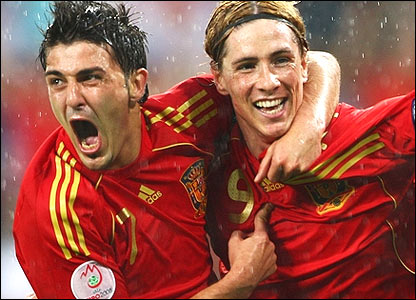
Torres' role reduced again for Spain

The man they miss with the man whose form they miss
courtesy: worldcupblog.org
Spain manager Vicente del Bosque opted to start yesterday's match against Italy with four defenders and six midfielders. Ostensibly, Cesc Fabregas started up front – and indeed found himself forward more often than his midfield counterparts and scored his country's goal.

 It's unlikely Fabregas will start as far forward of the ball for the entire tournament given that Italy's unusual 3-5-2 formation (with a libero!) contributed to Spain's unfamiliar team selection. But rather than shoehorn a poorly-fitting player into the side in the name of orthodoxy, del Bosque announced that Spain's gameplan doesn't require the prototypical “no. 9”. Also, by not deploying Torres in his favoured role, he also tacitly admitted that he views the Chelsea man as a player only to be used in the right circumstance.

 Bountiful Spanish midfield quality suggests a replacement for David Villa is a luxury rather than an immediate necessity. Were Spain only to create six shots a game, an penalty box predator would be crucial. But by employing the pass 'n' press, Spain can philosophically expect to dominate possession against every team they play; they are likely to create enough chances against harried defenders from which a midfielder like Fabregas, Iniesta or Silva can score.

 This is the form and model of play which has seen Spain win their past two major tournaments. It is also the model in which Fernando Torres now struggles heftily. While serving his country well at Euro 2008, and despite the greatest collection of providers any striker could want, Fernando Torres' confidence issues meant he couldn't play the same role in South Africa and still can't now.

 Torres' Chelsea form this season was fair, at best. He played better as Chelsea reverted to a counter-attacking side, but still patently can't find his strutting best.

 Because Spain so dominate the ball, del Bosque now sees Torres almost exclusively as a player whose best use is in exploiting overextended defences; a player to be brought on fresh for the last twenty minutes when the game naturally produces more chances. His form has regressed to the point where he's now only a player to be used in one situation, a luxury. According to Sid Lowe of The Guardian, del Bosque said as much in his post-match press conference.

 This is a story simply because of Torres' reputation; on form he deserves to be in the squad, but hardly a shoo-in for selection. Spain still have Fernando Llorente and Alvaro Negredo to use at centre-forward. However, without a more clinical edge in front of goal, Spain's goal of a third successive major tournament victory becomes more difficult.

Wednesday, January 12, 2011

Messi a worthy Ballon d'Or winner

When FIFA announced that Barcelona and Argentina forward Lionel Messi had won the Ballon d'Or as the world's best player during 2010, it flew in the face of convention by selecting a player who, although universally regarded as tremendous, had not "won it all" that year.


In all fairness, we're talking about a slightly different Ballon d'Or from now on. First and most importantly, the award is now the FIFA Ballon d'Or, dispensed by football's governing body and it's comical - and not in a good way - head, Sepp Blatter. In times past it was awarded by the magazine France Football from 1956 and until three years ago was given only to players who played in Europe. In 1991 FIFA began doling out their World Player of the Year and have wrapped their all-encompassing tentacles around a trophy they didn't own the rights to, appropriating the most famous individual footballing award and stencilled their acronym stencilled across it.


The criteria now for FIFA's Ballon d'Or winner include: performances in major tournaments; individual and team honours; individual talent; skill and fair play; their overall career and finally personality and charisma.


A second key difference is that Messi, although almost indisputably the best footballer in the world, was presented the trophy without actually being part of a winning World Cup squad. This was the first time the award has been presented in a World Cup year to a player who didn't feature for the World Champions. The Spanish press reeled and then railed against the selection of the Argentine, suggesting that triumphant Spain midfielders Xavi and Andres Iniesta were more worthy recipients. The clamour only increased when Spain coach Vicente Del Bosque was beaten into the minor places by Jose Mourinho, who helmed Inter Milan to the UEFA Champions League title.


As much as FIFA has suffered a year they had hoped for more from, we can't lay the blame squarely on the head of Sepp and his eminently swayable bureaucratic chorus. The Ballon d'Or was voted upon by journalists, coaches and captains of teams all over the world and as such the blame - or credit - can be apportioned to people inside the game and not just to those who oversee it. It's telling that Champions League winner and World Cup finalist Wesley Sneijder of Inter Milan and the Netherlands was voted for in large numbers by journalists but not as much from players and coaches, perhaps testament to his notoriously abrasive personality.


The clamour for Xavi, in particular, to win the award is fair and had he walked away with the trophy could be very few arguments. He has claims to being the best midfielder in the world - perhaps the best of his generation - and played alongside Messi with Spanish champions Barcelona and for World Cup winning Spain. But really, could anyone definitively say Xavi is a better player than Messi? And with that said, according to FIFA's criteria he only has one more string to his bow than Messi, who perhaps could have an advantage in several others. As far as Xavi ultimately having more team success, you could say Messi helped Argentina to their World Cup finish in spite of a wacky coach who selected a team which wasn't the best Argentina had to offer. In fact, Messi should be congratulated on his World Cup display while being surrounded by the circus that inevitably follows Diego Maradona. It appears, especially when noting Sneijder's miserly vote tally, that personal preference for each player's role and personality played a role.


Great players don't have to win it all to be recognised as great but they do have to perform on the largest stages. Winning certainly does provide a boost for a player's legacy but it takes a lot of convincing to prove that winning is the be-all and end-all to defining a player's greatness.