Showing posts with label Italy. Show all posts

Friday, June 29, 2012

Euro 2012 Final preview

As we regard the Euro 2012 final, it's apparent that we will watch the tournament's two most irresistible sides. Spain have for four years been the international game's standard, a gestalt of tiki-taka, creation and industry. Italy, too, have been utterly compelling; where Spain have over a dozen world-class talents to call upon, arguably the Azzurri boast only a handful – their achievement has come primarily through unity, adaptability and system.

To some observers, their group clash was the best match of the tournament. Since then, the Italians have moved from unknown quantity to having a real puncher's chance at taking the Championship.

Italy manager Cesare Prandelli went into the tournament expecting to play a 4-4-2 with players rotating through a midfield diamond but opted for an unfamiliar 3-5-2 in Italy's opening matches against Spain and Croatia. When this proved only functional versus the Croats, Prandelli went back to his favoured formation which consequently produced sterling results against England and Germany. How they'll line up on Sunday is still unknown, neither formation would surprise.

Tactically, Italy are likely to attempt to free their key midfielders Andrea Pirlo and Daniele De Rossi. De Rossi plays deeper and has struggled to play the full ninety minutes on occasion; Pirlo, the team's creative hub, has been the tournament's best – if not necessarily it's most important – player. The only suggestion Italy may opt for the 3-5-2 again is to offer this duo more protection from a Spanish philosophy based almost entirely upon retrieving possession as soon as it is lost.

Almost to a man, Spain are circuitous, dutiful pests. They discombobulate opponents with tricksy approach patterns amid waves of possession seemingly engineered by Phil Spector. Possession is both weapon and targe; a plastic object moulded and shaped into beautiful creation.

Spain are likely to stick to their favoured 4-3-2-1. Their only question is whether to opt for a true centre-forward or keep Cesc Fabregas out of position as a False 9. With his choices in the semi-final – Alvaro Negredo, who was only mediocre before being subbed early for Fabregas – del Bosque appears to have made his decision. The presence of Fabregas could be crucial in pressuring Pirlo and De Rossi, while also allowing Andrés Iniesta to advance forward and create.

It's worth noting however that Spain have often looked best after withdrawing one of Iniesta, Fabregas or Silva and employing either Barcelona's Pedro or Sevilla's Jesús Navas as out-and-out wide players. This is probably because each triumvir prefers to operate in the centre of the park, while Pedro and Navas earn their coin down the flanks. It isn't that Iniesta or Fabregas can't do so – but that they prefer the field's centre.

Euro2012 logo
Both teams have developed their own effective methods of pacifying their opposition; the most important factor in producing a win from that power-position is the generation of goals. Perhaps the greatest fundamental difference between the two finalists is in each team's ability to draw a goal from the ether: in Antonio Cassano and Mario Balotelli. Prandelli's two forwards have probably been two of the tournament's best and their mere presence – backed by impressive spells by Alessandro Diamanti and Riccardo Montolivo – mean the Italians can feel confident of scoring.

More than perhaps any other team, this Spain team lend themselves to analogy, simile and cliché. Pass and move. Death by a thousand cuts. They pass you to death. Metronomes. Boa Constrictors. They use Alan Rickman's spoon. They possess column inches and bandwidth like they do the football. A win would place them firmly among the best sides of all time, yet they've never had an iconic opponent or truly “all-time” match.

Sunday promises to be that mountaintop.

Thursday, June 28, 2012

Cometh the hour, cometh Prandelli

While Mario Balotelli once again proved he has enough talent to justify any of his off-field misdemeanours and Gigi Buffon has intimated that all he's still the silent member of the World's Best Goalkeeper club, the man most crucial to Italy's semi-final triumph wasn't a player but their manager, Cesare Prandelli.

Prandelli has achieved an Italian harmony through measures both regulation and unorthodox. He ha changed formation as required – employing Daniele De Rossi as a libero in a 3-5-2 – as well as deployed Serie A's most effective as his stalwarts, regardless of repute. However, what has set him apart has been his deft handling of a forward corps brimming with unharnessed, childlike energy.

Few managers have managed to obtain the best from Balotelli. However, without him the Italians would tonight start to return home to start their holidays. When at midseason Balotelli indulged his amusing wilful streak, he found himself banished from the Italian team with only an even chance of making the squad for Euro 2012. However, with time he was reintegrated into the Azzurri squad and has formed its most potent attacking weapon thus far.

A potential collaboration between Mario and the man he superseded as the enfant terrible of calcio? The stuff of Marcello Lippi's sweat-drenched nightmares? Rather than fearing a situation of knucklehead-squared, Prandelli has with an attitude of easygoing respect made that couplet not just workable but fearsome, all silky skill and unpredictability.

If Lippi wouldn't countenance leading his line with the terrible twosome, backing them up with the venerable Antonio Di Natale would have been an act of fevered imagination. Yet when Balotelli hobbled from the field with cramp against Germany, the manager turned not to a defensive option but to the diminutive Udinese marksman. This is indicative not simply of the faith he has in Di Natale, but of a changed culture around the Azzurri.

The mark of an excellent coach is that they achieve buy-in from their players.  From the way that Italy plays - from the performances he's mustered from players as wide-ranging as Andrea Pirlo, Buffon, Emanuele Giaccherini, Thiago Motta and, ultimately, Balotelli - it's obvious that he has his men completely invested in his gameplan, and he himself as leader.

A sense of controlled adventure is encouraged, an endeavour that has served them well against Spain and Germany. It appears an entirely different side from the one that didn't make it out of their World Cup 2010 group. That was disgruntled side who were trying to get back to where they once had been; this one has accepted that rejuvenation was inevitable and embraced it. That open attitude is engendered by the mangement of Cesare Prandelli.

Monday, June 11, 2012

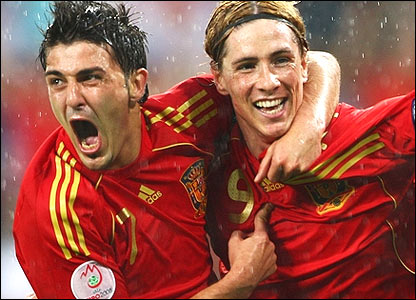
Torres' role reduced again for Spain

The man they miss with the man whose form they miss
courtesy: worldcupblog.org
Spain manager Vicente del Bosque opted to start yesterday's match against Italy with four defenders and six midfielders. Ostensibly, Cesc Fabregas started up front – and indeed found himself forward more often than his midfield counterparts and scored his country's goal.

 It's unlikely Fabregas will start as far forward of the ball for the entire tournament given that Italy's unusual 3-5-2 formation (with a libero!) contributed to Spain's unfamiliar team selection. But rather than shoehorn a poorly-fitting player into the side in the name of orthodoxy, del Bosque announced that Spain's gameplan doesn't require the prototypical “no. 9”. Also, by not deploying Torres in his favoured role, he also tacitly admitted that he views the Chelsea man as a player only to be used in the right circumstance.

 Bountiful Spanish midfield quality suggests a replacement for David Villa is a luxury rather than an immediate necessity. Were Spain only to create six shots a game, an penalty box predator would be crucial. But by employing the pass 'n' press, Spain can philosophically expect to dominate possession against every team they play; they are likely to create enough chances against harried defenders from which a midfielder like Fabregas, Iniesta or Silva can score.

 This is the form and model of play which has seen Spain win their past two major tournaments. It is also the model in which Fernando Torres now struggles heftily. While serving his country well at Euro 2008, and despite the greatest collection of providers any striker could want, Fernando Torres' confidence issues meant he couldn't play the same role in South Africa and still can't now.

 Torres' Chelsea form this season was fair, at best. He played better as Chelsea reverted to a counter-attacking side, but still patently can't find his strutting best.

 Because Spain so dominate the ball, del Bosque now sees Torres almost exclusively as a player whose best use is in exploiting overextended defences; a player to be brought on fresh for the last twenty minutes when the game naturally produces more chances. His form has regressed to the point where he's now only a player to be used in one situation, a luxury. According to Sid Lowe of The Guardian, del Bosque said as much in his post-match press conference.

 This is a story simply because of Torres' reputation; on form he deserves to be in the squad, but hardly a shoo-in for selection. Spain still have Fernando Llorente and Alvaro Negredo to use at centre-forward. However, without a more clinical edge in front of goal, Spain's goal of a third successive major tournament victory becomes more difficult.