Showing posts with label MLS. Show all posts

Thursday, April 10, 2014

Is the MLS spread too thin?

Just the right amount. Courtesy wikipedia.
Word out of Atlanta suggests that MLS may be expanding again, with the owner of the Atlanta Falcons being offered a franchise in the rapidly inflating league.

While expansion can be considered good news to the current clubs (a buy-in is likely to produce an immediate cash windfall for each team owner), the pace at which MLS is growing is perhaps slight cause for concern.

In the next four years, the league seems set to increase its membership by at least four, with teams in New York City, Orlando, Miami and now Atlanta ready to join. This next raft of newcomers joins the recent growth into markets as varied in success as Philadelphia, Vancouver, Portland and Montreal.

With current MLS rosters set at 30, there are serious questions as to the ability of the United States and Canada to support an extra 21% growth within three years. Simply put – do the US elite ranks (that is: MLS, college, NASL and USPro leagues) have enough talent to put an extra 120 players into MLS without “watering down” the product that has begun to win so many local fans?

In the league’s past four expansions, the 110 players who comprised opening day rosters came from one of five main sources: 25% came from US minor leagues, 38% from MLS, 22% from International transfers, 11% from college and 4% made their way through their club’s academy.

That would suggest that a further 120 players would need to be pumped from similar sources. So far, 51 players have been “sent down” to the NASL/USPro leagues in 2014, while some notable players without MLS clubs will try to attract further notice in the NASL. The most notable of these is former Vancouver designated player Eric Hassli, who will play this season for the San Antonio Scorpions, while Freddy Adu remains in discussions with Eric Wynalda’s Atlanta Silverbacks.

However, gut feeling suggests that the step up may be too difficult for more than 15-20 of these elite minor leaguers. College ranks might be able to provide more than the above 11% - but enough to cover the shortfall? The simple answer is that there won’t be – at least temporarily. Without a great influx of foreign talent to maintain the requisite standards, the overall quality of the league simply must decrease.

The answer, at least in the long-term, comes from within. MLS academy products are now vastly improved in quality – see the likes of DeAndre Yedlin and Erik Palmer-Brown. Their emergence makes it now imperative that these academies become the future of MLS, just as in their brother leagues abroad. If MLS is to continue expanding both its geographic and power bases, then replenishment must come from the league’s own resources.

Friday, January 17, 2014

USMNT: The beef comes home

Michael Bradley’s return to play for Toronto FC has met with several sources citing the impact on the US Mens National Soccer Team. Could Bradley playing in a supposedly inferior league mean the US’ chances of a performing well in Brazil be somehow lessened?

Any answers will be purely speculative until the US kicks off their campaign on June 16 against Ghana. However, this trans-Atlantic shift heralds another interesting landmark in US Soccer – with Clint Dempsey arriving in August 2013, Bradley’s arrival means that most of the elite outfield talent in US men’s soccer now resides locally rather than abroad.

The nation’s three most marketable, game-changing stars – Donovan, Dempsey and Bradley – now play at home.

Only a few of the world’s top 20 teams (Spain, Italy, England, Germany, Greece and the Ukraine) can make such a boast, exemplifying the progress of MLS as a competition and highlighting both latent forces that underlie future success in US Soccer – a wide player base from which nascent stars can emerge, and an increasing fiscal robustness.

When we last explored a fictional game between US teams made up from MLS and abroad, the absolute elements of class played for Tottenham Hotspur, the LA Galaxy and AS Roma. Let’s revisit that concept now, eighteen months later and ask who would win a one-off match between a US team made up solely of MLS talent, or an XI who all play professionally away from home?

MLS XI (4-4-2):  Rimando (Real Salt Lake), Evans (Seattle Sounders), Gonzalez (LA Galaxy), Besler (Sporting KC), Morrow (Toronto FC); Zusi (Sporting KC), Alonso (Seattle Sounders), Bradley (Toronto FC), Dempsey (Seattle Sounders); Donovan (LA Galaxy), Wondolowski (San Jose).

Non-MLS XI (4-4-2): Howard (Everton), Beasley (Tijuana), Cameron (Stoke City), Ream (Bolton Wanderers), Johnson (Hoffenheim); Diskerud (Rosenborg), Jones (Schalke 04), Edu (Stoke City), Johannsson (AZ Alkmaar); Altidore (Sunderland), Gomez (Tijuana).

(c) Author's own collection
In August 2012, our final verdict was that the MLS XI (featuring only four players from this iteration) would trouble their intercontinental brethren, but winning might have been a bridge too far. Now? Nine of the MLS XI are almost certainties to make the World Cup squad, with Justin Morrow and Ossie Alonso dark horses. Could the same be said for the non-MLS squad? Perhaps not.

There’s every chance that the early-2014 MLS team might be able to defeat their visiting compatriots. That such parity home and abroad reflects negatively on US Soccer is a nonsense; US Soccer is patently in as rude a health as it has ever been.

Friday, November 1, 2013

Beckham and Miami a perfect fit

News filtered through this week that David Beckham has selected Miami as his venue of choice for a new MLS franchise. The as-yet-unnamed team seems set to become the third visible expansion team after the Manchester City and New York Yankees’ joint venture, New York City FC and the record-setting Iron Lions of Orlando.

Really, selecting Miami was a no-brainer. The appeal of the city to athletes is notorious, and although one MLS franchise has already failed in South Florida, the times have changed in MLS such that Beckham and his co-investors are making this decision based on expected strong crowd support. While this hasn’t always been the case in South Florida – especially during particularly unsuccessful sporting summers – the city is a major market with a passionate soccer fan base.

(c) Author's own collection
Scanning the list of major US and Canadian cities without MLS franchises, Miami is the most populated unrepresented city and has been targeted by the league as a possible location for some time. Other options it was believed Beckham was looking at were San Diego, Orlando and … wait for it … Montreal.  

Commissioner Don Garber is on record plugging the merits of a twenty-four team league with a presence in Florida, Atlanta (please let this potential franchise keep their NASL nickname, The Silverbacks) and another SoCal team. That he has now leveraged three global brands into associations with MLS means smaller, more … optimistic parties should begin doubting their immediate chances.

As the business plans for each nascent franchise gain clarity, so does the picture of MLS’s mid-term future. Fittingly, David Beckham is front and center for this new era.

Wednesday, October 30, 2013

Dempsey behind Seattle Sounders' decline

(c) Author's collection
Rumours persist that Seattle Sounders coach Sigi Schmid needs at least an appearance in the MLS Cup Final to retain his job. 

He won’t get it.

Despite boasting – on paper – the best forward line in the seventeen-year history of MLS, the team has almost completely failed to gel and enters the playoffs with form that can only be described as calamitous.

The downturn can be traced to what seemed the Sounders’ zenith, the capture of USMNT talisman Clint Dempsey from Tottenham Hotspur and his presentation to the throng as all-conquering Caesar.  The crowd thrummed as “The Deuce” emerged onto CenturyLink field to his rather overstated rap, all expectant that the best-credentialled outfield player in American soccer would complete Seattle’s reformation from inertia-bound locomotive into filthy, filthy machine.  Dempsey, Obafemi Martins, Eddie Johnson and Mauro Rosales?  Heaven help Real Salt Lake and the Galaxy.

Friday, May 17, 2013

Farewell, David Beckham, and thanks

David Beckham has retired from professional football at the age of 38.  The former England captain and fashion icon leaves the game a ten-time league champion in twenty seasons – winning six titles with Manchester United, two with Los Angeles Galaxy and one each with Real Madrid and Paris Saint-Germain.

He will be remembered for a great many things – scoring from midfield to announce his arrival, romancing a Spice Girl and transcending his sport more than any other footballer.  In some ways it’s a pity that his global fame has overshadowed his formidable footballing ability, for he was a truly outstanding midfielder for Man U.  He was absolutely brilliant with his dead-ball delivery and could deliver a Hollywood assist better than anyone of his generation outside retirement companion Paul Scholes

A cross from David Beckham?  On time, every time.

He will go down as the defining player of his generation, a name for the ages carrying greater widespread appeal than those who accomplished more on the field like former teammates Ryan Giggs, Raul and Andrea Pirlo.  The names forever linked with football from the late 90s and early 2000s will begin with David Beckham.

(c) Balanced Sports - from author's own collection
While his mystique was awe-inspiring, he was hardly an overpowering or dominant player.  Aside from those elegant, glorious set pieces, David Beckham rarely inspired fear in the manner of Ronaldo, nor did he befuddle like a Ronaldinho or Messi.  Indeed, it might be his greatest achievement that he leaves the game as his generation’s defining (and most marketable) player without actually being amongst the very best of the era.

Beckham’s singular talent wasn’t for football or a particular skill within it, but an immense charisma that saw everyone seek his approval (aside from one or two particular managers).  So powerful was the impression left by his simple and dignified affect that he belongs in the Athletic Charisma Hall of Fame alongside the likes of Michael Jordan and founder member Muhammad Ali.  While these two boasted a more primal and combative magnetism, Beckham’s appeal is based around a graceful and understated – almost minimalist – style.

The other skill that David Beckham perfected was an ability to make money.  This is inextricably linked to his other singular asset: his bearing created a demand that expanded his pocketbook exponentially.  It’s hard to rationalize an athlete making the lucrative money he has, and even harder to justify.  However, considering the amount of rabid publicity he and his family endured, he deserved every penny.  Even in his last season, he earned £30 million – including a rich contract for a dozen appearance from PSG’s bench that only further heightened his public appeal

He leaves the game with as much class as he entered it.  When a young David Beckham sent a 45-yard ball floating past Wimbledon ‘keeper Neil Sullivan, the football world opened up to him and anything seemed possible.  Now, as he now walks into a much larger world, the same could be said again. 
Anything is possible.

Thursday, May 2, 2013

MLS and Manchester City a good match

With MLS seeking again to swell its ranks, the discussion has seemingly moved from where the next franchise will be located – New York City – and onto whom is best positioned to own and run such an enterprise. 

It has emerged that Manchester City’s flush-with owners are interested in soldering together this prometheus, appropriately based in the borough of Flushing.  The new team would serve twin purposes of generating talent for its parent club and increasing City’s brand recognition in the ever-expanding US market.

City’s expansion into the US market seems to have been received positively by fans of MLS as well as Don Garber, as well it should.  The league was recently judged the seventh-most attended on the planet, as has begun regularly producing players of true quality and an open gateway to Europe could provide more exposure in a nation where football highlights rarely make Sportscenter.

Close ties between are commonplace within countries, or continents even - Manchester United have had a longstanding relationship with Belgian club Royal Antwerp.  More recently – and perhaps more similarly as well – the Pozzo family has expanded from their black-and-white binding fiefdoms at Udinese to annex clubs in Spain and England, using them to develop players that they can then either use or sell, usually with a significant sticker price increase.

Any concerns MLS fans have about being home to “feeder” clubs can be assuaged by investigating the benefits of and exposure that having Sheikh Mansour involved in American sport would deliver.
Setting up an expansion franchise, youth academy and building a stadium in the real-estate mire of NYC will cost a bucketful.  Such hard costs coupled with the expense of bringing in players might intimidate a new ownership group and delay fan aggregation – we all love a winner.  Not only would the New York Blues have the opportunity to raid the Sky Blues for loan players, but also the backing to deliver some of the country’s most promising young talent.  They have more money to spend at chiseling out market share than could possibly be needed, no small feat in the City that Never Sleeps.

And perhaps the greatest benefit of all might come from the increased visibility.  The popularity of the English game transcends that of all other major leagues (with the exception of two notable Spanish clubs) and the Citizens’ five-year spending spree has ensured their position at that league’s apex until their patriarch suffers from a case of terminal boredom. 

Links with a league as outgoing as the English Premiership should be actively encouraged.

It is a fundamental truth of business that if a superwealthy investor shows interest in your product, you’re doing something very right or very wrong.  Another reality is that you generally look to involve these multi-multi-multi-billionaires wherever possible, as long as it doesn’t put you out too much – having capital in the bank never hurts.  The continued growth of MLS suggests that Sheikh Mansour bin Zayed al Nahyan’s interest isn’t hostile; if the feelers he is putting out are genuine, rest assured that Garber et al will move heaven and earth to make him a part of the league.

Tuesday, February 19, 2013

Robbie Rogers comes out, then "retires" on his own terms

On his website on Friday, former USMNT forward Robbie Rogers both came out and “stepped away” from football.  The 25 year-old, scorer of the first goal in Jurgen Klinsmann’s reign as US coach, last played on New Year’s Day for English League One side Stevenage.

He was immediately greeted with a swarm of support emanating from all corners of the football world.  Former teammates, casual observers and even loudmouths in Southern France – anyone who appreciates a triad of courage, honesty and diversity – issued messages of support. 

The response has been so overwhelmingly positive from administrators, coaches and players that it can be thought of as a high-point for sport in the fight against homophobia.  During the past few years, fans have witnessed a number of athletes and executives publicly stand up to bigotry directed at them because of their sexual orientation*.

The second part of Rogers’ blog post regarded his decision to walk away from the sport to which he has devoted so much of his life.  Much conversation on the topic followed Rogers’ statement, including Clark Carlisle, the chief of England’s Professional Footballer’s Association, congratulating Rogers and hoping the player’s de facto retirement wasn’t linked to his decision to come out.
Let’s get one thing straight: the two are inextricably linked, but perhaps not for the reasons to which one might immediately leap.  

I doubt highly Rogers has retired because he fears victimization.  From speaking with gay friends, coming out takes an awareness that you could provoke a reaction – either positive or negative – and the courage to make the choice anyway.  For a public figure, the reaction is amplified and therefore the strength of character must also be.  If it was ever in doubt at all, Friday proved that Robbie Rogers has guts. 

This suggests the (secondary) retirement decision wasn’t driven by fear at all.  He can’t not be aware of the bigotry that exists in some corners of sport and he showed he was a man strong enough to deal with those challenges.  If Robbie Rogers has the stones to come out to his “loved ones” after 25 years, then he has the stones to face the prejudiced judgment of complete strangers.

It seems more plausible that Rogers’ retirement might give him space enough to adjust to an unfamiliar new role.  Deliberate or unintentional, Robbie Rogers is now one of the most prominent “out” athletes in the United States and ultimately more newsworthy than he was a week ago.  Coming to grips with this will probably take time: it behoves fans and media outlets to allow him this basic civility.

*For a magnificent insight into a gay professional footballer’s fight, try this read on former Montreal Impact star David Testo by Leander Schaerlackens on SBNation.

Friday, October 5, 2012

Michael Ballack retires

Earlier this week, former Germany captain Michael Ballack retired from all professional football. The most stylish and (sometimes brutally) effective German player of his generation leaves the game permanently at age 36.

Ballack had both the fortune and misfortune of being born five years too late. To look at it another way, he was born five years too early. He could have been a precocious youngster alongside Lothar Matthäus, Jurgen Klinsmann and the greatest years of Oliver Kahn, but was born as the seventies turned. Born half a decade later and he wouldn't have just nurtured the startling Germany team of the home World Cup in 2006 but championed it. Instead, he scraped into the tail of one wonderful era and was moved on before the second blossomed.

In hindsight, this may actually have suited him. As the best player in the country, Ballack enjoyed starring roles at Bayer Leverkusen, Bayern Munich and for Die Mannschaft; after the success of 2006, he moved to Chelsea before concluding his career at Leverkusen. A man betraying precious little self-doubt, the spotlight rests easily on him. He was Germany: it wasn't a burden, just the way things were.

Courtesy: heraldsun.com.au
His polished – if not definitive – turn as an analyst for ESPN over the 2012 European Championships only highlighted his readiness to step away from the centre of midfield.

Michael Ballack rarely took a backwards step. And in a weird kind of way, that could be why his mooted move to Toronto FC or the fledgling Western Sydney Wanderers never really made it off the ground. Wage demands might have played a part, but had he wanted to keep playing the monetary terms could have been arranged. Some men are made to be ambassadors, but Michael Ballack just isn't one of them.

Sydney FC signee Alessandro Del Piero will be crucial to the A-League and football's growth in Australia. Without question, he is the best player to ever play in the Antipodes. Ballack is two years younger and fit a role which doesn't necessarily depend on speed. He could have owned the A-League; if Christian Tiffert makes such an impact in Seattle, how deadly would Michael Ballack be? However, doing so – even for reported millions – may have felt like a backward step. At 36, once usefulness at the very top level has been exhausted, the best players must accept a reduced role - one of venerable sage, goodwill ambassador or even figurehead.

Some athletes are engineered to keep going; Del Piero joins his English contemporary David Beckham as the most obvious examples. Ballack probably isn't wired that way, and that's fine – not many have the combination of talent, temperament and stamina to do so. The ultimate cost/benefit analysis all footballers face contrasts desire and depreciation. When that ratio dips too low, it's time to enter the tunnel for the final time.

Michael Ballack leaves the game on his own terms. It couldn't really have happened any other way. However, his luxuriant bouffant and measured analysis on ESPN suggests we will see a lot more of him in the future.

Tuesday, September 11, 2012

Follow the money - and talent - back to MLS

In the August 27th issue of Sports Illustrated, senior writer Grant Wahl compiled a team of American soccer players playing abroad. Such a mainstream publication – find any dentist in the States who doesn't subscribe – publishing a full-page “lightweight” feature on US soccer is relatively rare and Wahl takes the opportunity to pull the usual names from the regular hats. It's the basic, all-purpose US men's national team.

Assembling fictitious teams is a pleasant exercise in pointlessness. Almost every blogger and journalist has done so – they stimulate discussion, can be used to illustrate a point, attract pageviews like crazy and finally, much of the legwork (ie. research) is already completed meaning a quick turnaround. (Look here and here for some examples on Goal Posts).

For writers, they're our side of an enjoyable pub debate.

However, this team made for an interesting test-case. This is because many of the best US footballers – as with Canada, Australia and several other nations – play in Europe. The Americans, however, are a special breed as the quality of their local game is improving as its popularity increases. No longer does a player have to move to Europe to fulfill their footballing destiny or monetary desires, meaning that in the past half-decade the standard of MLS has taken a quantum leap.

MLS, while of inconsistent quality, can produce scintillating football and as the standard improves, so does local talent. Due to the Impact, Whitecaps and Toronto FC, Canadian football reaps some of the same benefits.

In fact, Major League Soccer has developed the quality of US football to a standard now where players earning a quid locally could quite easily compete with – and, if the conditions were right, perhaps defeat – a team made up of “exports”. This is a major signal that the league is prospering the sport both at a grass-roots and professional level.

While Wahl's team undoubtedly boasts more class than a team drawn solely from MLS, the gap in quality isn't as different as you'd initially expect. A team derived of American players who play only in MLS could be as potent as many European sides:

US MLS XI: (4-3-3) – Rimando (RSL), Beitashour (San Jose), Clark (Houston), O. Gonzalez (LA), Pearce (NY), O. Alonso (Seattle), Donovan (LA), Davis (Houston), E. Johnson (Seattle), Shea (Dallas), Wondolowski (San Jose).

courtesy: zimbio.com
While the team lacks je ne sais quoi, it would certainly be enough to trouble their overseas brethren. Eighteen years removed from the iconic 1994 World Cup – the event that begat Major League Soccer – the spot in general is seeing the results of hard work put in by the USSF/US Soccer.

Teams made up of local players in many of the “second-tier” big football countries such as Korea, Japan or Mexico would rival – if not defeat – their globe-trotting compatriots. These leagues, new and old, are deep enough to compete financially and competition-wise for the country's best players. The result is Keisuke Honda spearheading Japan's wonderful 2010 World Cup and Asian Cup campaigns or a major club like Arsenal signing Park Chu-Young.

The next step up in competition is when the league produces entire teams capable of contesting the CONCACAF Champions League and eventually, competing – if not beating – South American and European clubs at the World Club Championships.

Progress has been slow, but assured. Now the league is reaping the rewards.

Thursday, July 26, 2012

Tim Cahill joins New York Red Bulls

Tim Cahill MLS
Courtesy: montrealgazette.com
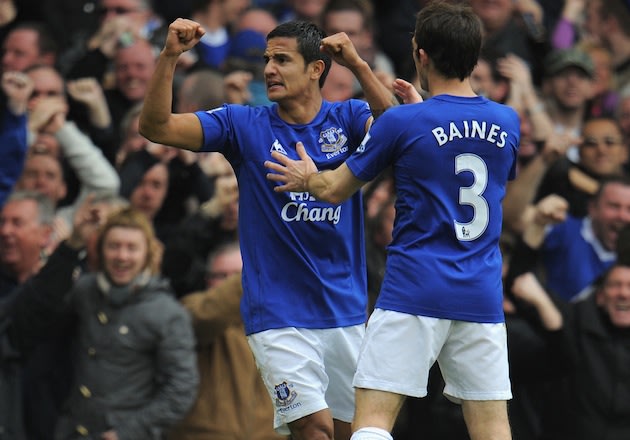
The New York Red Bulls have (all-but) signed Australian Tim Cahill from English Premier League side Everton. He joins MLS after eight successful years on Merseyside as a attacking-minded midfielder. He's the kind of player who can – and will – succeed enormously in MLS.

The time was right for him to move on. As one of the youngest members of the the Socceroo Golden Generation, it was time for him to follow his ageing brethren in leaving a major league for a more fiscally rewarding one. Already this summer, his head was turned by enticements from Al-Nasr of the Saudi Professional league, among others. After a down 2011-12, Everton manager David Moyes obviously thought it best to sanction the move.

Other factors play into Cahill's eagerness to shift continents. Meaningful minutes – despite his stature, not guaranteed as a Toffee – should cement his spot in the Aussie midfield at the World Cup in Brazil in two years' time; any impact he makes will also be the first any Australian has had on MLS, hopefully making Cahill a trail blazer for Aussies chasing a step up from the A-League.

Despite this move suggesting Cahill sees himself more as a big fish in a smaller pond, RBNY secured a major bargain with the acquisition. He remains one of the best headers of the ball in world football, and still ghosts into the box like he trademarked the phrase. These traits should combine well with the silk of Thierry Henry and further strengthen New York's MLS Cup push. Cahill's relative youth and a move back into the midfield (he's played out of position as a striker for much of the past two seasons) make him not only a bargain but potentially a league-wide star.

Monday, July 9, 2012

Short Pitch: Zakuani hugs the man who broke his leg

In front of a typically vocal northwest crowd on Saturday, Steve Zakuani made a touching return to MLS. He appeared as an eighty-sixth minute substitution and impressed: the first pick in the 2009 draft looked his usual energetic self. Zakuani had missed the past fourteen months after sustaining multiple fractures to his right leg, courtesy a reckless tackle by the Colorado Rapids' Brian Mullen.

His return wasn't special because he further increases depth in a formidable front line, nor because the occasion snapped the team out of a nine-match winless streak. His return was special because when the final whistle shrilled, Zakuani and Mullen searched each other out and hugged, exchanging jerseys in one of the most touching moments in MLS history.


Century Link Field achieved a small claim to fame in 2011 when the crowd set off seismographs during an NFL playoff game. On Saturday, reverberations were felt around the league as first Seattle, then the league offered Zakuani a warm welcome.

Sportsmen are often expected to display a stoic aggression that touches on bluster. Occasionally, decency is lain at the altars of gamesmanship and achievement. However, often the most powerful gestures on sports arenas aren't dripping with machismo but those where a player takes the opportunity to do the right thing. On Saturday, MLS was fortunate to see one of those moments.

Thursday, June 21, 2012

MLS: a taste of the Euros

Last night I saw the Seattle Sounders play Sporting Kansas City in a thoroughly enjoyable MLS encounter. It started uneasily,  however, as on a very pleasant Seattle evening we traipsed down to SoDo.
The trip involved me fielding several obvious-but-unhelpful statements from my companions, mutterings like “It's not like the Premier League” or “I'd rather watch the European Championships”.

 When the whistle sounded to end the tie, we'd taken in slice of everything we'd seen over the past two days of the Euros.

 Firstly, defender Paul Ianni scored a goal that reminded me of Zlatan Ibrahimovic's masterful strike for Sweden against France – one legged and using all his martial arts ability to stabilise his upper body while channelling all his power into his striking leg.


 In front of 47,000 singing fans – nearly the same attendance as saw England defeat Ukraine – Sporting Kansas City managed to grab an early goal, before Ianni's set-piece strike levelled the match in the fifteenth minute.

 In the second half, the match first appeared as if Seattle would dominate possession and the match as Sporting KC were pegged back by an impressive Sounders midfield. The ex-Wizards looked most likely to pinch a winning goal by quick ball movement on the counter-attack, which again reminiscent of so many teams throughout Euro 2012.

As if consciously mimicking yesterday's match between the Ukraine and England, a crucial goal (in this case the potential game-winner from Fredy Montero) became more transparent - most of the ball crossed the line, but not all - and we had ourselves a ghost goal.

 There was also plenty o' niggle, as KC persistently fouled a more fleet-footed Sounders attack; the fulminating when Seattle sub Alvaro Fernandez was sent off with a straight red in the ninety-first minute.
I didn't have to temper my companions' expectations when the game finished, just sit back and enjoy my beer as they enthused about our shared spectacle.

 It was a match that had everything that football can provide. The Euros have been fantastic, and it's been great to see the sport receive all the attention such a tournament deserves, but to think of MLS as a poor relation is unfair and patronising. MLS is what it is – a retirement investment, a development league, an enviable top tier. It is many things to many people, and is now creating its own impressive identity because of that multicultural background.

Monday, February 6, 2012

Kris Boyd's arrival signals a change in Timbers' style

With the Portland Timbers signing ex-Scotland striker Kris Boyd, the MLS in the Pacific Northwest takes on an intriguging new look. He replaces former USA international Kenny Cooper, who was traded to wannabe-glamour-club, the New York Red Bulls.

The Timbers started their MLS existence relatively strongly last season, finishing sixth in the Western Conference and two games out of a wildcard playoff position. Should he replicate even half of his Scottish league form, Boyd should prove a more than adequate replacement for Cooper, who mustered only eight goals last season. Boyd, with a game described by the Shin Guardian as “a little bit of nastiness and a whole lot of go-go-go” could replace this total with no more than three games’ hard graft.

Boyd’s move leaves Houston Dynamo in severe need of a new forward. With last season’s offensive centrepiece Brian Ching now leading the line for Montreal and without Boyd, the Dynamo will need to find another forward – stat – or be forced to rely upon a lineup whose top goalscorer managed only six majors last term.

Many are cognizant of Boyd’s reputation as a bit of a dud when playing anywhere other than the SPL. Perhaps they should be more interested in the change of style he will bring to a team that was often last season devoid of precision.

The Scot’s reputation as a poacher who contributes only sporadically to lead-up play is stylistically the complete opposite of the man he replaces. Though Cooper’s play matched neither Stumptown expectation or his wage packet, he had undeniable value as a blunt-instrument forward that occasionally provided a valuable get-out-of-jail free card.

Rather than a player who will earn you probation, they hope Boyd will stop the team needing to play such a desperate game. Boyd’s style is based around deft incision and razor-sharp goal sense, and so can’t hope to provide such a leviathan target figure as the 6’3, 210 pound Cooper. Rather than being a creator, he is a finisher. That the Timbers went for a proven scorer indicates the team quite rightly hopes to change their gameplan accordingly.

All that remains is to question whether the rest of the Timbers’ squad are able to provide him with the supply he needs to flourish. Because with the money reportedly involved, this amounts to an gamble by General Manager Gavin Wilkinson. Should the club not adapt to their new front-man, the team will fail even to reproduce last year’s win totals.

Friday, February 3, 2012

The Return of "Smithy"

As I flicked past the A-League results page on ESPN Soccernet's page this morning, I chanced upon an odd name: a player named “Smithy” apparently started at centre-forward for the Wellington Phoenix in their match against Adelaide on Friday.
Screen dump from ESPN Soccernet

This struck me as odd, as the last guy to make it big in the world of football with that name was (sit down Alan Smith, it's not you) James Corden, who performed as Smithy the plumber for 2009 Comic Relief. It certainly wasn't him; nor was it one of those South American names that sound unusual to the anglophone (Vagner Love?).  Nor had Joel "Smithy" Corey switched codes.

It turns out on closer inspection that the mysterious “Smithy” is US/English footballer Alex Smith who was on the books at FC Dallas before appearing in Australia for Gold Coast FC, Sydney Olympic and recently the Phoenix. Nowhere can I find mention of him changing his name to “Smithy” so either the lads at Soccernet are having a bit of a joke, or there's something about the big Ginger fella we don't know.

On second thoughts, as a second-tier player in a relatively minor league, there's probably a lot about him we don't know.

Wednesday, November 23, 2011

MLS welcomes the Impact; Montreal unlikely to host Ching

Obviously it's hard to predict how a club will perform throughout their first season of Major League Soccer - there are simply too many variables to make prophecy a worthy exercise. Today though, we begin to take stock of exactly what Montreal can expect to achieve given the players they selected in the MLS Expansion draft.

The Impact selected some quality players for their own use, some for leverage purposes and others simply to on-trade. It was puzzling that they left good (and cheap) prospects like Mike Fucito alone. They, like the Whitecaps last year and Philadelphia before that, chose to ignore some high profile (read: expensive) guys like Freddy Adu and Jonathon de Guzman, preferring to focus on supplementing their NASL quality with legitimate CONCACAF talent.

Public and pundit response has been mostly positive - especially given the calibre of player left unprotected by the established eighteen MLS franchises. Reaction has been fair, with the selection of former US men's national team forward Ching by far the most debated business item. As the draft was structured, the Impact simply had to select the Houston forward regardless of his threats to retire. Doing so put the Impact - and coach Jesse Marsch - in a bargaining position where they hold all the cards.

The purpose of Expansion Drafts is not to provide the bulk of a team's roster for the future. Were a club coach to take that approach, the club becomes mired in youthful mistakes and that coach is fired. The best strategy to take is to focus on acquiring serviceable starters without stretching for salary or the future.

It is rare that expansion draftees last for the long-term at a club: three of the Sounders taken in 2008 now remain in Seattle. Two initial Union draftees still reside in Philadelphia only two seasons into that club's MLS existence. Of last year's Expansionistas, three sapling Timbers are still in Portland while the Whitecaps finished with five of their initial ten.

courtesy: yanksarecoming.com
Whoever sticks - perhaps Sanna Nyassi, Justin Mapp or Zarek Valentin - can be joined by Impact players who've competed well in Gold Cups and attempt the step up. The new boys have high hopes for new signings like Nelson Rivas and Evan Bush. Perhaps Marco Materazzi, Luca Toni or SuperPippo Inzaghi could bowl up in Little Italy as well.

It's not the place of Expansion Drafts to provide the basis for future success, only for stability and to give the incoming club some assets that aren't initially super out-of-pocket expenses. In following this principal, the Impact came out winners from today's draft.

Wednesday, May 4, 2011

Memphis Grizzlies vs. Oklahoma City Thunder a sad Pacific Northwest Basketball tale

This year's NBA Western Conference Semifinal series between Memphis and Oklahoma City is a particularly painful one for many NBA afficionados to watch. Not for the quality of the play: the Grizzlies cuurently may be playing the best basketball in the West, while Oklahoma City's roster includes superstars Kevin Durant and Russell Westbrook combined with feel-good role players like Serge Ibaka and Kendrick Perkins. It's hutsome - especially in my current home city - because it showcases two NBA franchises that relocated from the Pacific Northwest to smaller Midwest markets.


In 2008, the club formerly known as the Seattle Sonics bolted town after forty-one years ingrained into Northwest folklore. That span included twenty-two playoff campaigns, three NBA finals appearances and the 1979 NBA Championship where a three-guard rotation of Gus Williams, Dennis Johnson and "Downtown" Freddie Brown were anchored by the outstanding hair (and post game) of young centre Jack Sikma. It rankles Seattle fans so much that many now take no interest at all in pro basketball. Nearly three years since new owner moved the franchise to Oklahoma City, there's still enough ire for the man who sold the team, Howard Schultz, to eject fans from a book signing in upmarket Bellevue. Many of the disenfranchised Sonic Nation now boycott his company, Starbucks, for having the nerve to sell to a man whose known aim was getting the NBA into Oklahoma City.


Even though the city of Seattle refused to relinquish the Supersonics' name and the yellow and green which defined their jersey, Seattleites still seethe at the factors and faces involved in taking a young playoff team (comprising Westbrook and Durant) away from a staunch basketball city. even during periods of basketball droughts, the fans turned up. Key Arena, the Sonics' home for most of their Northwest tenure, is now home only to the Seattle Storm and the Rat City Rollergirls.


Vancouver's is a different story - the city simply wasn't given a viable chance at NBA life. They existed in their expansion form for only six years before Michael Heisley purchased the team and moved them to basketball purgatory, Memphis, home of exactly zero other pro sports franchises. The Grizzlies allegedly haven't been profitable since moving to the Midwest, which led to a series of costcutting moves and Heisley's consistent presence on "NBA's worst owner" lists. That their current roster is successful runs almost in spite of Heisley's ownership as time and again he has failed to pay the right players and forked over for the wrong ones. According to reliable hearsay, the decision to draft uberbust Hasheem Thabeet over almost every other draftee was his, overruling his personnel division. Only recently has he started to dig into his own capacious pockets, realising the only way to be profitable is to win. Even with this new fiscal policy, his lucrative extension to Zach Randolph (while bidding against no-one else) proves he still struggles to get it right.


While it's true that basketball has no chance to be the number one sport in Vancouver, it could well establish itself as a solid second behind a beloved Canuck team which consistently folds in the playoffs. Rogers Arena is a beautiful, state-of-the-art complex which could easily, comfortably and profitably house an NBA franchise (The Vancouver Pacers, anyone?). As someone who is a recent resident of both cities, there's certainly demand enough for pro basketball in both cities: witness the support that both cities' new MLS franchises have so quickly accumulated.


Seattle, however, is a basketball town. The list of great basketball players who grew up in Washington is remarkable: Brandon Roy, Jamal Crawford, John Stockton, Jason Terry, Detlef Schrempf, Doug Christie and Aaron Brooks all attended High School in the state. Shawn Kemp, Fred Brown, Slick Watts and Bill Russell, among others, all still reside on Puget Sound. During NCAA tournament month, bars go crazy with expectation for the Universities of Washington, Washington State and Gonzaga. Now, playoff time in Seattle is met only with the green and blue of Seattle Sounders scarves.


Game One was a typical Grizzly win, as the club rode Z-Bo's inside scoring. To even the series, Game Two saw the Zombie Sonic bench blow up behind young guards Eric Maynor and James Harden. The Thunder, even though they won 55 games this year, lost three of their four games against the 46-win Grizzlies this season, although key post defender Kendrick Perkins did not play in any of those matches. With the teams evenly matched, the series should be an exciting spectacle for the average NBA fans, especially in light of a pending lockout. Here in Seattle, there's a small, sad shrug and hope the Mariners don't suck as bad tonight.


Pro basketball's dead to this city. It's why all in Sacramento fear the Anaheim Royals. They should.

Image courtesy: http://www.thearch-info.com/Sports/Basketball/White_HOF.html

Thursday, February 3, 2011

10 Simple Rules for Nicknaming a Franchise

If I ever accumulate enough money to buy a sports team, major or minor league, a lot of thought's going to be put into it's nickname. Time and again, I'm amazed at the sheer lunacy of the buffoons put in charge of creating mascots and "sellables" for our beloved sports teams. Over time as the number of appalling nicknames has risen dramatically and I've gotten more and more angry, I've compiled a list of rules, simple ones, that should be followed when creating an identity for a club. As more and more competitions vie for a slice of rich televisual chocolate cake, it so happens that ridiculous numbers of franchises ignore and disdain these principles as "focus groups" and surveys and competitions drive the selection of almost every new team's nickname.

It's worthwhile noting that several characteristics make up a good nickname and that any words chosen after the name of the locality make an impact on whether the casual fan chooses to follow a team or not. It's a lot easier to get excited about the Central Coast Mariners than it is the Buchan Cavemen. Before about thirty years ago, poorly named clubs just didn't survive; now as leagues become more regulated and owners grow in their awareness of potential pitfalls we see fewer failed teams. Hence more teams with rubbish nicknames cluttering my sporting landscape.

1980 or so was also about the time corresponding with the rise of marketing analysts and political correctness. We still see the Chicago Blackhawks and Washington Redskins - references to native American culture and all because in the past sixty years or more they've been able to build a culture of their own; a history strong enough on its own to resist the PC age. It's only because of their identifiability that these nicknames persist from a less tolerant epoch. But the PC age has rightly cut into the total of nicknames available.

I've taken it upon myself to collate a list of rules which absolutely must be obeyed when post-scripting a location. It's not complete by any means but, should my Great Auntie Maggie deign to leave her millions to me, I'll be enforcing these rules when I buy a franchise.

1. No Concepts.
A hard and fast rule, but broken in as many sports as I can think of. The chief offenders are the WNBA (New York Liberty, the Atlanta Dream and Indiana Fever) and any professional soccer league founded in the past fifty years. MLS (New England Revolution, Chicago Fire, Columbus Crew, ) and the A-League (Melbourne Victory, Perth Glory, North Queensland Fury) are also palpably culpable.
As fans, we follow fierce concepts, not proud ones - so, bye-bye Melbourne Victory & Perth Glory. Hello Melbourne Rangers and Perth Fire Ants. A few of these concepts work but do so because they sound fierce - and very cool - like the Alabama Crimson Tide.

2. Go Plural
Goes hand in hand with Rule 1. If your mascot can't be multiplied there is little chance the nickname will generate popular support in the casual follower. Why did the Houston Dynamo refuse to add an "s" at the end? Sure, the nickname still sucks, but at least it's better and you can yell "Go Dynos". Usually new fans are family-based, with parents ruled by what the kids like or dislike. It's hard to attract new fans, younger ones especially, with a nickname like "The Liberty". But changed to "Liberties" and, while not a good nickname by any stretch, it reads much better and is easier to cheer. It also better follows the next rule...

3. Local rules
When it comes to choosing a nickname in the American sporting culture, many of the best were chosen for geographic or native features of the team's home. Example: the Los Angeles Lakers started life as the Minneapolis Lakers, in the land of 1000 lakes, Minnesota. The Bulls of Chicago was chosen for that city's plethora of stockyards. Dallas' Cowboy is based on popular perception of the Old West. Locality matters - so choose local animal or phenomenon and go with it. If your most important local artefact is a date, then use that number. It works for the 49ers.

4. Coolness matters
Sport is increasingly pitched as family entertainment and it's usually Dad or the kids who's going to pick the sport. Not always, but mostly. And it just so happens that Dads and kids are much more susceptible to "cool" things. There's less chance of Dad's buying tickets to a team with a Butterfly mascot than of him taking the fam to a Bulldogs game. And for the tots, there isn't anything more awesome in the world than what's around you - birds, spiders and snakes. Appeal comes from the Awesome Factor.

5. Stay away from Alliteration
Alliteration is a tempting, but ultimately naff way of choosing a franchise mascot. It's OK when it's accidental - the Lakers again - but almost all the most famous nicknames in sports have nothing to do with the first letter of their locality. The Boston Celtics, Dallas Cowboys, Collingwood Magpies, Manchester United Red Devils - all chose a mascot which suited their city's roots, or their preferred colours. The prosecution calls the Port Adelaide Power, charged with violations of rules 1 to 5. Yeah, in the SANFL you were the Magpies and that was taken, boo-freaking-hoo. Apart from Power being a concept, alliterating to make it fit your locality just makes you seem sad and pathetic. There's no room for poetry.

6. No deliberate mis-spellings
You'd think this was a no-brainer, wouldn't you, but NOOOOoooooooooooooOOOO! As recently as the last half-decade clubs have tried to assimilate themselves into popular culture by mis-spelling their names, graffito-style. Yes, New Zealand Football Kingz, I'm looking in your defunct direction. And at your folded arses, Pennsylvania Valley Dawgs. No! A six year old monkey can spell "Kings" and "Dogs"; by mis-spelling them deliberately, you alienate 85-90% of your buying market - the people who hate "tagging" - and concentrate on the remainder who don't think mis-spelling is crass. There's a reason both your crappy franchises failed. And that's not even starting on the Pittsburgh Xplosion.

7. No in-jokes
You'd think this one was obvious. When in 2004 a new Charlotte NBA team was created to replace the departed Hornets, a competition was held to choose a nickname. The competition was won by a submission - The Bobcats - playing off the owner Bob Johnson's christian name. It was Johnson who was to select the winning entry. It's an in-joke, and since he recently sold out to Michael Jordan, a redundant one. Though perhaps unavoidable, sponsored nicknames don't work either: the MLS's New York/New Jersey Metrostars became the New York Red Bulls after their sale. By naming a team after a product is cheapens the franchise in itself - an unwitting message of "we need corporate support to survive" or "we're a planned tax loss". And the Toronto Raptors - naming yourselves after the bad guys in a movie? No wonder your franchise has sucked it's entire lifetime.

8. Any nickname over two syllables needs to be readily shortenable
Sounds complicated but isn't. Hockey's most (in)famous franchise, the Montreal Canadiens, usually go by the local diminutive The Habs. Hockey is particularly good at this shortening - the Pens, Isles, Hawks, Wings, Sens, Leafs, Preds, Ducks and Canes all easier forms of their mascots. diminutives for longer mascots. Case in point: being a Bostonian, it's impossible to cheer "GO PATRIOTS", especially after seventeen beers and a congential lack of teeth: "GO PATS" is much less of a mouthful.


9. Don't be afraid of colours

Many of the best nicknames are simply colours: the Reds, the Blues, the Whites, the Oranje. They are simple, they reflect a team's jersey and they are easy to say after a bunch of alcohol. You can even use colours to pep up another noun, like we saw with the Alabama Crimson Tide or the Man U Red Devils. Colours are your friend.

10. Moving franchises keep nicknames
There's never been a more inappropriate nickname than the Utah Jazz, who were named at the start of their five year stint in New Orleans. The Lakers, another basketball refugee, reside in a land almost devoid of inland water. But dammit, they work - each franchise has created a history for itself like the aforementioned Blackhawks or Redskins. If the franchise has a period of success or a transcendent player or two then the nickname must be kept. It's just the rules.

Using this set of rules, any new franchise can easily come up with a list of candidates so we don't have another Melbourne Heart, Miami Fusion, Indiana Fever or Perth Glory. By choosing a poor nickname, a concept or something based on pride rather than power never works and just ends up making attracting and keeping fans harder.


Tuesday, July 20, 2010

Follow the Yellow brick Road

Thierry Henry's arrival in MLS marks the “Out of the Closet” moment of perhaps the worst-kept football secret of the last three years. Anyone who's observed the game over that time can't have failed to notice his open statements that playing football in the US was intriguing while MLS has been keen to lay its hands on anyone resembling a big star in order to grow their brand.

Let's not beat around the bush, it's a terrific coup for US soccer. Henry now beats the well-worn trail as David Beckham and Arsenal teammate Freddie Ljungberg did before him. Both have had some measure of success: Beckham's Galaxy has been consistent playoff teams, where Ljungberg's Seattle Sounders came close to topping the Western Conference in their debut season last year. But are these gentlemen stars of World Football really here for the soccer?

The simple answer is of course not. How could they be? Henry has made the move down (as did Beckham) from La Liga Champion to a mid-level MLS team and Ljungberg came from the EPL; the very peak of Association football to bang-on middle of the road. Make no mistake, these decisions are all about lifestyle and a pay cheque so large that team owners thank their lucky stars that MLS pays half. The move of an ageing superstar to the US soccer scene is driven primarily about money, lifestyle and future job opportunities: Ljungberg is a model, Henry has done some commentary and charity work and as for Beckham ... good grief.

MLS contributes 50% of these marquee salaries because it needs the boost. As the “fifth” league, it competes with LaCrosse, Indycar, NASCAR, tennis and even shuffleboard or curling for attention. Getting a bonafide superstar at an age where he's still of international class is a major win for the MLS, even at an overinflated price tag. And Henry is not shackled with being the first to walk this road. He's not the Football missionary sent to convert the heathen horde to the Beautiful Game; that path has been trod to varying degrees by Pele, Romario, Georgie Best and Paul Gascoigne. It's also telling that the most success at this has been achieved by “Brand Beckham”. Because he's joining a revolution and not starting one (MLS's words, not mine), Henry can now focus on doing what he does best: scoring goals. His languorous pace is not gone. His clinical eye for goal is still sharp – only twelve months ago he scored 26 goals in all competitions as his side won the Champions League on Barcelona's way to an unprecedented sextuplet of major trophies. He could easily have joined a midtable top-flight club, been an effective line-leader and maintained his European profile.

Henry's landing spot, the New York Red Bulls, have been the perpetual underachievers of the MLS, yet to make it to the championship series after being a foundation team created at soccer's US rebirth fifteen years ago. The Red Bulls optimistically rate tenth in the tri-state area in terms of team identity and popularity, behind every single NFL, NBA, baseball and NHL franchise. Even the New Jersey-based Nets or the Devils rank higher in the average New Yorker's consciousness than any soccer team.

But here's the catch. Thierry Henry has lived under a microscope since he was seventeen. Before his American Jaunt, he played for Monaco, Juventus, Arsenal and Barcelona: four of the biggest and toughest – and most visible - heavyweights of European football. His life has been subject to English and Spanish voyeurism since boyhood. And he spent the vast majority of his career in London – a city where the Quest for Celebrity has grown to a level that's more painful to watch than a kick in the groin. Then he followed London with Barcelona, a city so egocentric about their football (and footballers) that the only privacy he got in his three years was probably when he entered the smallest room. Is it any wonder he chose New York, a city where maybe 1 in 10 people has any idea about their faltering football team, and he can be an ordinary Joe and walk down the street unmolested by autograph hunters? If his ego needs a boost, New York has nearly 25 million people crammed into its Metropolitan area so if, as rumoured Henry likes to be the big fish in a small pond, there will still be those crucial pockets of adoration enough to soothe his ruffled ego.

It's different with Beckham. For better or for worse, Team Beckham has actively promoted a lifestyle and (shudder) brand (imagine kids born into “Brand Beckham”) that completely removes all trace of a normal life and replaced with living out a perverse iteration of the Oscar Wilde-ism: “The only thing worse than being being talked about is not being talked about”. They have made their bed and – failing Posh joining a cult and let's not rule that out, if only in hope – we're the ones cursed to lie in the bed Brand Beckham created for as long as we all shall live.

You get the feeling though that celebrity didn't sit that well with Henry. Sure, he liked the attention and adoration – who doesn't? But the public furore and inarticulate screaming that came first with his divorce (from English model Nicole Merry) and the “Hand of Frog” obviously rankled, especially for such an eloquent man who had tried to act always in a sporting manner. Now, whether this sportsmanship was an act or not is not the question, nor really does it matter. But the more the thought strikes me, the more it resonates: Henry had tired of having his entire life questioned publicly and perhaps though it time for an image reboot. Popular opinion of Beckham before his LA Galaxy move was of a washed-up player whose legs had gone; a guy more interested in pleasing his celebrity wife and her plastic Hollywood friends than in playing a perfect cross in to an open teammate. But his US exile has rehabilitated Beckham's image to such an extent that he's now congratulated and not derided for his innate marketability; he's now a guy who happens still to be very, very good at some aspects of the game. Focus has shifted from what he couldn't do back onto what he could. British culture now celebrates rather than attacks Brand Beckham, and Henry, a very smart and articulate man, has seen and observed.

To use an old adage: If you want to hide a tree, where better than in a forest? That's what Henry has seen and enacted. He became public enemy no. 1 last year for his blatant handball against the Irish in their World Cup qualifying playoff – and the public conveniently forgot that Ireland was not guaranteed a win, only a chance to go to extra time. After the match, he was ridiculed for what was seen as faux-sportsmanship. But, if you ask any average New Yorker about Thierry Henry's most famous moment, most would just reply with “Who?”.

So welcome to MLS, Thierry Henry. In footballing terms, Beckham has proved you don't lose top-drawer talent as a result of geography; he's also established that slowing down doesn't really matter, class is always evident. Henry has class both on- and off-field in spades. New York is a fantastic city, and if he wants a post-football career in the media he now has both location and personal advantages already in placed.