Showing posts with label Premiership. Show all posts

Tuesday, August 7, 2012

Arsenal finally swimming in the deep end

courtesy: guardian.co.uk/football
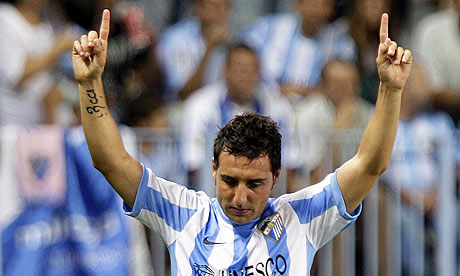
With their acquisition of Málaga's Santi Cazorla, Arsenal have for the third time this summer acquired a potential Premier League star. At worst, the twenty-seven year old will consign the somewhat-resurgent Tomas Rosicky and a turgid Andrei Arshavin to the North London scrapheap. At an unlikely best, his signature may even convince Robin van Persie to stay at the Emirates Stadium.

A classy attacking midfielder with a corner-seeking free kick, Cazorla will inherit the role of creative hub made vacant three times in recent seasons by injury and infirmity: Jack Wilshere's foot refuses to heal properly, Cesc Fabregas' homesickness finally bested him and Samir Nasri contracted a distressingly severe case of wandering-eye-syndrome (not a real condition). In Arsene Wenger's preferred 4-2-3-1 formation, Cazorla is liable to start in the middle behind van Persie or fellow newbie Olivier Giroud.

The squad has been reshaped dramatically from August last year. Fuelled by the 8-2 drubbing at the hands of Manchester United, Wenger threw cash to the four corners of Europe and came up with Mikel Arteta, Andre Santos, Chu-Young Park and Per Mertesacker. In retrospect, only Arteta performed to his potential during 2011-12, but each – except the lamentable Park – played a role in salvaging Arsenal's season.

With Podolski, Giroud and now Cazorla arriving however, that quartet's greatest contributions may not come as absolute first-teamers. Apart from (maybe) Arteta, not one of these four purchases projects in Arsenal's best XI. This isn't a bad thing, though: they provide the quality squad depth Arsenal has needed since The Invincibles.

Tuesday, June 5, 2012

Obituary: Remembering Charlie Sutton

Image: Wikimedia commons
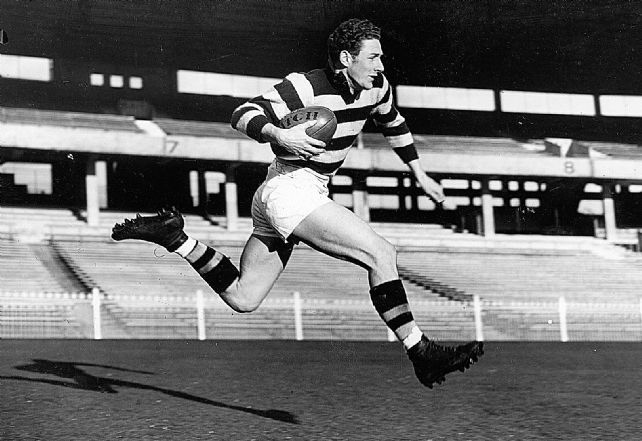
Charlie Sutton, the only man to coach the Western Bulldogs – née Footscray – to an AFL Premiership, has died at the age of 88. A man whose life exemplified pride in club and origin, he was born during the last of Footscray's successful VFA years before entering the VFL. Recruited to the Dogs from Spotswood Citizens, he embodied local and club spirit for seven decades, captaining, coaching and leading the boardroom as the club struggled first to emerge, and then to survive.

He earned renown as an uncompromising, iron-fisted back pocket. In an era where almost everyone ran in straight lines, regardless of human obstacle, Sutton's compact stature and ruthless attitude made him feared. He was the epitome of the back-pocket plumber, with no airs, graces or teeth.

Concentrating solely on his powerlifter physique and inexorable approach is to see only half the player. While his attitude and size defined his playing style, it didn't dictate his skill, which was formidable; when representing Victorian, he formed with Bernie Smith perhaps the greatest back-pocket duo the game has seen.

It was when he took over as coach that Footscray's story changed. His leadership and a bright bunch of recruits – Jack Collins, Brownlow medallist Peter Box and, crucially, Ted Whitten – brought the Dogs their sole Grand Final win of 1954. He taught toughness, responsibility and vim – traits with which the fans could identify. In winning the flag, the Dogs defeated powerhouses Geelong and the formidable Norm Smith-coached Melbourne, who were to win of 5 of the next 6 Premierships.

In a familiar story, it's probable that Sutton was replaced as coach for financial reasons. One of two transcendent stars in an amateur league, Whitten would be offered more financial and career opportunities outside Melbourne than the Bulldogs could provide for him as just a player. Serving as captain-coach doubled a player's match payment; the appeal to Whitten would have been obvious. No matter: Charlie would later serve as club President, omnipresent and omniscient to all matters Footscray.

Sutton coached the Dogs for three years after the flag to be succeeded by his protégé, the player he thought the best ever. Whitten is popularly considered the prototypical Bulldog, a boy who grew up in the shadows of the Western Oval and joined, then led, the only club he ever could. In doing so, he created a lineage that begat champions Doug Hawkins, Rohan Smith and Brad Johnson. While it's most public face, Whitten wasn't the progenitor of this dynasty, but Sutton.

Had it not been for Charlie Sutton, Whitten may have retired at age 21; if not for Charlie Sutton, EJ almost certainly wouldn't have grown into the man – the icon – he became. Charlie was tough, but honest and caring. E.J. Whitten was just a bigger, more athletic – and perhaps more eloquent – version.

Sutton was amongst the first inductees to the AFL Hall of Fame; and when in 2010 the Bulldogs created their own Asgaard, the first two honoured were Whitten and Sutton, inseparable again. No consideration was given to any others, nor should there have been. Their ground is named after one, while their best player each year receives a medal named for the other.

Charlie and Ted, forever Footscray Bulldogs 1 and 1A.

Perhaps Charlie Sutton is best defined by that 1954 Premiership cup. In 2008, the Bulldogs finished third on the back of great seasons from Adam Cooney and Johnson. Before the finals began coach Rodney Eade called a late-night team meeting in the depths of the MCG. When the meeting concluded, the players were led onto the surface to see a gnomelike figure in the centre, illuminated by the lights. It was Sutton, holding the 1954 cup. At age 84, he inspired half a group of cynical footballers to tears.

Charlie Sutton began the legacy of Bulldog champions who were men of the people. Players, and characters, to whom sons of the West could relate. No-one had a bad word to say about Sutton; the same applies to Whitten, Dempsey, Grant, Hawkins and Johnson. That in itself is a remarkable achievement. He will be remembered; he will be missed.

Wednesday, May 23, 2012

Overachievers/underachievers: 2011-2012 EPL

 After compiling a cumulative Premiership table over the past twenty years, one comment suggested an alternative method of comparing lasting football league performance.  It suggested comparing club-by-club seasonal performance against their average league position (ALP).  As history only provides a certain precedent, the we can also use multiple time periods: say, five, ten or twenty years. This also serves as a reference point for season 2011-12: did your team outperform, meet or fail to live up to expectation?

The following table lists the 2011-12 Premier League clubs by final league position and compares it with their average league position over both 20 years and five years.  Performance arrows suggest how well the club's past season achievements compare to their recent and mid-term history.

Club (by league position) ALP 1993-2012
ALP 2008-2012
Manchester City
16.7
˄
5.6
˄
Manchester United
1.6
˅
1.4
-
Arsenal
3.6
˄
3.4
-
Tottenham Hotspur
9.9
˄
6.4
˄
Newcastle United
9.0
˄
13.6
˄
Chelsea
5.1
˅
2.8
˅
Everton
10.9
˄
6.4
˅
Liverpool
4.6
˅
5.4
˅
Fulham
31.7
˄
10.6
˄
West Bromwich Albion
26.9
˄
16.8
˄
Swansea City
58.5
˄
26.8
˄˄
Norwich City
27.6
˄
31.6
˄˄
Sunderland
20.3
˄
13.4
˄
Stoke City
32.4
˄
14.4
-
Wigan Athletic
42.0
˄
14.4
˅
Aston Villa
8.8
˅
8.6
˅
Queens Park Rangers
30.8
˄
27.2
˄
Bolton Wanderers
19
˄
15
˅
Blackburn Rovers
11.7
˅
13.2
˅
Wolverhampton Wanderers
26.3
˄
20
-

*Some context: the only club to even approach Manchester United's 20-year form is Bayern Munich, who in the two decades to 2012 boasted an ALP of 1.9.  They also won three fewer league titles (9) than the Red Devils (12).  During the same period, Barcelona won 9 Liga titles with an ALP of 2.15; rivals Real Madrid won 7 titles with ALP 2.35 while A.C. Milan managed only 5 titles and ALP 3.4.  Love or hate them, their consistency is admirable.*

Thursday, May 17, 2012

The Twenty-year Premier League table

The following is the cumulative Premier League table dating back to the inception of the Premier League in 1992-93.  Although I'm among the first to admit that English football hardly began with that league's debut season, the twenty year mark create an anniversary feeling, allowing reminiscences and us to compile this table.

Movers this year include Manchester City, who climbed from eleventh to fifth, and Wolves, whose inept displays after Mick McCarthy's dismissal left them at the bottom of the table.  Two consecutive strong seasons from West Brom has finally allowed them to climb from the bottom to their current position.  Click here to view last year's table.

Team
Years
Title
Range
Top 4
Top 10
Relegations
Pts
Avg
Avg GD
Man Utd
20
12
1 to 3
20
20
0
1663
83.15
44.05
Arsenal
20
3
1 to 12
17
19
0
1449
72.45
31.85
Chelsea
20
3
1 to 14
11
16
0
1402
70.1
26.95
Blackburn
18
1
1 to 19
3
11
2
969
53.83
1.28
Man City
15
1
1 to 18
2
8
2
783
52.2
2.33
Liverpool
20
0
2 to 8
15
20
0
1314
65.7
25.05
Leeds United
12
0
3 to 19
3
7
1
692
57.67
5.67
Newcastle
18
0
2 to 18
2
9
1
1017
56.5
6.83
Aston Villa
20
0
2 to 18
2
15
0
1091
54.55
3.15
Tottenham
20
0
4 to 15
2
14
0
1086
54.3
2.25
Everton
20
0
4 to 17
1
8
0
1033
51.65
0.1
QPR
5
0
5 to 19
0
3
1
250
50
-6.2
Norwich City
5
0
3 to 20
0
1
2
248
49.6
-13.2
Sheffield Wed.
8
0
7 to 19
0
3
1
392
49
-6.88
West Ham
16
0
5 to 20
0
8
2
764
47.75
-9.81
Derby County
7
0
8 to 20
0
2
2
274
46.6
-21.29
Fulham
11
0
7 to 17
0
4
0
511
46.45
-3.6
Stoke City
4
0
11 to 14
0
0
0
183
45.75
-12.5
Coventry City
9
0
11 to 19
0
0
1
409
45.44
-11.44
Southampton
13
0
8 to 20
0
3
1
587
45.15
-10
Charlton Athl.
8
0
7 to 19
0
2
2
361
45.13
-12.5
Ipswich Town
5
0
5 to 22
0
1
2
224
44.8
-18.6
Bolton
13
0
6 to 20
0
4
2
575
44.23
-13.08
Sheffield Utd
3
0
14 to 20
0
0
2
132
44
-13.33
Sunderland
10
0
7 to 20
0
3
3
440
44
-17.2
Middlesbrough
14
0
7 to 21
0
2
3
611
43.64
-8.57
Birmingham
7
0
9 to 19
0
2
3
301
43
-12.43
Leicester City
8
0
8 to 21
0
4
3
342
42.75
-12.75
Wigan
7
0
10 to 17
0
1
0
295
42.14
-20
Nottm Forest
5
0
3 to 22
1
2
3
199
39.8
-11.6
Crystal Palace
4
0
18 to 21
0
0
4
159
39.75
-18.75
Portsmouth
7
0
8 to 20
0
2
1
293
36.63
-12.57
West Brom
6
0
10 to 20
0
1
3
216
36
-21.83
Wolves
4
0
15 to 20
0
0
2
136
34
-30.75

Table is arranged by order of:
1. Premiership Titles
2. Top Four Berths minus Relegations to zero (ie. can't go negative); clean relegation sheet outweighs more Top 4s and more Relegations.
3. Average Points
4. Average Goal Difference

Monday, May 14, 2012

Where to now for Bolton Wanderers?

The Premier League season concluded with one of the more exciting final days in recent memory. While it was certain that either they or QPR would drop to the Championship, the manner of Bolton's ultimate demise was unexpected but eventually deserved. Since a promising start to 2010-11, the Trotters slid rapidly from an FA Cup semi-final appearance to a horrible 2011-12 season.

There was bad luck, such as key forward Chung-yong Lee breaking his leg or Stuart Holden missing most of the year; lack of form and age plagued Kevin Davies and Martin Petrov; decisively the Bolton defence was so leaky one imagines the architect planned it that way.

That Fabrice Muamba collapsed on the pitch at Spurs was again an incident even the best planning couldn't anticipate.

Coyle, only a year ago rumoured as a potential Arsenal manager, has an almighty job to lead his club back to the Premier League. Considering Bolton's rather unsound fiscal state, it is a task he'll likely be expected to complete at the first attempt. Here are four steps which will allow Bolton to earn back their Premiership status:

Tuesday, April 24, 2012

Alternative XI: Footballing Autofills

The fantastically funny Dave Gorman podcast features a segment called “Autofill your boots”. In it, a listener is invited to answer quiz questions which have been autofilled by Google's search engine algorithms.

It works like this: if you type the querulous words “Can you” into Google's query box, it suggest the next most likely conclusions to your request. These autofill answers are predicated by one's location and often by search preferences. As you can see below, the most popular completions in the case of “Can you” include “run it”, “feel the love tonight lyrics”, “freeze cheese”, “get mono twice”, “overdose on vitamin c” and “print from an ipad” amongst some other more unsavoury inquiries. Dave then asks the challenger if you can, in fact, contract mononucleosis twice.

 This parlour-game derives from Google's reputation alongside Wikipedia as the font of all knowledge, arbiter of all sexual health questions and the bane of pub trivia masters everywhere. When we enter certain football personalities into Google, the autofills can amuse, tell a sordid tale, sum up or even reveal a public concern for their (potential) religious views or sexuality.

So, without any further introduction, here's the Autofill Eleven – with subs included.

Monday, April 23, 2012

Book review: And God created Cricket - Simon Hughes

by columnist Ben Roberts, re-posted from our affiliate site Books with Balls.

Former veteran county cricketer now cricket journalist Simon Hughes posits this work as being something of an antithesis to the efforts provided by most cricketing historians. Hughes even goes as far to mention that those works developed by ex-Prime Ministers are too serious. 'And God Created Cricket' is a light hearted romp through centuries of cricket (not to mention debauchery, skulduggery, and downright bad manners).

Image thanks to telegraph.co.uk
Hughes has researched others works to provide the flow of events from which he latches onto the more obscure notes of players and matches and embellishes the stories to their full extent. One must credit Hughes for sticking to the historical script well, providing those with less desire for details, a work of ease to get a picture of the history of cricket. But there are flaws.

Firstly, as a tabloid journalist one should not be surprised, Hughes seems incapable of allowing a chapter to pass without finding need to mention or compare cricket to Premiership Football. Really if you had never heard of Hughes the cricketer (and likely given his mediocre career you would not have) you would think that he is a Football journalist trying his hand at something new. Some of the references are just a waste of words. Cricket has a history longer and with far greater depth than any football code, to feel it necessary to attract readership this way is missing the point.

Secondly, there are a number of errors throughout the book, the sort of errors that should never get through good proof reading and editing, but they did. These are not errors of judgement in interpreting history but errors of name. The 1930's Australian batsman was Vic Richardson, not Viv; and the bowler Fleetwood-Smith's Christian name was not Laurie, but Leslie and in fact he was better known as 'Chuck'. Simple things that with some care would have been avoided and may have helped the more educated readership enjoy the book more.

Fair is fair. However, as a cricketing purist, this book was never likely to rate highly with such factual errors.  It's barely worth the weariness it inflicts.

Monday, January 30, 2012

A statistical breakdown of Premier League goalkeeping

Last year, we asked what would  happen if we applied hockey stats to goalkeepers in the English Premiership.  The results were interesting, if expected - decreased save percentages and often reduced GAA across the board.

What was more interesting was the amount of variation between goalkeepers on the same team: where David Stockdale rode an early wave of form (and a Mark Schwarzer injury) into the England squad yet wasn't able to repel the big Australian when he came back to full fitness.

This year, save percentages have decreased ever so slightly (from a league average 0.694 to 0.691) while GAA has seen a commensurate tiny increase (1.396 to 1.416).  The following tables show all the Premiership's goalkeepers arranged by GAA.  The red line marks the approximate league averages.

(c) Balanced Sports
This second table orders each goalkeeper according to their relative save percentage.   "Backup" Lindegaard again tops the league, with a save percentage slightly greater than Chelsea second-teamer Hilario and England's Joe Hart.

(c) Balanced Sports.  Please not the error in Michael Vorm's GAA in this table.  It is correct in the table above.
These numbers mean little without full context - Wojciech Szczesny's percentages still suffer greatly from Arsenal's 8-2 drubbing at Old Trafford, while Ali Al Habsi of Wigan and Tim Howard of Everton have perhaps been their club's best performers this season.  Therefore, it bears reminding that these numbers don't reflect the quality of the goalkeeper, but the quality of the defence in front of them.


For all the raw goalkeeper stats you can lay your hands on, visit our Goalkeeper Stats page.

Saturday, December 17, 2011

What I'd like for Christmas

In an annual tradition, we look at the bottom ten teams in the Premier League and ask what wish they'd really like granted for Christmas.  Here's what we think they'd say:

Bolton Wanderers:  A team that challenged for a top-half finishlast season now at the bottom of the table?  What could we possibly want?  Thinking big, Gary Cahill to sign to a new contract (or to receive heaps on his sale) and the broken leg corps (Lee Chung-Yong & Tyrone Mears) to recover swiftly enough to mount a second-half charge.

Blackburn Rovers:   The fans want Steve Kean out, the board want Champions' League football, Steve Kean wants the fans not to want Steve Kean out ... could we just settle for stability?  This may take the departure of one of the three entities above, and hopefully not the already-declining crowd numbers.

Wigan:   We'd love the talented Victor Moses to convert his opportunities more regularly, and Hugo Rodallega to turn from back into the guy whose goals last year kept us up to partner him.

Wolves:  There's not much to say about Wolves - we aren't playing above ourselves and neither are we playing badly, we just haven't won enough.  If the teams around us keep struggling, we should have enough to avoid a last-day scramble like last year.  If Kevin Doyle could turn lead-up play into scoring would also be grand.

Sunderland:  I think the thing we wish for most is for Martin O'Neill to work his magic quickly before the confidence lost during Steve Bruce's bunker days becomes terminal and we slide, Hammer-like, into the Championship.  If you're feeling generous, Santa, you could also convince Asamoah Gyan that Wearside really isn't such a bad place now Brucie's gone.

QPR:  For a Neil Warnock team, we've got remarkably few complaints as to the season so far.  Adel Taarabt has been remarkably quiet this year (a combined 0 goals + assists, compared to last year's oustanding tally of 35) and we'd like him to find his feet at this level, and for Joey Barton to continue focusing on football and not Nietzche.

Everton:  Santa, our biggest wish is for the club to be sold to someone with enough money to invest in either the squad, a new arena or both.  If new loanee Landon Donovan can contirbute more than Denis Stracqualursi and last year's bargain Apostolos Vellios keeps improving, we'll be (somewhat) satisfied.

West Bromwich Albion:  We'd like Shane Long and Peter Odemwingie to gel really well as a forward tandem.  Even though our back five will give up a few goals, if those two combine and fire rather than one at a time, we'll stay up and could even give the top ten a run for their money.

Swansea City:  If someone other than our goalkeeper, Michael Vorm, could really assert themselves as a top-flight Premier League performer, we should avoid relegation and continue a Welsh football renaissance.  Scott Sinclair, Wayne Routledge, Joe Allen, and Ashley Williams have performed reasonably well, but we'd love one or two of our midfielders or forwards to grab a few games by the scruff of the neck.

Fulham:   Costa Rican import Bryan Ruiz owned the Dutch league while at Twente Enschede; so far he's struggled to bed in well with our other forwards Dempsey, Zamora and Johnson.  No-one doubts his talent, just his fit.  If he could fire, we could challenge for the Europa League again.

Aston Villa:   We'd like Alex McLeish to "free the beast" and let our offensive talents Marc Albrighton, Charles N'Zogbia, Gaby Agbonlahor and Darren Bent free.  This staid, boring football isn't suited to such pacy attacking players.

Wednesday, August 10, 2011

Promoted teams' survival rates

(click photo to enlarge)

Key: Blue = Uninterrupted Premier League tenure; Red = In lower division; Grey = season yet to be played; Green = team in Premier League after relegation (and probable lineup changes).

The above chart maps the fortunes of all the teams promoted tot he English Premier League since 2001.  It shows the startling decrease over the past four years of promoted teams strengthening over time.

Full analysis coming Friday.  As this is as artistic as I get, thought it was worth sharing early.

Tuesday, June 7, 2011

Complete English Premier League Table, 1993-2011

Yes, we know, we're stat-heads and have no life. At least, that's what it feels like at times! But the pointy-heads at Balanced Sports have spent the past several hours slaving over an increasingly hot lap-top to bring you THE COMPLETE ENGLISH PREMIER LEAGUE TABLE since 1993!

Manchester United sits atop with twelve titles, but who sits behind them? Arsenal? Chelsea? Palace? The Battersea Home for Lost Dogs third XI ... click across to find out. (It's too big to post here).

Tuesday, May 24, 2011

The Ten-Year Premiership Table

We've been working hard and mindlessly to bring you special stats pages on Balanced Sports. You can find out all about which players contribute most to their team scoring, how the English Premiership ladder would look over a decade, rather than a season, or how each EPL Goalkeeper performed last year compared to his peers.

Our newest addition is the 2002-11 Cumulative EPL Table. Take a peek to see how your club fared.

Enjoy!

Thursday, May 19, 2011

Wednesday, May 18, 2011

Applying NHL Goalkeeper stats to the English Premiership

In the English Premiership, goalkeepers often face the most scrutiny and pressure. It's a simple truth of football that custodians need to maintain concentration during long periods of inactivity and then make a save, clear a ball or claim a cross. When they fail, often it costs their team a goal. In short, to have a reliable man between the posts is the foundation of a solid defence.

There are many methods of evaluating goalkeeper efficacy such as Goals Conceded and Saves but rarely with this position do stats tell the full story. As with statistical application across all sports, much depends on interpretation. The only GK stats readily available don't take into account things such as howlers (for which Tottenham's Gomes must be very thankful), nor aspects of defending which usually fall to the 'keeper such as communication, marshalling a defence or their (in)ability to deal with crosses. The one stat however which doesn't appear is Save Percentage.

Save percentage in football doesn't fully measure a goalkeeper's efficiency but it can provide some small insight into how the goalkeeper for each team performs. Often GKs are exposed to "no win" situations due to the size of their goalmouth, their defences' positioning and the skills or pace of an opposition player. Save percentage and Goals Allowed Average are key indicators as to an NHL custodian's performance, even though they still don't fully reflect a backstop's value.

To port those NHL numbers across to the Premiership makes for interesting reading. The following table is arranged by Goalkeeper Save Percentage. It shows (perhaps) why Fulham's David Stockdale got such big raps while covering for Mark Schwarzer earlier in the season and that Joe Hart's slight slip in form this year since returning to City from Birmingham is perhaps overstated.

For the full analysis, visit the Goalkeeper Stats page.


Top 15

Team

Goalkeeper

Games

Saves

Conceded

GAA

Save %

Fulham

David Stockdale

7

26

6

0.86

0.81

Tottenham

Carlo Cudicini

7

21

6

0.86

0.78

Man City

Joe Hart

36

107

33

0.92

0.76

Stoke City

Asmir Begovic

27

93

31

1.15

0.75

Tottenham

Gomes

30

115

39

1.3

0.75

Chelsea

Petr Cech

37

98

32

0.86

0.75

Man Utd

Edwin van der Sar

32

80

30

0.94

0.73

Bolton

Jussi Jaaskelainen

34

118

47

1.38

0.72

Fulham

Mark Schwarzer

30

91

35

1.17

0.72

Arsenal

Wojciech Szczesny

14

42

17

1.21

0.71

West Ham

Robert Green

36

154

66

1.83

0.7

Wigan

Ali Al Habsi

33

112

49

1.48

0.7

Sunderland

Craig Gordon

15

50

21

1.4

0.7

Arsenal

Lukasz Fabianski

14

36

14

1

0.7

Liverpool

Pepe Reina

37

96

43

1.16

0.69

Bottom 5

Team

Goalkeeper

Games

Saves

Conceded

GAA

Save %

Newcastle

Tim Krul

19

47

32

1.68

0.59

West Brom

Boaz Myhill

6

18

13

2.17

0.58

Blackpool

Paul Rachubka

1

6

5

5

0.55

Man Utd

Tomasz Kuszczak

5

6

5

1

0.55

Wigan

Chris Kirkland

4

5

12

3

0.29

Image of Mark Schwarzer courtesy: free-football.tv

Image of Carey Price courtesy: leshabitantssontmagnifique.wordpress.com

Tuesday, May 17, 2011

Obituary: Remembering Bobby Davis

Today the tributes flow for Bob Davis, "The Geelong Flyer", as well they should. Davis passed away yesterday at the age of 82. With it, he leaves behind a legacy as Geelong's favourite son.


The reason Bob Davis is so fondly remembered isn't his footballing ability, though he had loads. Neither is it his coaching, which delivered in 1963 Corio Bay's last flag for the twentieth century. It wasn't World of Sport, "Fair Dinkum Unbelievable", League Teams or the Three Wise Monkeys. It was his lifetime love for Geelong Football Club. Bobby was the essence of a one-club man, totally aware of the incredible gift the Cats were to the city of Greater Geelong.

It would be unfair to gloss over his influential play and coaching. As a half-forward flanker, his athleticism was unparalleled and he boasted a devastating long kick. He represented his state with flair and distinction. Any rumours suggesting the Cat teams of those years weren't tough are completely unfounded - no-one won in that era without being hard. He captained, coached - starting at 26 - and won a Best & Fairest award before calling time on a 189-game career. Perhaps the greatest compliment paid to him is that the iconic image of him, in full stream with football tucked under arm, is one of the defining images of that era of Aussie Rules.


There's a pleasing symmetry in that during his coaching period US President John F. Kennedy declared "Ask not what your country can do for you, but what you can do for your country", because that was Bob's attitude to the Kardinia Park faithful. After taking over the reins as Geelong coach, he brought Polly Farmer to Geelong and used Polly's unique skill-set to kickstart a running game which echoed back to Hickey's slick, speedy 1951-52-53 unit; teams in which Bob Davis was a key member.


Bob Davis defined Geelong Football Club for over sixty years. During that time, he was an entertainer both on and off the oval. Alongside Jack Dyer and Lou Richards in League Teams, Davis had access to almost every home in Victoria in a format-defining show which with the modern proliferation of media sources will never again be replicated. His - and his comrades' - impact on football commentary shows should make (Davis protégé) Sam Newman, Eddie McGuire and the Cats' next best born entertainer, Billy Brownless, offer up daily prayers of thanks. There was no laddish behaviour or uncouthness, only three blokes having fun talking about football.


Throughout almost his entire adult life, Bobby was the first source for comment on all matters Geelong: from the brawl with Hawthorn in 1985 to near-bankruptcy in the early 2000s and finally, memorably, awarding Tom Harley the 2009 Premiership Cup and celebrating with "the boys". He was conscious of the blessing the win would be not only to the players, coaches and administrators of Geelong Football Club but also the boon it would prove to the entire region. The city of Geelong, the AFL community and a lot of Victoria will mourn his passing.


Bob Davis, dead at eighty-two. He will be remembered. He will be missed.

Image courtesy: geelongadvertiser.com.au

For The Age's photo gallery honouring Bobby Davis, click here.

Monday, May 16, 2011

Geelong, like Manchester United, are the "Crap Invincibles"

Geelong's unbeaten start to the AFL season has surprised many. Even so, their gritty three-point victory on Friday night perhaps stamped them again as a viable Premiership threat. Pre-season the Cats were daubed old, one-paced and vulnerable not for any lack of skill - they still boast players such as Enright, Corey, Chapman, Scarlett and golden child Joel Selwood - but because they'd lost their best player and their fabled "window" was closing. Rumours of their demise have been greatly overstated. While many expected the Cats to fall from contention this season, they've done quite the opposite.


This is hardly a different viewpoint to some reports emanating from Victoria. The Cats still bear (most of) the fruit of a decade's intelligent drafting and their core, though nearer retirement than debut, may eke out another triumph or two. The Premiership may be a bridge too far, but it is now firmly on the Cats' radar.


This isn't the first time such successful renewal on the fly has happened at the Cattery. In 1995, nearly broken from three Grand Final defeats, Malcolm Blight walked away from coaching Geelong to be replaced by his assistant Gary Ayres. The former Hawthorn defender wanted to toughen a notoriously freewheeling and attack-minded club and got immediate results. The Cats hardened up and were rewarded with another Grand Final appearance that year only to be demolished by an irresistible Carlton unit. They made the finals again in 1997 - with a team many thought much improved over their mid-90s teams - and were eliminated after losing in Adelaide amidst the drama of Leigh Colbert's phantom mark.


These memories have been re-awakened this year. Rookie coach Chris Scott - in his playing days an uncompromising defender like Ayres - has revitalised some aspects of the playing group, most obviously David Wojcinski. He has empowered others, like Taylor Hunt and Daniel Menzel. But more than that, he and the club don't subscribe to 2010 tactics that then-coach Mark Thompson admitted were flawed. The Cats have begun to grind out results as if they've become so accustomed to winning that they have simply just continued this learned behaviour, albeit in a different style.


A parallel can be drawn from the land of tea, Sherlock Holmes, Doctor Who and Pippa Middleton. Manchester United were crowned English Premier Leauge Champions on Saturday, capturing their fourth title in five years. This triumph has been touted rightly as one of Sir Alex Ferguson's greatest achievements: his team - missing Cristiano Ronaldo, Carlos Tevez and (mostly) Wayne Rooney's form - clung onto top position relying on an ageing squad sprinkled with youth.


In 2010, United lost the title to Chelseas and pundits predicted a fall-off. The squad - with only one new player really contributing - went unbeaten into February, the equivalent of the AFL's Round 16. The ESPN Soccernet podcast dubbed Ferguson's mob "The Crap Invincibles" for their ability to avoid defeat yet look totally uninspiring doing it.


Although the AFL's answer to Sir Alex is working in his lab preparing to mastermind an orange outfit into season 2012, it sounds familiar, doesn't it? While the Cats have been impressive so far, the high-scoring juggernaut of 2007 is gone. Like United, Geelong has the enviable gift of being able to win despite their skills not being at their peak. They are the AFL's "Crap Invincibles". This isn't an insult - quite the opposite - their ability to get results such as Friday night's win (against a Magpie outfit they at times looked unable to cope with) is testament to their determination and smarts. They are achieving not because of what they can do physically, but because of strength of character.


Neither club's time-derived ability to win has died. In fact, though their squads are unquestionably weaker than during their pomp of 2007-08, their collective nous has perhaps increased. Injury time has become synonymous with a United rally and goal, while the Cats have made a (slightly annoying but understandable) habit of being able to overpower their opposition with a quarter and a half of devastating play. The popular adage states that success breeds success. It couldn't be more true than in Geelong or Manchester United.

Chris Scott image courtesy: theage.com.au

Sir Alex Ferguson image courtesy: simply-reds.blogspot.com

Friday, May 6, 2011

Blackpool, Premiership strugglers, stick to their (pop) guns

Though Ian Holloway has earned plaudits for his attacking play and forthright press conferences as well as Charlie Adam for his "wonderful left peg", it could be that their Blackpool team are doomed to relegation from the Premiership this season. Holloway's philosophy, which he said came about after a period out of the game where he watched too much boring football, is to attack at all costs - a vast difference from the dour style he favoured as manager of Bristol Rovers, QPR, Plymouth and Leicester.


Adam and a mildly-surprising DJ Campbell helped the Tangerines into the top half early this term with an flurry of goals, but the club has won only twice this year in the Premiership and now sits seventeenth, out of the drop zone only on goal difference. But the offensive style so favoured by the Seasiders has come at a cost - Blackpool have conceded seventy goals already this season, one of the worst totals in the Premier League over the past ten years. There are still three matches to go.


Only seven other times has a team shopped over seventy goals. Three of those times occurred last year as Wigan (79 goals conceded), Burnley (82 conceded) and Hull (75) got pounded repeatedly by larger clubs. Over the past decade, of all the teams that conceded more than Blackpool have this year, only last year's Wigan escaped relegation; a fact due probably more to other club's incompetence rather than any particular Latic resolve. So does a promoted team playing expansive football have any benefit - other than aesthetic - in the Premier League?


Holloway's men have a goal difference of -22, meaning they've conceded 22 more goals than they've scored. Since 2001-02, every other club who's conceded more than seventy goals in a season boasts a goal difference in excess of -35. His fast-paced tactics mean their scoring balanced (somewhat) the ineptitude of their defence leaving them better placed (for now and without them taking a disastrous thumping in their last three games) than every other porous club this decade. Perhaps we're looking at this the wrong way: while 'Olly likes attacking football and instructs his club to play that way, he's probably correctly surmised that with the defence at his disposal, their best chance to avoid the drop is to attack.


However, football is more than stats. The Blackpool boss could have (again) correctly judged his club didn't have the mettle to compete against giants like United and Chelsea and thought it best to go out playing the style that got them to the Big Dance in the first place. As with Owen Coyle at Burnley and now Bolton, there's something to be said for sticking to one's principles. If Blackpool were to survive to fight again next year, many would celebrate: another year of Olly's sound-bites, more fluid football and the joy of supporting an underdog in the top flight.

Image courtesy http://live4liverpool.com