Monday, July 2, 2012

Book review: Over Time, by Frank Deford

Frank Deford talks of his work Over Time not as a memoir but a we-moir, a collation of transient connections with figures more famous than himself. When asked to write a piece for alma mater Sports Illustrated about his early days at the United States' foremost sports magazine, he initially resisted; but as it became obvious there was a desire for a Mad Men style homage to the golden age of US magazines, no-one was in a better position to detail those salad days of the sixties.

Were you to boil down Deford's style to a single adjective, it would be wry. He is observant yet economical, distilling major events and people into their vital alchemy and transmitting what he absorbs with a pleasant mix of good humour and gravitas. He has used the same affable style for fifty years, through books, editorials and myriad essays; the result is four-hundred-odd pages of brilliant simple statements. In fact, Deford writes with vision and simplicity that makes readers often think “Why didn't I see it that way before?”

This geniality is only magnfied by an attitude of supreme moderation. Deford is a sporting centreist – as he proves with his weekly NPR commentaries – well aware of the unique position sport occupies in our cultural landscape. At a recent speech at the Seattle Public Library, he suggested both the import and triviality of sport by announcing the only two unnecessary cultural phenomena developed individually by every people have been sport and religion.

Acutely aware of his position as an observer rather than newsmaker, he presents his life journey quite superficially and bases his experiences around those in public life who were attracting the same attention. Where he writes about personal matters, it is almost entirely in regard to his artisanship, or concerning the athletes were the root source of his material and observations. A perfect example comes from one of the work's final chapters where he talks with shark Jimmy the Greek about their shared loss – children lost to Cystic Fibrosis.
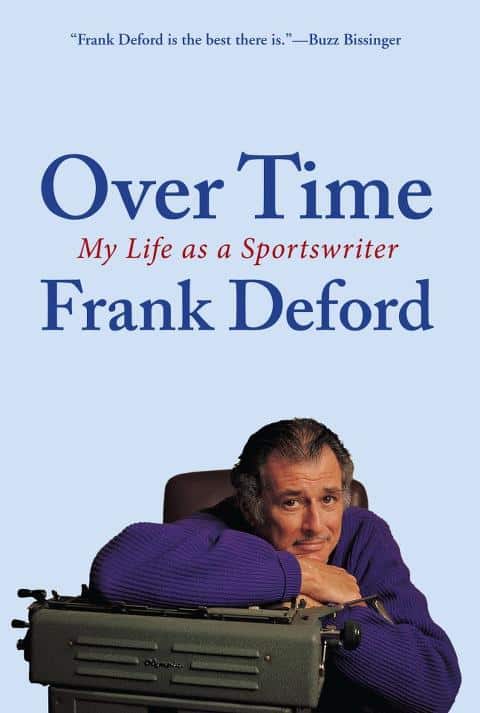
This isn't your typical me-me-me book, detailing “my struggle against the odds” or a list of accomplishments made more impressive when taken out of context. Deford freely admits to benefiting from luck and the era in which he got his start. His writing is about his profession, rather than himself and as such you find yourself knowing less of the man than you would choose; no doubt Deford prefers this way. He revels in what he has seen throughout his career, being able to witness the triumph and despair that's inherent at any sport; at the same time however the career is obviously only part of the man.

However, because his scope spans five decades, he really does no more than touch upon so many of the topics that could conceivably sell Over Time: these are anecdotes of his time observing sport, rather than his opinions. The stories are personal and not hearsay; a particular example being when he caught a train with a young Muhammad Ali and found him searching for spiritual and emotional understanding, exploring that which would make him controversial. In this manner, his writing on Arthur Ashe is sad but upbeat and the reader absorbs Deford's patent respect for the great tennis player.

As a text for aspiring sportswriters it has no definite teaching points, or at least very few. Deford's lack of personal conceit contributes to this somewhat; his belief is that writing is something you can or can't do, something rarely learned well. This seems partially a cover for such a humble man about whom his craft agrees that he is the patrician.

While there are few absolute commandments, the aspiring blogosphere would do well to heed his obvious breadth of vision. The value of a broad intake of news and views is tacitly suggested, as being well-rounded provides writers with the ability to place sport and the context from which stories emerge into a more global spectrum.

It's a wonderful piece of writing. But from Frank Deford, would you expect anything else?

Friday, June 29, 2012

Euro 2012 Final preview

As we regard the Euro 2012 final, it's apparent that we will watch the tournament's two most irresistible sides. Spain have for four years been the international game's standard, a gestalt of tiki-taka, creation and industry. Italy, too, have been utterly compelling; where Spain have over a dozen world-class talents to call upon, arguably the Azzurri boast only a handful – their achievement has come primarily through unity, adaptability and system.

To some observers, their group clash was the best match of the tournament. Since then, the Italians have moved from unknown quantity to having a real puncher's chance at taking the Championship.

Italy manager Cesare Prandelli went into the tournament expecting to play a 4-4-2 with players rotating through a midfield diamond but opted for an unfamiliar 3-5-2 in Italy's opening matches against Spain and Croatia. When this proved only functional versus the Croats, Prandelli went back to his favoured formation which consequently produced sterling results against England and Germany. How they'll line up on Sunday is still unknown, neither formation would surprise.

Tactically, Italy are likely to attempt to free their key midfielders Andrea Pirlo and Daniele De Rossi. De Rossi plays deeper and has struggled to play the full ninety minutes on occasion; Pirlo, the team's creative hub, has been the tournament's best – if not necessarily it's most important – player. The only suggestion Italy may opt for the 3-5-2 again is to offer this duo more protection from a Spanish philosophy based almost entirely upon retrieving possession as soon as it is lost.

Almost to a man, Spain are circuitous, dutiful pests. They discombobulate opponents with tricksy approach patterns amid waves of possession seemingly engineered by Phil Spector. Possession is both weapon and targe; a plastic object moulded and shaped into beautiful creation.

Spain are likely to stick to their favoured 4-3-2-1. Their only question is whether to opt for a true centre-forward or keep Cesc Fabregas out of position as a False 9. With his choices in the semi-final – Alvaro Negredo, who was only mediocre before being subbed early for Fabregas – del Bosque appears to have made his decision. The presence of Fabregas could be crucial in pressuring Pirlo and De Rossi, while also allowing Andrés Iniesta to advance forward and create.

It's worth noting however that Spain have often looked best after withdrawing one of Iniesta, Fabregas or Silva and employing either Barcelona's Pedro or Sevilla's Jesús Navas as out-and-out wide players. This is probably because each triumvir prefers to operate in the centre of the park, while Pedro and Navas earn their coin down the flanks. It isn't that Iniesta or Fabregas can't do so – but that they prefer the field's centre.

Euro2012 logo
Both teams have developed their own effective methods of pacifying their opposition; the most important factor in producing a win from that power-position is the generation of goals. Perhaps the greatest fundamental difference between the two finalists is in each team's ability to draw a goal from the ether: in Antonio Cassano and Mario Balotelli. Prandelli's two forwards have probably been two of the tournament's best and their mere presence – backed by impressive spells by Alessandro Diamanti and Riccardo Montolivo – mean the Italians can feel confident of scoring.

More than perhaps any other team, this Spain team lend themselves to analogy, simile and cliché. Pass and move. Death by a thousand cuts. They pass you to death. Metronomes. Boa Constrictors. They use Alan Rickman's spoon. They possess column inches and bandwidth like they do the football. A win would place them firmly among the best sides of all time, yet they've never had an iconic opponent or truly “all-time” match.

Sunday promises to be that mountaintop.

Thursday, June 28, 2012

Cometh the hour, cometh Prandelli

While Mario Balotelli once again proved he has enough talent to justify any of his off-field misdemeanours and Gigi Buffon has intimated that all he's still the silent member of the World's Best Goalkeeper club, the man most crucial to Italy's semi-final triumph wasn't a player but their manager, Cesare Prandelli.

Prandelli has achieved an Italian harmony through measures both regulation and unorthodox. He ha changed formation as required – employing Daniele De Rossi as a libero in a 3-5-2 – as well as deployed Serie A's most effective as his stalwarts, regardless of repute. However, what has set him apart has been his deft handling of a forward corps brimming with unharnessed, childlike energy.

Few managers have managed to obtain the best from Balotelli. However, without him the Italians would tonight start to return home to start their holidays. When at midseason Balotelli indulged his amusing wilful streak, he found himself banished from the Italian team with only an even chance of making the squad for Euro 2012. However, with time he was reintegrated into the Azzurri squad and has formed its most potent attacking weapon thus far.

A potential collaboration between Mario and the man he superseded as the enfant terrible of calcio? The stuff of Marcello Lippi's sweat-drenched nightmares? Rather than fearing a situation of knucklehead-squared, Prandelli has with an attitude of easygoing respect made that couplet not just workable but fearsome, all silky skill and unpredictability.

If Lippi wouldn't countenance leading his line with the terrible twosome, backing them up with the venerable Antonio Di Natale would have been an act of fevered imagination. Yet when Balotelli hobbled from the field with cramp against Germany, the manager turned not to a defensive option but to the diminutive Udinese marksman. This is indicative not simply of the faith he has in Di Natale, but of a changed culture around the Azzurri.

The mark of an excellent coach is that they achieve buy-in from their players.  From the way that Italy plays - from the performances he's mustered from players as wide-ranging as Andrea Pirlo, Buffon, Emanuele Giaccherini, Thiago Motta and, ultimately, Balotelli - it's obvious that he has his men completely invested in his gameplan, and he himself as leader.

A sense of controlled adventure is encouraged, an endeavour that has served them well against Spain and Germany. It appears an entirely different side from the one that didn't make it out of their World Cup 2010 group. That was disgruntled side who were trying to get back to where they once had been; this one has accepted that rejuvenation was inevitable and embraced it. That open attitude is engendered by the mangement of Cesare Prandelli.

Wednesday, June 27, 2012

On Tony Greig's Cowdrey lecture

Tony Greig makes a lot of sense. Re-read that sentence because I probably won't type it again for a while – at least not while he consistently forces rubbish memorabilia down our gestalt craw on the telly. But, in his recent Cowdrey Lecture on the Spirit of Cricket, the man in the panama hat spoke passionately and – for the most part – incisively as to the state of the sport and issues facing the game in general.

He ruffled some feathers throughout, but what else could you expect? It's Tony Greig, for crying out loud! As far as he can make out, many of world cricket's problems come with the effective power of veto that India holds over the ICC; this, when combined with his unfortunate reluctance to address the Indian cricket cognoscenti as “the BCCI” rather than “India” means that Twitter was alight this morning with comment both moderate and vitriolic.

Tony Greig is not a buffoon. Occasionally he seems like it, but he is neither incompetent nor stupid. In fact, his references to legendary cricket writer E.W. Swanton and Alec Bedser were touching memories, sad in nature and an insight into a complex and – in his own special way – honourable man. It's a guess, and I may be doing some people a great disservice, but I'd hazard such personal, relational disappointments would be scarce in the autobiographies of many current cricketers.

That said, Greig is indubitably guilty of poor choices from time to time, as are we all. Unfortunately, his happen to be extremely high-profile. On this occasion, while highlighting some of those past choices, he unwittingly stumbled into another in generalising a cricketing culture too freely.

However, to dismiss all he has to say as wrong or even “establishment” just because the speaker has a past history of gaffes is incredibly short-sighted. Those gaffes shouldn't discount his every utterance, but instead mean his words must be examined carefully and sometimes taken with a grain of salt. I doubt Greig himself would suggest any differently, neither did he suggest his view was gospel – merely his opinion. While they must be considered, his past cases of foot-in-mouth have been used too often to flay Tony Greig without proper cause.

When invited to speak about a subject on which he is passionate, he gave his opinions. Any suggestions of ulterior motives or personal agendas are bunk. He addressed first and foremost the questions he has in regards to the game's future direction, a bearing linked inextricably with the globally-nuanced “Spirit of the Game”.

How an oration is received is a very personal process. Each listener will take home a completely different message as it relates to them and their world view. With that said, in my opinion the kernel of the lecture was a call for reconciliation and to attempt to move forward together.

It was unfortunate that the reference became somewhat confused, but Greig spoke of Nelson Mandela and the honour in which he is held by peoples everywhere – a man who was wronged, yet rather than wreaking his revenge when coming to power, did what he thought was best for the nation of South Africa. Mandela's global legacy will be one of reconciliation achieved through his struggle both as one of the oppressed and as a member of the powerful.

It's almost never perfect, and it doesn't solve everything, but reconciliation is an action of forgiving debts. It's a big ask because often those wronged have been so unfairly treated, and it certainly doesn't excuse or wipe clean past actions.  Though clumsy in his execution, Greig's suggestion is that giant steps can be made when parties approach each other not with self-interest but collective growth at heart.  Thinking of him altruistically, he then contends that because the BCCI (and by extension, India as a whole) holds so much power in the game, leadership on that nebulous issue of "Spirit" must come from that them.

The reason Greig's speech focused so much on India – how I wish he had said BCCI! – is simply because the BCCI are now the global creditors of cricket and find themselves in such a position after being mistreated for a long time.  In my opinion, Greig's point is valid and his premise strong; however he can be condemned for failing to separate the game's governing body from the nation as a whole. He has called for reconciliation, yet in some ways made it harder to achieve by misnaming those he hopes to entreat.

It was entirely Tony Greig – observant yet flawed, an exercise in his humanness.  Far from perfect but also far from an attack on India or their cricket.

Because Greig's speech was on the Spirit of Cricket it behoves us therefore as supporters and fans of the game to accept it with the grace inherent in that same Spirit of Cricket. That doesn't mean automatically redressing each of his suggested action points, but accepting his point of view – as his perspective if not a comprehensive one. Believe it or not – and the internet would love us to believe “not” – it is possible to accept someone's point graciously but still disagree with it. To shout him down is neither in the spirit of the game nor any decent spirit.

Some may suggest that Greig deserves no grace because his speech was delivered with none. Personally, I'd disagree with that, but surely – and to my mind, this is Greig's take-home point – if someone has operated without grace then the higher road, the more constructive path, is to be gracious in return rather than seek vengeance or simply dismissing them. This simple dictum is the core of many religions. From a global perspective, how often is revenge or even “getting mine” the way forward?

Tuesday, June 26, 2012

Euro 2012: On Spain and Popular Culture

When the immortal celluloid “Robin Hood: Prince of Thieves” flickered onto my television screen last year, I got quite excited. Carefree days of sixth grade came flooding into my mind, so I decided a re-viewing was in order.

It was rubbish.

It was typical, arch Costner replete with florid dialogue, a full-scale Swiss Family Robinson tree house in twelfth century Britain and Brian Blessed dying very early. Let's not even mention Celts making the unlikely silent pilgrimage from Wales to England's Midlands so as to attack said treehouse.

And the less we talk about Costner's mullet, the better.

However, re-watching left me in no doubt as to the film's best line, delivered in a cadence that linguists can only describe as Ultimate Rickman: “Locksley … I'm gonna cut your heart out with a spoon!

In contrast, the novel “The Princess Bride” features the Spaniard fencing wizard Inigo Montoya. After watching his father cut down by the evil Count Rugen, the boy Inigo spends his entire life practising sword fighting so as to take his revenge. By the book's conclusion, Inigo cuts out his opponent's heart out so deftly, so precisely, that Rugen is able to keep fighting until the killing stroke. Montoya had planned this so Rugen could experience the same as heartbreak and pain he had felt as a boy.

So why is this relevant?

Because Spain, the best international team we've seen in years, have played throughout Euro 2012 balancing uneasily between the two. The Spanish midfield conjures memories of Inigo Montoya's ruthless precision, while their conversion rate (11.9%) exhibits spoon-like execution. Rather than Spanish forwards merely lacking a sharp edge, for all their time in possession – 221+ minutes over four games – la Furia Roja have mustered only 67 shots. In comparison, semi-final opponents Portugal have had the ball for only 166 minutes for seventy shots.

Like Inigo Montoya, Xavi, Iniesta and Xabi Alonso cut the heart from their opponent; but when it comes time for the killing blow, they discard Montoya's magnificent weapon and pick up a Rickmanesque spoon.

Going back over Euro 2012, we've posted several times about Spain failing to adequately capitalise upon their possession. With David Villa missing, manager Vicente del Bosque hasn't used Fernando Llorente, apparently distrusts Alvaro Negredo like a bent bishop while Fernando Torres has regressed almost into a glint in the eye. Their continued dominance while carrying baggage like this is nothing short of amazing. Even devoid of top class strikers they are indomitable – but not undefeatable.

The time has come for del Bosque to use his squad depth. It is time for Llorente, the target man who looks like an inverted pyramid and whose finishing instincts (and luxurious bouffant) have him desired across Europe. It is time for Spain to stamp their authority on Euro 2012 and well past time for Spain to put away Rickman's spoon.

Monday, June 25, 2012

When Cristiano Ronaldo isn't Portugal's main man

The European Football Championships enter their final week. Fittingly, the confederation's four best teams will contest the final matches of the tournament.

A joyfulness has been incorporated into the Teutonic predisposition for precision, while Spain have eschewed the previously successful “death by a thousand cuts” for “death by a thousand paper cuts”. Italy's on-paper mismatch of talent makes them more interesting than at any time since their 2006 World Cup victory and Portugal have created working weaponry from a formerly blunt object.

The most anticipated final matchup would undoubtedly be a rematch of the Euro 2008 final where Spain defeated the Germans to claim their first major tournament win since 1964.

If Spain's midfield can be thought of as a hydra, Portugal are well placed to complete the Herculean labour of subduing the many heads of la Furia Roja. In fact, the Selecção are such popular underdogs that they are in danger of losing that unfavoured status: it's becoming increasingly apparent that their strengths match well against Spanish weaknesses.

Spain's overriding failing this tournament has been an almost negligent attitude towards their end product. With Fernando Llorente out of favour, Roberto Soldado missing and Fernando Torres missing under completely different circumstances, their goals have, as ever, been derived predominantly from the midfield. The centre of the park will be as congested as in any match with the likes of Xabi Alonso, Xavi and Busquets lined up against the territorial Raul Meireles

The best method of countering possession dominance combined with such flagrant reluctance to shoot is with stout central defenders – like Pepe and Bruno Alves – and crucially, midfielders willing and able to carry the ball into positions which create the best springboard for quick and tricksy forwards such as Cristiano Ronaldo and Nani to exploit.

Courtesy: footballzz.com
Portugal have improved in each of their matches, especially in the quality of the link play between defence and attack. A backline of Bruno Alves and Pepe should field no questions of resilience, the transition forward has come chiefly from unheralded sources: Joao Moutinho and Miguel Veloso. Moutinho certainly stood up to the challenge and while Ronaldo was the spearhead, thrusts were generated behind him and chiefly via Moutinho's creation.

Most things will have to fall to their favour for Portugal to win. They'll need Ronaldo at his direct best, Meireles to perform his role, Moutinho to advance the ball well and Good Nani rather than Evil Nani. But given their pedigree and a pragmatic manager in Paulo BentoPortugal could prevent the final of Euro 2012 being the typical sequel which fails to live up to advanced billing.

Friday, June 22, 2012

What if Cristiano Ronaldo played for Australia?

http://dayhairstyles.blogspot.com

A relatively obscure fact about Cristiano Ronaldo is that he was once – a long time ago – eligible to represent Australia. His grandparents live in Perth, Australia's westernmost outpost, the most remote city in the world. It's not known if the Football Federation of Australia explored “recruiting” him, but it's highly unlikely given how passionately he represents Portugal. Greece forward Giorgos Samaras and Turkey defender Ersan Gülüm likewise have chosen other nations over Australia.

However, even had he chosen the green and gold of the Socceroos rather than his Iberian homeland, Ronaldo may well have not been accepted as easily as you'd think. We'd love his pace, skill, aggression and athleticism – but could Australians stand his hair? Certainly, many find his predilection for product rather unnerving; Ronaldo is undoubtedly one of the best footballers of all time, but often takes the field looking as if he's dipped his hair in a bucket of furniture varnish.

He certainly likes to stand out, and unfortunately that can lead to being lampooned just because you're confident enough to do so.  It's a good thing his ego appears puncture-proof.

This takes nothing away from his skill or achievement. But Australia, home of “Tall Poppy Syndrome” and about as cynical a country as you could find, doesn't tolerate sporting prima donnas particularly well. Much about Ronaldo has a touch of the diva: from his personal grooming habits to his demonstrative body language.  I'm honestly not sure how well he would fit with Lucas Neill or Sasa Ognenovski.

He'd be welcome, of course – Australia have sought a forward who can score like him since the game was invented.  Plus, who wouldn't want Cristiano Ronaldo apart from Sandro Rosell? That said, as Harry Kewell (Australian football's biggest ego) found out when playing the diva in the early part of last century, the acclimatisation process would probably be quite rough.

Thursday, June 21, 2012

Breaking down Forbes' Top 100 highest earning athletes

Forbes is perhaps the highest profile business magazine in the world. It certainly boasts as much clout as any, and an effective part of this has simply been their willingness to create reams of lists: the Best Paid Actors, the most overperforming stocks for 1955.  The internet loves this stuff.  These aggregations are easy on the eye - and almost as easy on the brain.  But because it's easily digestible information, a interweb culture raised on instant gratification laps it up.

The following chart has its origins in one of Forbes' more popular lists.  It was released yesterday and estimates the net income for those highest earning athletes.  Typically, players in sports with broad appeal played by Average Joe do better in endorsements: those with the most lucrative sponsorship are usually golfers, tennis players, footballers and basketballers.  The best in motorsport earn as much or more in endorsements as they do in prize money or salary.  Players who form part of an extensive rotation - ie. baseballers and NFL players - can earn as little (!) as $100,000 for the year in endorsement deals.

The chart is broken down where an athlete's endorsement income is plotted against his earnings from salary or prize money.  Minimum qualifying income for 2011-12 was $16.6 million (US) for the year.  Athletes are coloured according to their sport.  As always, we recommend clicking on the chart to enlarge it.

Copyright Balanced Sports

The list is relatively easily broken down.  The two highest earners were both boxers who pulled in relatively minimal endorsement deals - considering the world's most highly paid athlete was Floyd Mayweather, who is currently serving a prison sentence for threatening his ex.  You can see the obvious trends - those most marketable NFL/MLB stars earn up to eight figures in endorsements (Peyton Manning and Derek Jeter respectively), but generally the highest paid players in those sports earn comparative peanuts by selling their name.

The list comprised four boxers, one sprinter (Usain Bolt), five golfers, eight motorsport aces (4x NASCAR, 3x Formula 1 and Valentino Rossi), five tennis players, ten footballers, 13 basketballers, 30 NFL players, 22 baseballers and two Indian cricketers.  It almost goes without saying that the three outliers - top red, and far-right greens - were Tiger Woods, Mayweather and Manny Pacquiao.

Only two women made the list, tennis players Maria Sharapova and Li Na, who came in at 26th and 81st on the list, respectively.  Both only earned a small fraction of their total endorsement value in prize money, making them typical for their sport.

MLS: a taste of the Euros

Last night I saw the Seattle Sounders play Sporting Kansas City in a thoroughly enjoyable MLS encounter. It started uneasily,  however, as on a very pleasant Seattle evening we traipsed down to SoDo.
The trip involved me fielding several obvious-but-unhelpful statements from my companions, mutterings like “It's not like the Premier League” or “I'd rather watch the European Championships”.

 When the whistle sounded to end the tie, we'd taken in slice of everything we'd seen over the past two days of the Euros.

 Firstly, defender Paul Ianni scored a goal that reminded me of Zlatan Ibrahimovic's masterful strike for Sweden against France – one legged and using all his martial arts ability to stabilise his upper body while channelling all his power into his striking leg.


 In front of 47,000 singing fans – nearly the same attendance as saw England defeat Ukraine – Sporting Kansas City managed to grab an early goal, before Ianni's set-piece strike levelled the match in the fifteenth minute.

 In the second half, the match first appeared as if Seattle would dominate possession and the match as Sporting KC were pegged back by an impressive Sounders midfield. The ex-Wizards looked most likely to pinch a winning goal by quick ball movement on the counter-attack, which again reminiscent of so many teams throughout Euro 2012.

As if consciously mimicking yesterday's match between the Ukraine and England, a crucial goal (in this case the potential game-winner from Fredy Montero) became more transparent - most of the ball crossed the line, but not all - and we had ourselves a ghost goal.

 There was also plenty o' niggle, as KC persistently fouled a more fleet-footed Sounders attack; the fulminating when Seattle sub Alvaro Fernandez was sent off with a straight red in the ninety-first minute.
I didn't have to temper my companions' expectations when the game finished, just sit back and enjoy my beer as they enthused about our shared spectacle.

 It was a match that had everything that football can provide. The Euros have been fantastic, and it's been great to see the sport receive all the attention such a tournament deserves, but to think of MLS as a poor relation is unfair and patronising. MLS is what it is – a retirement investment, a development league, an enviable top tier. It is many things to many people, and is now creating its own impressive identity because of that multicultural background.

Wednesday, June 20, 2012

My Favourite Cricketer: Victor Trumper by S.A. Rennie

My Favourite Cricketer sees the teams at Balanced Sports and World Cricket Watch invite the best cricket writers and bloggers to tell us who their favourite cricketers are - and, more importantly, tell us why they stand out.  Today's submission is by S.A. Rennie of Legside Filth.  You can find Legside Filth on the web at www.legsidefilth.com, or on Twitter at @legsidefilth

I never saw my favourite cricketer play; he died 56 years before I was born. But like a cricketing Alexander the Great he left behind him a legacy of achievement, literature, and myth, and changed the face of batting forever.

It could have been my first reading of Arthur Mailey’s recollection of bowling to him in club cricket, with its famous last line (“I felt like a boy who had killed a dove”). It could have been my first viewing, in the Lord’s museum, of that iconic photo by George Beldam of Trumper jumping out to drive, taken at the Oval when Australia played Surrey in July 1902. Whatever triggered it, my obsession became total and all-absorbing. I read everything I could about the man, spent a fortune on books and ephemera and bitterly rued the impossibility of time travel, because unlike Harold Pinter with Len Hutton, I never saw Trumper in his prime, and it was another time - a time when a batsman could successfully break the shackles of orthodoxy, could have stories told about his greatness as a human being and as a cricketer. That fascinated me just as much as the man.


Courtesy: arcadia.com
If Trumper were a superhero, he’d have been rocketed to Earth as a baby from the planet Krypton to crash-land behind Charles Trumper’s boot factory. It is believed he was born in Sydney in 1877, but no record of his birth exists. There is a theory that he was the illegitimate son of an Auckland chambermaid, adopted into the Trumper family through a cousin of his mother’s. Like Phar Lap, he could be another hero New Zealand might claim for its own.

His accomplishments glow like an illuminated manuscript amongst fusty tomes. 300 not out against Sussex at Hove on his first tour to the “mother country” in 1899; first man to score a century before lunch on the first day of a Test match, at Old Trafford in that damp but glorious annus mirabilus of 1902; 335 in 180 minutes for Paddington against Redfern in 1903; that last, poignant hurrah at Lancaster Park where he contributed 293 to a record 8th wicket partnership of 433 with Arthur Sims for a touring eleven against Canterbury. That was in 1914; fifteen months later he was dead from kidney disease. News of his passing knocked the Great War off the front pages, and thousands of Sydneysiders lined the streets to watch his funeral cortege on its way to Waverley Cemetery.