Showing posts with label Arsene Wenger. Show all posts

Tuesday, August 20, 2013

EPL: Re-installing Arsenal

After a disappointing 3-1 defeat to Aston Villa on the season’s opening day, speculative glare has fallen upon Arsenal and their unsuccessful efforts to improve their squad.  Despite controlling the ball for long periods against the Clarets, the Gunners seemed strangely faceless – perhaps a side effect of Gervinho’s departure two weeks ago.

Over the past number of years, Arsenal have reinforced sparingly and with haphazard success.  Purchases like Mikel Arteta and Per Mertesacker have proven generally effective and Santi Cazorla is a star, but other players in whom manager Arsene Wenger has placed much faith (and not inconsiderable investment) have yet to fully work out.

While rivals such as Chelsea and Spurs appearing flush with vibrant talent and opportunity, it would take only the most ardent optimist to suggest the same of the Arsenal.  It’s not only the club’s player list that needs refreshing; perhaps the club requires a reboot. 

Or, more appropriately, a complete re-install.  The hardware has been upgraded at great cost, the processor still seems to have some life and the software is capable of getting the job done, but the system is not running smoothly or easily.  In computer parlance, this is usually a symptom of tiny corruptions in key parts of the operating system; rather than repair these one by one, it’s easier and cheaper to wipe the slate and hope you’ve kept the backup discs. 

For the lads at the Emirates, this doesn’t mean selling their best players or throwing money at others – though this is usually the way such things happen and Wenger has priors.  Perhaps the best way to rejuvenate a stale squad might simply be to give them a greater sense of identity. 

While Arsenal have  an marginally impressive spread of talent – Cazorla is one of the Premiership’s more creative types, while all of Mertesacker, Laurent Koscielny and Thomas Vermaelen are all first-choice for respective international sides of exceptional quality – the overall façade presented by the playing group is not one of a club itching to shape their own destiny, but of a team having it thrust upon them.  While Carl Jenkinson, Kieran Gibbs and Ramsey are very nice pieces, even the most one-eyed Gooner should admit that they are hardly the types of players to stamp their authority on a team.  The same could be said of Bacary Sagna, Wojciech Szczesny and Arteta.   Jack Wilshere has the potential to be such a iconic player, but will he turn into that guy consistently, or be overwhelmed by the surrounding tepid waters?

To borrow a much-used phrase, the whole has somehow become less than the sum of its parts.

After Manchester United lost the 2011-12 Premiership on goal difference, former manager Sir Alex Ferguson promised himself that the club would never lose out in such circumstances again.  The defensive mindset of the prior three years was cast to the netherworld and United made one single purchase to spearhead to a goal difference of 43 and a return to the league’s pinnacle.  The mindset came first, and it’s on-field embodiment arrived shortly thereafter.

The same can happen at the Emirates.  However, will Arsene Wenger, Ivan Gazidis or even Stan Kroenke recognize the opportunity?

Tuesday, August 7, 2012

Arsenal finally swimming in the deep end

courtesy: guardian.co.uk/football
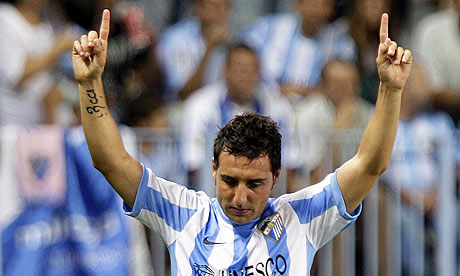
With their acquisition of Málaga's Santi Cazorla, Arsenal have for the third time this summer acquired a potential Premier League star. At worst, the twenty-seven year old will consign the somewhat-resurgent Tomas Rosicky and a turgid Andrei Arshavin to the North London scrapheap. At an unlikely best, his signature may even convince Robin van Persie to stay at the Emirates Stadium.

A classy attacking midfielder with a corner-seeking free kick, Cazorla will inherit the role of creative hub made vacant three times in recent seasons by injury and infirmity: Jack Wilshere's foot refuses to heal properly, Cesc Fabregas' homesickness finally bested him and Samir Nasri contracted a distressingly severe case of wandering-eye-syndrome (not a real condition). In Arsene Wenger's preferred 4-2-3-1 formation, Cazorla is liable to start in the middle behind van Persie or fellow newbie Olivier Giroud.

The squad has been reshaped dramatically from August last year. Fuelled by the 8-2 drubbing at the hands of Manchester United, Wenger threw cash to the four corners of Europe and came up with Mikel Arteta, Andre Santos, Chu-Young Park and Per Mertesacker. In retrospect, only Arteta performed to his potential during 2011-12, but each – except the lamentable Park – played a role in salvaging Arsenal's season.

With Podolski, Giroud and now Cazorla arriving however, that quartet's greatest contributions may not come as absolute first-teamers. Apart from (maybe) Arteta, not one of these four purchases projects in Arsenal's best XI. This isn't a bad thing, though: they provide the quality squad depth Arsenal has needed since The Invincibles.

Monday, August 8, 2011

English Premier League Season Preview

If you want in-depth analysis, visit The Guardian. If it's startling stat-facts you're after, then it's OptaJoe you're looking for. Amusement? Try the Football Ramble. But here, after a summer in which an awful lot was made of ridiculously little, is Balanced Sports' Q & A preview to the English Premier League 2011-12.

courtesy: bleacherreport.com
Arsenal: Where's the love for Arsene Wenger?
The Arsenal faithful want to lynch someone - anyone - for their second-half fades in recent seasons. With Wenger's refusal to reinforce the Arsenal backline to the fans satisfaction, Cesc looking to leave and Nasri increasingly likely to follow, it's liable the Professor is the posse's first choice. Has anyone considered he may have a point? Injury has robbed him of a first-choice central defensive partnership of Vermaelen and Djourou, while Wojciech Szczęsny could have a Joe-Hart-at-Birmingham breakout.

Aston Villa: How much does it matter that McLeish is as popular as a dead polecat?
Due to the dour football his Birmingham City squads chundered out last year, popular opinion of McLeish in Birmingham is like Greece's economy: toxic. This staid mindset, plus Shay Given, may be just the thing Villa need to rectify ageing Central Defensive duo Collins & Dunne's 2011 propensity for mishap. They won't uproot the redwoods, but do look capable of counterpunching behind Charles N'Zogbia, Marc Albrighton and Darren Bent.

Blackburn: Do Venky's care about football?
In a word, no. Or if they do, they've got a weird way of showing it: sacking the effective-on-a-budget Sam Allardyce, commiting ₤5 million to a transfer fund which would take the team "into the Champions' League", frequently summoning manager Steve Kean to India and announcing their interest in every has-been on the planet. They should care though, because if this is the publicity grab it seems, they'll be aghast to see how much revenue (and support and merchandising and sponsorship and ... ) drops on relegation to the Championship with a threadbare squad.

Bolton: What did they do to anger the Gods of broken legs?
Who knows? With promising Chung-Yong Lee sporting a double leg break and attacking right-back Tyrone Mears suffering a similar injury, boss Owen Coyle must looking for a Harry Potter-style Time Turner to re-live the past two weeks. Creative US international Stuart Holden broke his leg had his leg broken in March and probably won't be back until the new year. Without these three cogs and looking short a striker, it's questionable they can create enough goals to capitalise on his preferred passing game.

Chelsea: How many times will we see André Villas-Boas referred to as the New Mourinho?
At a rough guess, 547 by Christmas and the under/over for the season is at 999.5. While he boasts lengthy connections to the Special One, AVB seems to be his own man and is charged with disarming and deconstructing the player cabal that runs the backroom at Chelsea - a unity engendered by Jose. He'll need specialised bomb defusal skills to do so as aggravating John Terry got first Jose and then Big Phil Scolari fired.

Everton: When will David Moyes' eyes finally pop out of his head for good?
It must be frustrating for the ginger man - to consistently assemble good players only to see them want to leave. And after ten years at Goodison Park, he's hardly a Bright Young Thing any more. He's happy in Liverpool, but for a man with tremendous competitive drive the sell-to-buy philosophy must be wearing. He'll probably stay with the Toffees for ages - because at this stage neither he, nor the club, can do better. It's a saddening state of affairs in Mersey's blue half.

Fulham: Where to now?
Fulham once again contest the Europa League after Roy Hodgson led them on a wild ride two seasons ago. Much as they loved that run, fans are already wondering if a second trip to watch their boys in the Ukraine is worth the outlay. The experienced Martin Jol has had success nearly everywhere he's been, however he must confront an ageing squad that takes longer to recover from Thursday night matches. Signing Palermo's teen Patjim Kasami should help, but other newbie John Arne Riise is already the wrong side of 30. Is two days' break enough?

Liverpool: Is King Kenny the Messiah?
The essence to success in video game Football Manager is simple: keep players happy. You do so by winning, praise and goals. While FM bears as much resemblance to the Real Thing as a smoked meat sandwich does to a hot dog, it does underline Kenny Dalglish's early "success" at Liverpool. He's played the kids, signed enough multi-skilled central midfielders to start his own cloning facility and given them targets to aim at in Luis Suarez, Andy Carroll and a reinvigorated Dirk Kuyt. To his credit, Kenny understands it's not rocket science but simple Human Resources.

Man. City: Is it finally my time?
Perhaps. As always the Citizens' fortunes rest on Carlos Tevez - only now, they don't depend on his on-pitch strut. A successful season behind Sergio Aguero, David Silva, Vincent Kompany and even Wesley Sneijder hangs on their ability to rid the dressing room of a malcontent and potential unsettling influence. If he stays, Tevez will contribute mightily but - because of his preference to work up front alone - perhaps at the cost of playing one of Aguero or Dzeko. If he leaves, he'll be replaced perhaps by that little-'n'-large show with Johnson & Silva out wide. It all sounds mouthwatering. Anything less than a Title challenge will disappoint.

Man. United: More important: Cleverley, Welbeck, Jones, Smalling, Gibson, Carrick or De Gea?
Surprisingly enough it's Tom Cleverley, who spent last season on loan at Wigan. Rewarded for an excellent Charity Shield with a call-up to the England squad, he - not Darron Gibson or Michael Carrick - is earmarked as Paul Scholes' successor. While David De Gea is young, he's also a work in progress and, as former coach Abel Resino says, will peak in a decade. He can't be expected to to be more than solid in his first year - especially as he doesn't speak English. Ferguson has invested for the far future between the sticks.

Part two will be published tomorrow.

Wednesday, July 27, 2011

An Arsenal, Barcelona and Fabregas love triangle

Arsenal, Cesc Fabregas and Barcelona could be the most public love triangle since Marilyn Monroe sang "Happy Birthday Mister President". It started with a sixteen year-old Fabregas moving to Arsenal from Barcelona and has dragged on interminably much of the past four years as player and boyhood club dream for his return to Catalonia. His story has dominated every transfer window - particularly summer - and public statements now lack all authenticity.

courtesy: the12thmanblog.com
He will soon play for Barca. Chiefs of Arsenal and Barcelona will put heads together in such a way that his move will be agreed, if not this window then next year. However, the conduct of many Spanish parties has hardly covered Catlonia with glory. Publicly, Barcelona haven't shied from announcing their interest and have made bids which would make Harry Redknapp blush. Their outward decrying of respect for Arsenal is undermined almost totally by their conduct - and a galling sense of entitlement to the player.

Xavi wants him to come home. Barcelona wants him back. In fact, all of Spain wants Cesc Fabregas in La Liga. Even if he wanted to stay in North London, the clamour has been such that he may feel a Second Coming is necessary. On Monday Arsene Wenger asked why nothing has been done about this overt solicitation of his two biggest stars, Fabregas and Samir Nasri. Well he may.

While not strictly "tapping up" - where a player is approached illegally by a suitor club while still under contract - one is almost always swayed by the opinions of friends and others who say they wish the best for you. At the end of his contract this time next year, should Nasri sign with either of the Manchester clubs then an English FA inquiry will almost certainly be summoned. With Fabregas, it's much more tricky however as such any tribunal would have to operate across Football Associations.

Though not strictly "illegal", Barcelona are leveraging every conscious and unconscious tool at their disposal to unsettle the player. It would be hard to prove that Barcelona have broken any laws and indeed they may well not have. Their actions definitely violate another of those "unspoken laws", that of the spirit of the game. Thus, potential offenders are difficult to prosecute.

courtesy: championsleaguetalk.com
It's unlikely anything much can be done. The Spanish FA are unlikely to sanction the guilty parties, partly because they are so because they couldn't be seen to punish popular World Cup Champion Xavi and they too have a vested interest in having Cesc Fabregas play in La Liga. Much of the recent activity based around Cesc has been driven by Xavi and Estanislau Fors i Garcia*, the mayor of Fabregas' Catalonian hometown, Arenys de Mar. So with the English FA having no jurisdiction on continental soil, FIFA navel-gazing and UEFA unwilling or unable to involve itself in football's on-beat policing, to who else can Arsenal complain?

With such incidents increasing in scope and frequency (think Federico Macheda, Paul Pogba and Gael Kakuta) then FIFA needs to step in. It's best if clubs police themselves through a formal framework. The only way to stamp this out is for yet another independent tribunal. Given the global reach of this issue, it must be orchestrated by FIFA. (Shudders violently) After it's second conscutive annus horribilis, this could be the first step in re-establishing FIFA's control of the game rather than just over its marketing rights.

*(Comparisons to kidnapping and slavery are of course ridiculous. Footballers sign contracts as independent businessmen, mostly advised by agents or parents, motivated by love and/or money.)

Wednesday, July 13, 2011

Arsene Wenger: trying times under the wage-cap

As his fief struggles under the weight of a popular uprising, Arsene Wenger's reign from a high castle somewhere in the vicinity of Highbury appears destined to begin a decline. He has reigned justly and in the beauty of esoteric splendour for fifteen years in North London but appears unable to still this latest unrest.

Very few managers in the game have his alchemical ability to consistently synthesise young superstars from mere talent. Over the past decade that talent has most notably taken the form of Cesc Fabregas, Jack Wilshere, Robin van Persie, Gael Clichy and Samir Nasri. Clichy has departed while popular punditry appear in accord that it is a matter of "when" and not "if" Fabregas and Nasri join them. Wenger has sold some of his charges willingly, such as when Thierry Henry and Aliaksandr Hleb departed Arsenal to join Barcelona. Others, like Nasri, he appears to want to keep close.

courtesy: en.wikipedia.org
As yet more Spanish players declare publicly Fabregas' burgeoning desire to play for his Catalan home club, Wenger's media comments seem more aggravated and weary than inspired. Considering his Northern nemesis, Sir Alex Ferguson, has never played the media or public better than when Wayne Rooney announced he wanted out of United in October last year, this may be a poor portent indeed.  The Rooney incident was over within ten days. Sir Alex's form as two years of Cristiano Ronaldo transfer rumours persisted was to become increasingly bombastic ("I wouldn't sell that mob a virus"). It seems Wenger has passed that stage (of grief?) and is now simply tired.

His more powerful declaration yesterday that "Big clubs don't sell their stars" is, for the most part, true. He has fought for three summers to retain captain Fabregas, while very few other global superstars move clubs without the vendors receiving way above market value. Unfortunately, he seems to be riding the misapprehension that Arsenal are a big club in the business of world football. That may not be true any more. Unfortunately, the Professor is handicapped by a wage ceiling, meaning he's unable to pay players more than 90,000 per week, comparative peanuts to the salaries doled out by the fiscal elite of world football.

While they remain one of the best ten teams in the world. that wage ceiling in itself earmarks Arsenal - a big, successful club with an enormous, loyal supporter base - as not being a member of the roundball financial elite. While he may decry "Big clubs don't sell their stars", it is without realising the fundamental fact that, until the new stadium is paid off and the wage ceiling disappears, the Gunners will be forced to sell their best players as they demand pay rises.  Financially, Arsenal aren't in the top five in the world (top ten, even) - meaning competing with cash-flush heavyweights automatically becomes that much more difficult.

Emirates stadium was designed to make Arsenal an economic superpower in the football world. In concert with continued investment from Stan Kroenke, the club may once again enter the elite echelon of football-nomics. But the precedents set by Chelsea, Real Madrid and Manchester City mean there is now a two-tier system even within the richest of the rich in football. And though Arsenal are among the wealthiest clubs in the world, they aren't a member of that select "billionaire's row".

Gooners should hope Wenger is not losing his fire, for to maintain their grip on the top four facing harsher mercantile realities than their competition, Arsenal will need him at his absolute best.

Friday, April 1, 2011

Jack Wilshere - more valuable for Arsenal or England?

A re-post of our article published on Soccerlens:

Jack Wilshere is the future. The chosen one, he’s the face of English football for the twenty-first century. Miraculously, he remains somewhat personally underexposed for the amount of hype that surrounds him. Without him, the future of both Arsenal and England seems less positive.

His rise has been meteoric. Two seasons ago he was a seventeen year-old making occasional Carling Cup appearances, whereas today he is first-choice for both club and country. People have lined up to douse him with praise, not least his managers Arsene Wenger and Fabio Capello. The future’s rosy, the future’s Wilshere.

But his wish to play in the Euroean Under-21 Championships this year has put Wilshere’s two footballing allegiances on a direct collision course. North London management has no desire to risk their prize asset suffering burn-out, injury or fatigue. In the eyes of Stuart Pearce and many others, he is England U21s best midfielder and hence the best chance of a podium finish at the tournament.

Which poses the question – is Jack Wilshere more valuable to England or to Arsenal?

There are many parallels between the Wilshere dilemma and that of Wayne Rooney 6-7 years ago – he is young, talented and enthusiastic about playing for both club and country. Their teams are/were in the Top Four and each represented the tantalising taste of a new, unscarred generation. Wilshere, like his now struggling colleague has the combination of exuberance, sublime skill and mongrel that has occasionally looked lacking in his teams and is so crucial to success – the mix to become a world-beater.

Since Rooney’s debut, the only potential world-beaters to debut for the Three Lions have been (maybe) Arsenal teammate Theo Walcott and custodian Joe Hart. Other England debutants have been functional and usually leading premiership players but most often limited; Jack Wilshere’s recent displays in white mean he should be among the first midfielders Capello selects.

Not only is it Wilshere’s talent and potential that’s vital to England, but also what he represents. Jack Wilshere is the first of his U21 brethren to make the leap to full International regular. Though it’s likely, Wilshere isn’t necessarily even the most talented player of his generation either, just the first to make his mark on the international stage and therefore the best for his age. He is a glimpse into the future of England football, impossible to ignore. Jack Wilshere needs to play for England not for Fabio Capello, Arsene Wenger or even himself, but for English football fans.

The word talisman is overused in football – “As Zidane goes, so does France. “As Cantona performs, so do United”. Though those two players properly defined the word talisman, they could also simply be known as instrumental in performance. The word is belittled when lower echelon players are dubbed a talisman rather than instrumental. Wilshere’s importance for the national setup has now transcended his increasingly important performances on the pitch and he has become a talisman of things to come.

This may be true of England, but what of Arsenal? Their case is also based on what he represents: a local boy with the talent to stamp his authority on a famous club with an equally famous (and expensive) lineup. It could be that his value for Arsenal, moreso than England, depends on his performances simply because there would seem to be greater central midfield depth. This depth comes from players in their prime, like Fabregas, Song and Nasri or the potential of Aaron Ramsey, Henri Lansbury and even Abou Diaby.

Jack the Lad’s skill/mongrel ratio is weighted differently from each Arsenal’s midfielders and his enthusiasm and work ethic allow him a unique role and thus able to fit in seamlessly with all of Wenger’s other options. He is so treasured by Arsenal supporters (host of the Arsenal podcast The Tuesday Club Alan Davies recently said he wouldn’t swap Wilshere for Andres Iniesta) because he forms with Nasri and Fabregas a vital component in a troika of midfield poisons of which an opponent must choose one. Of course England relies on his performances as well, but for the Gunners faithful, they know they have a player on whom they can rely.

The question presents an unthinkable and theoretical choice, but it may be England’s bigger picture need which means Wilshere is more valuable to the Three Lions than for Arsenal. If only for reasons of depth – while Lampard, Gerrard and Barry drift into the ether, Wilshere has been anointed to pick up the pieces, perhaps even as captain.

At Arsenal, he is supported by the high-profile-but-still-amazingly-young trio Fabregas, Ramsey and Nasri. Song and Diaby remain in their early or mid-twenties, where Lansbury and Miyaichi look to follow his lead. Wilshere’s value to Arsenal is immense – measurable only by a fictional, guesstimated transfer price (40-50 million pounds perhaps, in the unthinkable situation of him wanting out of Arsenal). He may not be replaceable, but there is more fertile soil for Wenger to plough in search of a substitute. For England, he is new hope. Can you measure that?

Monday, March 21, 2011

Balanced Sports published on Soccerlens

An article on Arsenal's youth policy by Balanced Sports' Matthew Wood has been published on Soccerlens, one of the world's pre-eminent football blogs.

Tuesday, February 22, 2011

FA Cup revamp rebuttal

After Crawley Town's gallant display against Manchester United and Leyton Orient's surprising draw with Arsenal, any plans to change the format of England's FA Cup must surely now be thrown in the garbage. The world's pre-eminent domestic cup competition is sacred and should remain so, as notions of the death of "the romance of the cup" became greatly overstated.


For some time, occasional "experts" have suggested that from Round 3 of the Cup the draw should be seeded, ostensibly pitting smaller clubs against larger from that time on. The rationale behind that would be with more big-versus-small clashes, there comes a greater chance of a giant-killing effort from a "minnow". This is complete bunk simply because both the odds and the talent available suggests that it wouldn't lead to more of this melodrama, but only an increase in Goliath moments where impudent would-be Davids are squished by the giant feet of Champions' League clubs. If anything, seeding a draw would rob the Cup of mystery as any potential Crawley Towns or Havant & Waterloovilles unthinkingly know their fate in the third, fourth or fifth-round: likely a Premiership club and odds-on elimination.


It actually happens that small clubs like to come up against their larger counterparts as a match against Chelsea or Liverpool is liable to bring in larger crowds at home and a share of the (suitably large) gate takings when away. This could be preferable to clubs in or nearing administration like Plymouth. But what it does to the plethora of - and names like these are always debatable - well-run clubs like Peterborough, Ipswich or Millwall is rob them of a puncher's chance to advance further in the competition. Better to stay with the current system, where clubs discover their coming opponents mere weeks ahead of schedule.


Plans to change when Cup ties are played to maximise attendances are also clearly an idea by the same crowd who bought us the Collins-class submarine. The FA's former Chief Executive, Ian Watmore, recently suggested that games be played mid-week because he had seen several games played at night of good standard. When considering revamping an institution such as the FA Cup, one must tread very carefully and suggestions like this are dangerous if increasing attendance is the ultimate aim: if crowds are poor for a Bournemouth versus Dag & Red fixture on a weekend in sleet and howling winds, how much improved are they likely to be on a Tuesday night in rain/snow mix and very fresh winds? The answer is fewer attendees, if anything, simply because mid-week equals school for the kids and an automatic decrease in the available market.


The proposition that replays used in case of a draw in the first leg be abolished is also ludicrous. In a recent example, the Chairman of Leyton Orient Barry Hearn has been quoted as saying he would take all his players to Las Vegas as reward for their endeavour in earning a replay against the Gunners at the Emirates stadium. That replay would earn Orient a significant percentage of the gate money which the club say will abolish their seasonal operating loss. By robbing the Cup of replays, not only do you enforce penalty shoot-outs in almost every match, but slam the door in the faces of the small clubs needing those funds to get out of jail. The big clubs are happy with replays as well, with both Sir Alex Ferguson and Arsene Wenger coming out in support of them for the same reasons: they can allow a big club to get out of jail, albeit not from a financial prison but a footballing one.


The final suggestion mooted for "improving" the FA Cup involves a Champions' League place being awarded to the winner. This suggestion has much more merit than the previous three but is flawed in some ways: if this were in effect now, last year's runners-up would be entitled to a UCL position as the winners, Chelsea, attained automatic qualification. Meaning Portsmouth would be eligible to play in Europe's top club competition amidst a swarm of debts and, early on this season having only sixteen senior players under contract. With UEFA's Financial Fair Play rules about to bite home on many of Europe's largest clubs, it woudn't be a stretch to suggest similar rules could be put in place for FA Cup winners' European entrances: if your books aren't balanced (to a point) or two teams who finished in the EPL's top four play off for the Cup, the position is goes automatically to the fourth-placed Premiership club. This plan seems more satisfying than the previous three because it would add another air of mystery to the end of the season: would the Cup winner make Europe? Or would the team who came in fourth? This is unlikely to occur however, as should a runner-up make Europe, then their performances on the continent would affect England's UEFA coefficient and bad displays especially could see the country robbed of it's fourth UCL slot.


The first three suggestions: abolishing replays, playing midweek and seeding the draw from the third round on, mean one of two things. The first option is the FA have no concept of what they actually want to do with The Cup - reinforce the larger teams or smaller? Attendance or romance? Finance or football? If this is true, the answer is simple: there's not enough data to suggest what clubs or fans want from The Cup so it's best to do nothing until a clear picture appears. It's in no immediate danger of falling into irrelevancy, so best not to fix something which isn't broken.


The second alternative is that the story is media-driven, with no FA substance whatsoever, peddled by networks and newspapers who want only to write about the Gerrards, Rooneys and Terrys of this world and not, it seems, the football of lower tiers which props up the planet's most famous league. The narrative of many lower league clubs make fascinating reading: Bournemouth's lack of money hasn't stopped them charging to the top of League One and their 32 year-old manager Eddie Howe being poached by Premiership-aspirant Burnley. Or Gus Poyet's men at Brighton, destined for a spot in the Championship for the first year in who knows how long? Have you heard about Norwich's rise from League One also-rans to Championship Playoff team? Even in the top division there are stories to tell: Newcastle's rise from the ashes and the everlasting inquiry into Ian Holloway's sanity spring instantly to the fingertips.


Perhaps you've heard of some of these tales. Perhaps not.


Surely football for its own sake should be enough.

Thursday, January 20, 2011

Oxlade-Chamberlain, Walcott and Bale: All just a little bit of history repeating

Manchester United want Alex Oxlade-Chamberlain. So do Chelsea. And Arsenal. And City.


Southampton boss Nigel Adkins is a very shrewd operator on the transfer market after his time in the Championship with terminally-short-of-cash Scunthorpe. Three times he turned small money forwards into big dollars: he made a 2000% profit on both Billy Sharpe's move to Sheffield United and Gary Hooper's transfer to Celtic and trebled his money in Martin Paterson's Big Burnley Adventure. To mix Adkins' transfer smarts with the chunky bankroll sported by Southampton ownership makes for a formidable operation.


But should Arsenal, Chelsea, United or City wave a briefcase at the Saints containing a rumoured 10 Million, no club in League One could resist, no matter how much cash the owners have. In the furore surrounding Southampton teen Oxlade-Chamberlain, it's interesting to go back to the last great Southampton youngsters to move to the EPL. It was back in 2006-07 when North London duo Arsenal and Tottenham smashed-and-grabbed their way to Theo Walcott and Gareth Bale.


These two are both, like Typographical Tyro Oxlade-Chamberlainare both wingers, though Bale started out as a full-back. Southampton were treading water in the rising floodwaters of debt pocketed sums of ₤9.1 million for Walcott and ₤5 million rising to ₤10 million for Bale.


They started their big league careers in opposite directions. Walcott was Sven-Goran Eriksson's 2006 World Cup squad dark horse and played with an Arsenal team who led the league as late as February. Bale struggled to adjust to a struggling Tottenham's style and with the rigidity required to play fullback. It's easy to forget now after his outstanding 2010 that for the longest time - 24 games, a record - he didn't play in a winning Premiership match.


Bale is now worth perhaps ten times that initial ₤5 million investment and at 21 is liable only to improve. He is comfortable in his position, has a manager who trusts him and forwards to aim at. Some say his combination of pace, crossing and finishing skills make him the best left-sided player in the world, with plenty of time and appetite to improve.


Walcott has also increased in "value" but his is a different story. Rather than improving and diversifying as a footballer, he's been mired in injury, inconsistency and accusations of being a one-trick pony. Endowed - or perhaps cursed - with Thierry Henry's iconic number 14, the these factors haven't allowed him to become the potential world-beater Arsene Wenger saw in the Saints forward. He's got talent and has produced the occasional unplayable game - his treble against Croatia for England a notable one - but if two years ago you asked a football pundit who would be the better player every one would have plumped for Walcott over Bale. The development has apparently stalled.


With Darren Bent recently being sold for upwards of ₤20 million it's likely Theo's blend of pace and youth would command a hefty transfer fee, but have his fifteen Arsenal goals (from 100 appearances) justified Wenger's initial investment. All that glitters in League One is not, apparently, gold.


The recipe to create a successful footballer needs plenty of ingredients: talent, physical gifts, the right headspace and a lot of luck. Walcott has been unlucky with injuries, just as Bale was early in his Spurs career. But Bale has already repaid the money Tottenham invested for his services while with Walcott, it's debatable. He may very well turn into England's Centre Forward of the Future but so much time has passed now that rather than being expected of him, it is now just a fond hope.


Like trading futures on the stock exchange, throwing money at youth doesn't guarantee instant rewards. It may not guarantee rewards at all. Sometimes, like with Jermaine Jenas, it isn't even the buying club who gets the benefit. Not by a long chalk has time run out for Theo Walcott but his development is now a matter of "if" and not "when".