Monday, June 18, 2012

What happened to Holland?

Courtesy: thearmchairpundits.com

The Netherlands whimpered one final time, threw up their hands and now stumble away from Northern Europe. Three losses in a tough group has left the Dutch with fractured egos, a burnished reputation and questions as to the continued viability of employing manager Bert van Marwijk. Eviction from the tournament was always a possibility, especially in a group in which they were drawn against three other top-ten teams. However, the manner of their dismissal should be cause for extreme conern.

A constant tone of discontent undermined the tenuous harmonies of South Africa, goalkeeper Maarten Stekelenburg played all three matches despite poor play and two quality replacements, the Dutch defence showed as much resilience as a wet rolling paper and key players like Robin van Persie and Wesley Sneijder showed only a fraction of their full qualities.

Should he have any hope of retaining his position, van Marwijk will have to talk very hard – and potentially very quickly – to justify his creation: a dysfunctional iteration of the Dutch national team. Under his watch, Holland have displayed sublime talent, occasional violent streaks and a penchant for restlessness.

Any hopes of the Oranje making the same impact as in the 2010 World Cup was improbable almost as soon as the tournament began. Starting left-back Erik Pieters withdrew because of injury, while central defender Joris Mathijsen appeared unable to recover from an injury suffered playing for his club side. Despite a strong qualification campaign, Dutch achievements from two years ago appeared an effort of overachievement.

Saturday, June 16, 2012

Alternative XI: Euro 2012 Overachievers

As is usual for a major tournament, Euro 2012 has allowed us to witness the full spectrum of players from World's Best to those who walk a matter of metres to the ground that's always been their home. This tournament, we've had the opportunity to see players previously anonymous make a stamp on the football world – in fact, many of the best performed players aren't paid by Real Madrid, Liverpool or Juventus, but by smaller clubs. The tournament is made brighter by those who rise from anonymity.

Here's a previously relatively-unheralded XI who've made their name at Euro 2012:

GK – Przemyslaw Tyton (Poland): Despite entering the year the fourth-choice Poland keeper, made himself a home-country hero by saving a penalty with his first touch of the tournament. Whether he is replaced by the shaky but better-credentialled Wojciech Szczesny is now a legitimate question, a prospect unthinkable before the tournament.

RB – Theodore Gebre Selassie (Czech Republic): Kills the grass on the right side of the pitch at Slovan Liberec, who will compete in the 2012-13 Champions League after winning the Czech Gambrinus Liga. The might do so without their right back, who will doubtless have admirers after his two performances so far at Euro 2012.

CB – Mats Hummels (Germany): How can the most desired young centre-back in world football, playing for the second-best attended club in Europe, be classified as an emerging player? Simple: Mats Hummels is elegant on the ball and resolute off it and gets his work done with the absolute minimum of fuss without courting attention at all. Releasing him will haunt Bayern Munich for years.

CB – Damien Perquis (Poland): Perquis came so close to snatching a win for Poland against Russia while keeping the tricksy combo of Dzagoev and Arshavin from wreaking havoc in the Poland defence. He'll should be acquired by larger French club from Sochaux on the back of his impressive Euros.

LB – Vaclav Pilar (Czech Republic): Pilar has scored twice so far at Euro 2012 and looks to be another smart piece of scouting by Bundesliga club Wolfsburg, who have already arranged for his transfer from Viktoria Plzen.

RM – Mathieu Debuchy (France): It's no wonder he's been linked with clubs as storied as Manchester United and Barcelona. Although typically a right-sided defender, he plays with such attacking zest he fits in well here in the midfield. He was probably the player of the match in France's first match against England despite flying under the radar until Lille's emergence last season.

CM – Roman Shirokov (Russia): Practised Russian football observers such as James Appell tipped the thirty-year old as Russia's breakout player. He lasted all of one match at Euro 2008 at centre-back, but links the beaters in defence (Berezeutsky and Ignashevich) with the seeker in attack (Arshavin and Dzagoev).

CM – Niki Zimling (Denmark): His injury in Denmark's second match allowed the Portuguese a much easier run in the midfield than Danish coach Morten Olson had hoped. Regaining him for their crucial encounter with Germany will be crucial Danish hopes of advancing

LM – Andriy Yarmolenko (Ukraine): The resounding flop of Andriy Shevchenko at Chelsea may have previously kept “the new Shevchenko” at Dynamo Kiev. After wrong-footing a redoubtable Sweden defence on many occasions in the Ukraine's first match, he's unlikely to be playing domestic ball for much longer.

AM – Michael Krohn-Dehli (Denmark): Fizzed the ball between Dutch 'keeper Maarten Stekelenburg's legs to win the Danes their first game of the tournament and leave the Oranje reeling. A constant worker so far this tournament and able to put together moments of brilliance despite middling club form at Brondby.

FC – Mario Mandzukic (Croatia): Took two quality goals in Croatia's first match against Ireland to put the Balkan nation in a great position in a tough group. Another discovery by the tireless Wolfsburg scouting system, he doesn't get much press despite scoring twenty times last season.  

Wednesday, June 13, 2012

Simon Katich retired because Australia wanted him to

Simon Katich announced his retirement from First Class cricket earlier this week, ending a career that began when Mark Taylor and Paul Keating occupied the most coveted offices in the country. He leaves with a reputation as a hardworking player who moved up the order as his career progressed, starting at six and finishing facing the new pill.

Katich also leaves with a reputation for spirit; something which would surprise those who watched his Test debut during the 2001 Ashes series. Apart from his crablike wander across the stumps in playing each delivery, the most recognisable incidents from a long and quite distinguished career involve his 2009 bust-up with Michael “Bingle” Clarke in the sheds and his press conference last year, where he said what others dared not upon his axing from the Cricket Australia contract list.

Were he still opening the Australian innings with Shane Watson or David Warner, it's doubtable Katich would have retired. He felt he still had more to offer the Australian team and his stats backed him up. Western Australia certainly thought he had something left, as they wanted him to play 2012-13 for the Warriors.  The pay's also pretty good. 

Courtesy: crickblog.com
 The enmity with Clarke contributed to Katich's replacement and almost certainly left him jaded and fed up with the politics inherent in Australia's only truly national game. Although maturing, Simon Katich had earned his place ... only to be dropped simply because of his age.

Ricky Ponting and Michael Hussey fight the same battle every time they step onto the field. Both are older than Katich and appear near the end, but have no firm plans for retirement. When either fails, a gestalt Salomé appears, composed of a collective press, who screams persistent nonsense about ageing heads on salvers. The promise of youth is decried, a glorious future is prophesied – without admission that promise is all many Australian youngsters have to offer.

In a world culture where stardom starts early and young is better, Australia's sporting hierarchy leads the world. Since the country's failure at the 1976 Montreal Olympics, Australia has prided itself on world's best youth development; in cricket, this has manifested in the once-vaunted Australian Cricket Academy, an offshoot of the Australian Institute of Sport.

In Aussie Rules football, the dominant sport, the average age of last year's Premiers, Geelong, was 26.6 years old and considered almost supremely old. The year before, the average age of the Collingwood's Premiership side was 24. This led the expansion Gold Coast Suns to select a squad with average age of just 21.2 years last term. Players are often given only one chance and if renewal is required, players at age 24-26 are the first to go. Precious few delisted players are later re-drafted; an anonymous teen's promise now supersedes proven capabilities of the known foot soldier.

The trend has begun to reverse somewhat as veteran players like James Podsiadly and Orren Stephenson are drafted for short-term impact and clubs countenance that there is life in the lower leagues past the age of 21, but this  psychologically-straitjacketing desire for youth still prevails.

Australian football clubs have cottoned on that fans want one of two things: wins, or hope for the future. If you aren't challenging for the title, you regenerate the entire playing list on the back of high draft picks and hard work. Players emerge to stardom early, destroy their bodies and retire to the paddock of fond memories by age 31. With the success of young teams like Hawthorn and Essendon, the Australian public is prepared to sacrifice mid-term results – wholesale – in the ostensible guise of long-term progress.

This simply doesn't work on the cricket field. The best players should represent their country until their position becomes untenable. Due to the persistent averageness displayed by Phil “Snicker” Hughes, Usman Khawaja, Chris Lynn et al., Katich, Hussey and Ponting should have been left to judge themselves. Creating space for young players to grow is a ridiculous argument – if the players can't dominate the Shield, there's little or no reason to suggest they will perform consistently at Test level. Adam Gilchrist, Justin Langer and Glenn McGrath called time at the right moment – why should we treat Hussey and Ponting any different? Plus, although the dollars on offer cloud the decision, who else is better to judge?

Some athletes pick the correct time to go, while others hang on too long – here, cricketers could take a lesson from AFL players – but to simply remove Katich from national contention was ill-advised and affronting. At worst, a perilous drop in form deserves the oft-cited “tap on the shoulder”; Katich didn't receive even this much dignity in June 2011.

At least on Monday, his announcement carried a nobility not afforded by his former employers.

Tuesday, June 12, 2012

Ukraine heat a portent of 2022 World Cup

While England and France slugged out a draw in Donetsk, much the same occurred two days prior some distance from the Ukraine. The likes of James Milner appeared totally spent with temperatures reaching 33o celsius in oppressive conditions.

On Saturday, the Australian Socceroos played Oman in their first 2014 World Cup Qualifier. The match was played in Oman, a hope, skip and Ashley Young dive away from Qatar – the site for the 2022 World Cup. With a 5pm kickoff, temperatures reached a rash-inducing 41o celsius. The argument that "it's a dry heat" is quite nonsensical: when the Weather Channel says it feels like it's 46° outside, it doesn't matter whether the humidity scale is at 6% or 60.

In the first eleven days of June, Muscat recorded eight days where the mercury raised above 37o; the lowest maximum temperature was 35o. The average June temperature in Muscat is 39o. Even more amusingly, 75% of June days are officially categorised as “hot”; the rest (24.6%) are officially classified as “sweltering”.

In news likely to cause players from cooler climes to melt like so many Wicked Witches of the West – I'm looking at you, Scotland – the maximum temperature in Donetsk today did not reach the minimum temperature in Muscat.

It's summer in the Northern Hemisphere. It's hot. Players expect to play in uncomfortable conditions and expect a quick turnaround time between games. However, hosting a major tournament in heat such as this is patently ridiculous, as is moving the tournament to winter to accommodate its fabulously wealthy hosts.

Never mind tough laws, designated drinking zones and the occupational health and safety of players, but fan health simply must have been more of a consideration before FIFA awarded Qatar the Cup.

If you can't take the heat, keep the World Cup out of the Gulf States.

Monday, June 11, 2012

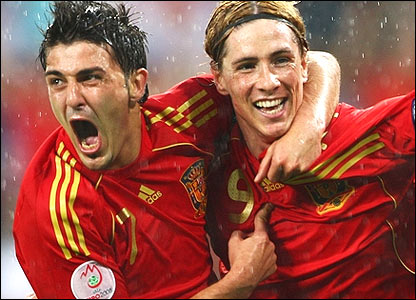
Torres' role reduced again for Spain

The man they miss with the man whose form they miss
courtesy: worldcupblog.org
Spain manager Vicente del Bosque opted to start yesterday's match against Italy with four defenders and six midfielders. Ostensibly, Cesc Fabregas started up front – and indeed found himself forward more often than his midfield counterparts and scored his country's goal.

 It's unlikely Fabregas will start as far forward of the ball for the entire tournament given that Italy's unusual 3-5-2 formation (with a libero!) contributed to Spain's unfamiliar team selection. But rather than shoehorn a poorly-fitting player into the side in the name of orthodoxy, del Bosque announced that Spain's gameplan doesn't require the prototypical “no. 9”. Also, by not deploying Torres in his favoured role, he also tacitly admitted that he views the Chelsea man as a player only to be used in the right circumstance.

 Bountiful Spanish midfield quality suggests a replacement for David Villa is a luxury rather than an immediate necessity. Were Spain only to create six shots a game, an penalty box predator would be crucial. But by employing the pass 'n' press, Spain can philosophically expect to dominate possession against every team they play; they are likely to create enough chances against harried defenders from which a midfielder like Fabregas, Iniesta or Silva can score.

 This is the form and model of play which has seen Spain win their past two major tournaments. It is also the model in which Fernando Torres now struggles heftily. While serving his country well at Euro 2008, and despite the greatest collection of providers any striker could want, Fernando Torres' confidence issues meant he couldn't play the same role in South Africa and still can't now.

 Torres' Chelsea form this season was fair, at best. He played better as Chelsea reverted to a counter-attacking side, but still patently can't find his strutting best.

 Because Spain so dominate the ball, del Bosque now sees Torres almost exclusively as a player whose best use is in exploiting overextended defences; a player to be brought on fresh for the last twenty minutes when the game naturally produces more chances. His form has regressed to the point where he's now only a player to be used in one situation, a luxury. According to Sid Lowe of The Guardian, del Bosque said as much in his post-match press conference.

 This is a story simply because of Torres' reputation; on form he deserves to be in the squad, but hardly a shoo-in for selection. Spain still have Fernando Llorente and Alvaro Negredo to use at centre-forward. However, without a more clinical edge in front of goal, Spain's goal of a third successive major tournament victory becomes more difficult.

Friday, June 8, 2012

Lookalike: Giorgos Karagounis

This is the kind of lookalike that could only come from a football-loving powernerd who boasts a vast familiarity with the works of deceased Gallic graphic novelists.

Greece captain Giorgos Karagounis scored the opening goal of Euro 2004, has captained his nation many times and is only four caps from becoming Greece's all-time leader in games played.  Despite advancing years, he's still the most crucial link in the Greece midfield.  He represents Greece better than their politicians.

And, he couldn't look more stereotypically Greek; the proof comes from Goscinny & Uderzo's 1968 masterpiece Asterix at the Olympic Games.  I think he's the second spartan from the right.

click to enlarge
Original photos above are thanks to: sportcafe24.com and asterix.com

Wednesday, June 6, 2012

Euro 2012: Easier to win than the World Cup?

Conventional wisdom suggests the European Football Championships are harder to win than the World Cup. There's reason behind this: despite increased familiarity with staff and styles, all teams come from a strong FIFA confederation and this means fewer easy wins and more Groups of Potential Fatality.

We can take a look at the final set of FIFA World Rankings before a tournament to suggest the quality of each field. These rankings are about as foolproof as a Bond villain's plan or FIFA's internal governance, but they are still the best mathematical evaluation available. (Even still, I won't ever believe the United States were ever the fourth-best team in the world). Also, given they are chundered out by computer according to wonderfully complex formulae each month, in theory they are equally uneven.

The table below suggests how powerful each tournament since the start of the millennium has been, using average and median FIFA ranks as a guide. A low average suggests a stronger field, a low median suggests that more of the world's elite teams took part.


Tournament
Teams
Average FIFA rank
Median FIFA rank
Alleged Easybeat
Euro 2000
16
15.3
12.5
Slovenia, rank 45
2002 World Cup
32
21.8
21.5
China, rank 50
Euro 2004
16
20.8
17
Latvia, rank 52
2006 World Cup
32
33.5
24.5
Togo, rank 61
Euro 2008
16
20.4
11
Austria, rank 101
2010 World Cup
32
26.0
19.5
North Korea, rank 105
Euro 2012
16
16.6
11.5
Poland, rank 65

As you can see, the average FIFA rank for the past two World Cups has raised markedly as more nations outside FIFA's top 20 obtained qualification. This of course doesn't take into account home-field advantage, which will surely serve Poland well in this tournament. These numbers are also somewhat swayed: each team wins games in order to qualify, which in turn boosts their world ranking.

According to FIFA's boffins, Euro 2012 could be the strongest tournament since Euro 2000.

Tuesday, June 5, 2012

Obituary: Remembering Charlie Sutton

Image: Wikimedia commons
Charlie Sutton, the only man to coach the Western Bulldogs – née Footscray – to an AFL Premiership, has died at the age of 88. A man whose life exemplified pride in club and origin, he was born during the last of Footscray's successful VFA years before entering the VFL. Recruited to the Dogs from Spotswood Citizens, he embodied local and club spirit for seven decades, captaining, coaching and leading the boardroom as the club struggled first to emerge, and then to survive.

He earned renown as an uncompromising, iron-fisted back pocket. In an era where almost everyone ran in straight lines, regardless of human obstacle, Sutton's compact stature and ruthless attitude made him feared. He was the epitome of the back-pocket plumber, with no airs, graces or teeth.

Concentrating solely on his powerlifter physique and inexorable approach is to see only half the player. While his attitude and size defined his playing style, it didn't dictate his skill, which was formidable; when representing Victorian, he formed with Bernie Smith perhaps the greatest back-pocket duo the game has seen.

It was when he took over as coach that Footscray's story changed. His leadership and a bright bunch of recruits – Jack Collins, Brownlow medallist Peter Box and, crucially, Ted Whitten – brought the Dogs their sole Grand Final win of 1954. He taught toughness, responsibility and vim – traits with which the fans could identify. In winning the flag, the Dogs defeated powerhouses Geelong and the formidable Norm Smith-coached Melbourne, who were to win of 5 of the next 6 Premierships.

In a familiar story, it's probable that Sutton was replaced as coach for financial reasons. One of two transcendent stars in an amateur league, Whitten would be offered more financial and career opportunities outside Melbourne than the Bulldogs could provide for him as just a player. Serving as captain-coach doubled a player's match payment; the appeal to Whitten would have been obvious. No matter: Charlie would later serve as club President, omnipresent and omniscient to all matters Footscray.

Sutton coached the Dogs for three years after the flag to be succeeded by his protégé, the player he thought the best ever. Whitten is popularly considered the prototypical Bulldog, a boy who grew up in the shadows of the Western Oval and joined, then led, the only club he ever could. In doing so, he created a lineage that begat champions Doug Hawkins, Rohan Smith and Brad Johnson. While it's most public face, Whitten wasn't the progenitor of this dynasty, but Sutton.

Had it not been for Charlie Sutton, Whitten may have retired at age 21; if not for Charlie Sutton, EJ almost certainly wouldn't have grown into the man – the icon – he became. Charlie was tough, but honest and caring. E.J. Whitten was just a bigger, more athletic – and perhaps more eloquent – version.

Sutton was amongst the first inductees to the AFL Hall of Fame; and when in 2010 the Bulldogs created their own Asgaard, the first two honoured were Whitten and Sutton, inseparable again. No consideration was given to any others, nor should there have been. Their ground is named after one, while their best player each year receives a medal named for the other.

Charlie and Ted, forever Footscray Bulldogs 1 and 1A.

Perhaps Charlie Sutton is best defined by that 1954 Premiership cup. In 2008, the Bulldogs finished third on the back of great seasons from Adam Cooney and Johnson. Before the finals began coach Rodney Eade called a late-night team meeting in the depths of the MCG. When the meeting concluded, the players were led onto the surface to see a gnomelike figure in the centre, illuminated by the lights. It was Sutton, holding the 1954 cup. At age 84, he inspired half a group of cynical footballers to tears.

Charlie Sutton began the legacy of Bulldog champions who were men of the people. Players, and characters, to whom sons of the West could relate. No-one had a bad word to say about Sutton; the same applies to Whitten, Dempsey, Grant, Hawkins and Johnson. That in itself is a remarkable achievement. He will be remembered; he will be missed.

Monday, June 4, 2012

Liveblog: Rocky IV

Also known as Rocky IV: Jumping the Shark.

Opening rehash: Eye of the Tiger! In the first montage! The shiny hammer/sickle and stars/stripes gloves are a really 1980s idea, cold-war fuelled. Given that Rocky IV is notorious for it's overt propagandist direction, there's symbolism in the hammer and sickle glove exploding before the American one. I must admit to missing the brassy opening, despite an obvious love for Eye of the Tiger; you can tell this is the one Rocky movie not not scored by Bill Conti.

And we've got a Mr. T sighting! Mr. T is a hero of mine for everything from his mohawk/beard combination to his his quote-unquote “acting”. I've got a theory that when Mr. T appears, your day improves. It doesn't matter if your dog has died or your wife has left you, if you see Mr. T, you smile. That his mode of entry is usually utterly random only makes that smile goofier.

You've gotta admit that Mr. T, version 1983, has a seriously impressive physique.

The original Rocky was inspired by the Ali/Wepner fight of 1975, where Balboa was an unashamedly modeled on Wepner, a self-described moderate talent (listen to this 5Live podcast, it's fantastic). Only two sequels and six years on, Stallone ascends from willing, but limited, brawler to Ali himself; recreating here that most iconic fight, the "Rumble in the Jungle”.

04:19: Four minutes in, and you can't help noticing how well Rocky enunciates. He actually speaks in this film (and in Rocky III), rather the nearly-unintelligible mumbling of the first two. It's kind of true-to-form, as the more famous one gets the more media training one will receive ... oh dear.

Friday, June 1, 2012

Graphic: The most efficient teams in Europe

Following on from our half-season efficiency studies, the following chart demonstrates the each team's offensive/defensive efficiency in a single measure and compares it across all four European leagues.

Each team's defensive stolidity is calculated by finding out how many shots they faced per goal, while offensive precision is calculated by the same means (how many shots per goal).  There's little surprise that Juventus and Borussia Moenchengladbach had the best defenses, nor that Schalke, Real Madrid and Barcelona supplied the most clinical offenses.  Stay tuned for a year-to-year EPL comparison.

As usual, we suggest clicking on the chart to enlarge it.